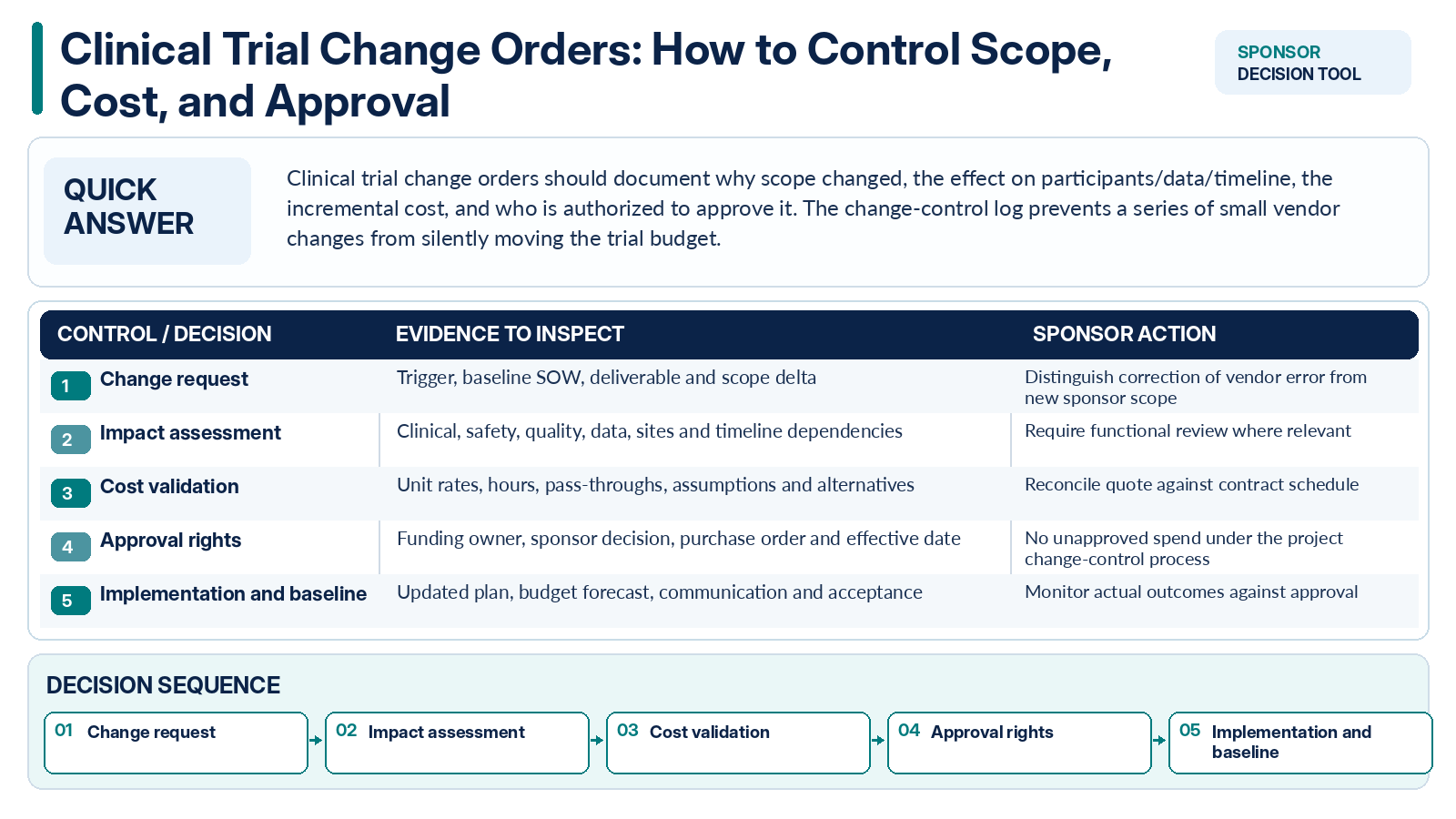
Clinical trial change orders should document why scope changed, the effect on participants/data/timeline, the incremental cost, and who is authorized to approve it. The change-control log prevents a series of small vendor changes from silently moving the trial budget.
How to apply this workflow in practice
Begin with the most consequential control and the evidence needed to resolve it. The following matrix connects each decision to records and an accountable action, rather than treating the list as a generic compliance checkbox.
| Control / question | Evidence to examine | Sponsor action |
|---|---|---|
| Change request | Trigger, baseline SOW, deliverable and scope delta | Distinguish correction of vendor error from new sponsor scope |
| Impact assessment | Clinical, safety, quality, data, sites and timeline dependencies | Require functional review where relevant |
| Cost validation | Unit rates, hours, pass-throughs, assumptions and alternatives | Reconcile quote against contract schedule |
| Approval rights | Funding owner, sponsor decision, purchase order and effective date | No unapproved spend under the project change-control process |
| Implementation and baseline | Updated plan, budget forecast, communication and acceptance | Monitor actual outcomes against approval |
For teams that need support implementing this across functions, BioBoston CRO Budget Tracking can help adapt the controls to the study, vendors, and decision calendar.
Working through the controls
1. Change request
Evidence: Trigger, baseline SOW, deliverable and scope delta. Decision: Distinguish correction of vendor error from new sponsor scope. Record the responsible function and the approved source version, and keep any remaining exceptions visible to the sponsor before this item is closed.
2. Impact assessment
Evidence: Clinical, safety, quality, data, sites and timeline dependencies. Decision: Require functional review where relevant. Record the responsible function and the approved source version, and keep any remaining exceptions visible to the sponsor before this item is closed.
3. Cost validation
Evidence: Unit rates, hours, pass-throughs, assumptions and alternatives. Decision: Reconcile quote against contract schedule. Record the responsible function and the approved source version, and keep any remaining exceptions visible to the sponsor before this item is closed.
4. Approval rights
Evidence: Funding owner, sponsor decision, purchase order and effective date. Decision: No unapproved spend under the project change-control process. Record the responsible function and the approved source version, and keep any remaining exceptions visible to the sponsor before this item is closed.
5. Implementation and baseline
Evidence: Updated plan, budget forecast, communication and acceptance. Decision: Monitor actual outcomes against approval. Record the responsible function and the approved source version, and keep any remaining exceptions visible to the sponsor before this item is closed.
Red flags that should change the plan
- Verbal approval with no record.
- Splitting change orders to avoid thresholds.
- Changing scope without adjusting risks and schedules.
Decision gate and governance
Use a change-order decision memo with options: accept, negotiate, defer, re-scope or reject; retain the financial and clinical rationale. The control owner should record the decision, evidence version, date, residual uncertainty and next re-review trigger. Where delegated providers perform the work, the sponsor should retain the relevant oversight and acceptance evidence.
Scope note: The planning and budget fields above are sponsor-side operating recommendations. They are not FDA-prescribed schedules, prices, or numeric thresholds.
Need practical support?
Use BioBoston CRO Budget Tracking to review the evidence, define decision rights, and build a study-specific action plan for the next milestone.