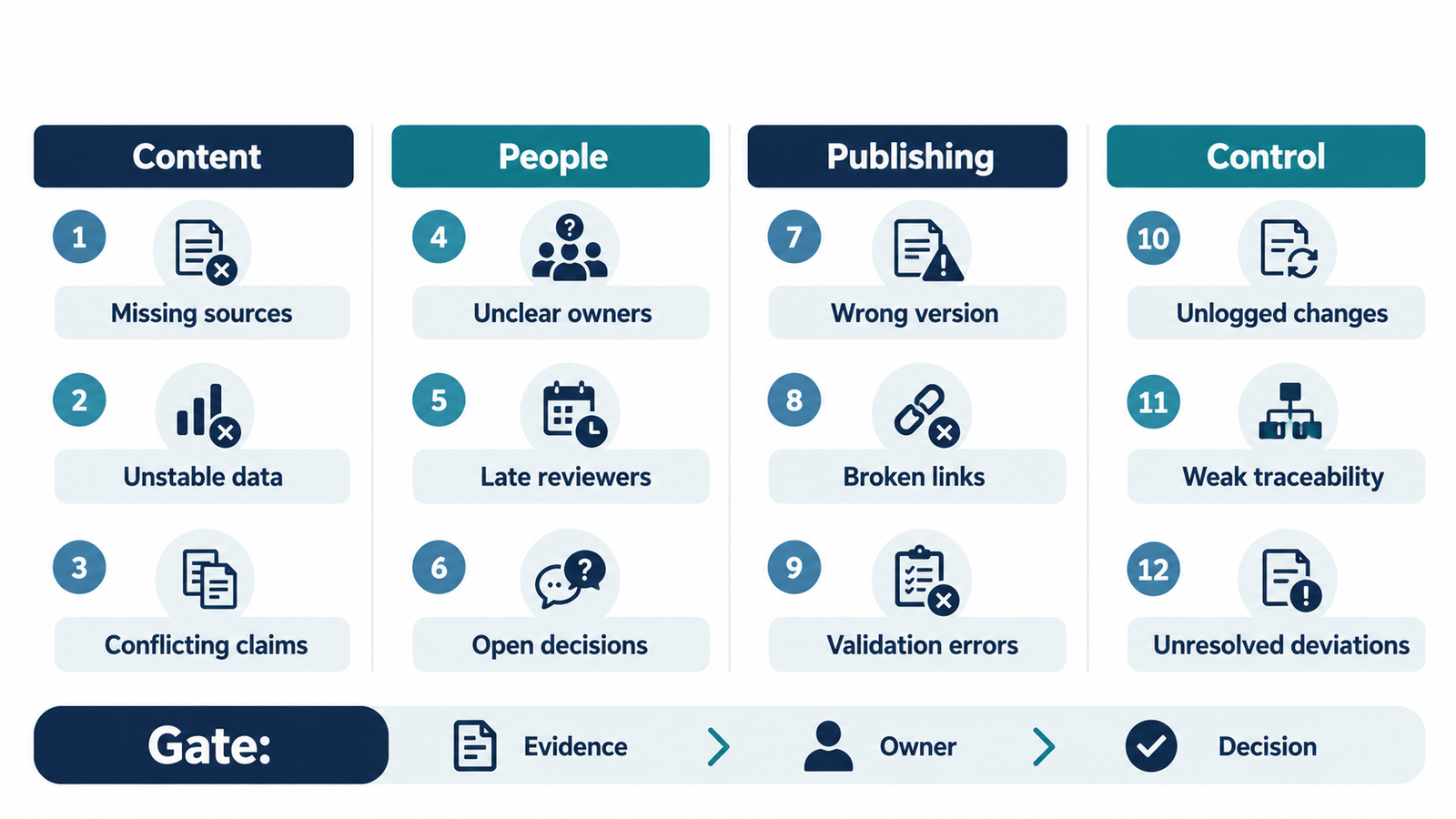
Regulatory submission readiness is not just having draft files in a shared folder. A writing and publishing package is ready when every critical section has reliable source evidence, a decision owner, an approved version, and a defined technical handoff. Most last-minute rework is caused by missed dependencies between these elements rather than by writing speed alone.
This readiness guide helps Regulatory Affairs, Regulatory Operations, medical writing, and cross-functional review leads identify twelve preventable handoff gaps. It focuses on the production and content-readiness gate. It complements, rather than replaces, a broader regulatory filing go/no-go assessment.
Use one evidence-based gate, not a subjective percentage complete
Label each gap Clear, Conditional, or Stop. Clear means documentary evidence exists and is approved. Conditional means a named owner can close a bounded item before the scheduled lock. Stop means the filing narrative, approval, or technical submission cannot be relied upon without additional work. These are operational categories for sponsor planning, not classifications required by FDA.
| # | Readiness gap | Evidence to request | Typical decision |
|---|---|---|---|
| 1 | Missing source documents | Controlled inventory with latest versions and exact locations | Stop critical claims without a defensible source |
| 2 | Unstable data cutoffs | Approved data snapshot and change log | Conditional only if late data will not change conclusions |
| 3 | Conflicting product or protocol facts | Cross-document fact sheet: strength, route, dose, population | Stop until the scientific owners agree a single version |
| 4 | No accountable document owner | Section-level ownership and sign-off map | Stop if no one can approve critical content |
| 5 | Reviewers booked too late | Reserved review windows and escalation backup | Conditional with a viable approved schedule |
| 6 | Open scientific or regulatory decisions | Decision log with owner, deadline, alternatives, impact | Stop when the unresolved choice drives the proposed filing position |
| 7 | Uncontrolled document versions | Baseline, change log, filename controls, audit trail | Stop if the publishing source cannot be identified |
| 8 | Broken references and navigation | Link, bookmark, table and cross-reference checks | Correct before packaging; severity depends on impact |
| 9 | Failed eCTD technical validation | Current publisher validation report and resolved findings | Stop unresolved errors that prevent acceptance |
| 10 | Late changes outside the change log | Impact assessment and documented approvals | Stop unreviewed changes affecting conclusions |
| 11 | Incomplete cross-document QC | Recorded comparison of shared facts and key claims | Stop material contradictions; document lesser editorial fixes |
| 12 | Approval not matched to final files | Signed release record with file/version identifiers | Stop until approval covers the exact release package |
Why these twelve gaps create cascading rework
Content gaps: 1-3
Missing source material, moving data cutoffs, and conflicting product facts usually reappear as contradictory statements. The cost is multiplied when several writers have already drafted from different baselines. Establish a source register and a common fact sheet before intensive authoring. For high-risk claims, record the precise source table or page and current version.
People and decision gaps: 4-6
A document can look complete while a major scientific judgment remains unresolved. Reviewers need explicit decisions and dates, not only comment invitations. Ask who is authorized to resolve a disagreement between CMC, nonclinical, and clinical interpretations; who can release the document; and who becomes the backup if the decision owner is unavailable.
Publishing gaps: 7-9
A polished PDF is not necessarily a valid electronic submission. Regulatory Operations should check supported submission specifications, file types, document placement, hyperlinks, and validation output. The FDA publishes version-specific eCTD standards and technical conformance documents, which are updated over time. A publishing plan based on last year’s specification should not be assumed current. FDA supports eCTD v3.2.2 and v4.0 subject to current program-specific implementation requirements.
Control gaps: 10-12
Late approved changes can be legitimate. Uncontrolled changes are a different problem. Track each post-freeze change against affected narrative sections, tables, references, and approval records. The final quality gate must connect the actual published package to its scientific and regulatory sign-off.
The two-minute readiness scorecard
Use a single row for each of the twelve gaps, and enter: status (Clear/Conditional/Stop), evidence link, accountable person, planned closure time, and impact on the submission. Sort first by decision consequence, then by time to closure. Do not let a simple count of green rows outweigh one unresolved critical risk.
Suggested escalation rules:
- Stop: A critical source, scientific decision, approval, or technical-validity error is missing or contradictory. Escalate immediately and revise the lock or filing plan if required.
- Conditional: An item is bounded, has a credible owner and deadline, and can be resolved without changing a major conclusion. Keep it visibly open until evidence is available.
- Clear: A second person can retrieve the evidence and reproduce the status without asking the author for clarification.
A practical review calendar
Before authoring lock: identify all source gaps, data windows, scientific interpretations, and document owners. Before publishing lock: complete cross-document comparisons, stabilize formatting, and obtain release approvals. Before transmission: validate the exact package against current FDA technical criteria and confirm the authorized submission process. Avoid assigning universal day counts: timelines vary by submission type, sponsor processes, and quality of source material.
Hypothetical example: a late nonclinical report
A sponsor has all narrative sections drafted, but a final nonclinical report arrives with a different exposure value from the prior draft. The team should not simply patch one paragraph. It should confirm the approved report version, identify every dependent statement (including any dose-justification discussion), assign a scientific owner to reconcile interpretation, and reapprove the affected sections. The decision to defer, qualify, or update the filing is product-specific and belongs with the regulatory/scientific decision makers.
Distinguish production readiness from filing suitability
This guide addresses whether the submission-writing and packaging workflow is controlled. It does not decide whether an IND, NDA, BLA, or other filing is substantively adequate. Those determinations depend on the relevant regulations and product-specific evidence. For broader filing strategy, see BioBoston CRO Submission Planning and Regulatory Pathway services.
Final readiness check
Before release, ask one person outside the authoring team to retrieve the exact source and approval for three critical claims and the final publishing report. If this cannot be done promptly, the process is not yet reliably controlled. Record the issue, owner, and decision rather than marking an unverified task complete.
Need an independent submission production check?
BioBoston CRO Submission Writing support can help sponsors organize source inventories, cross-functional review gates, document QC, and controlled publication handoffs before a regulatory filing.