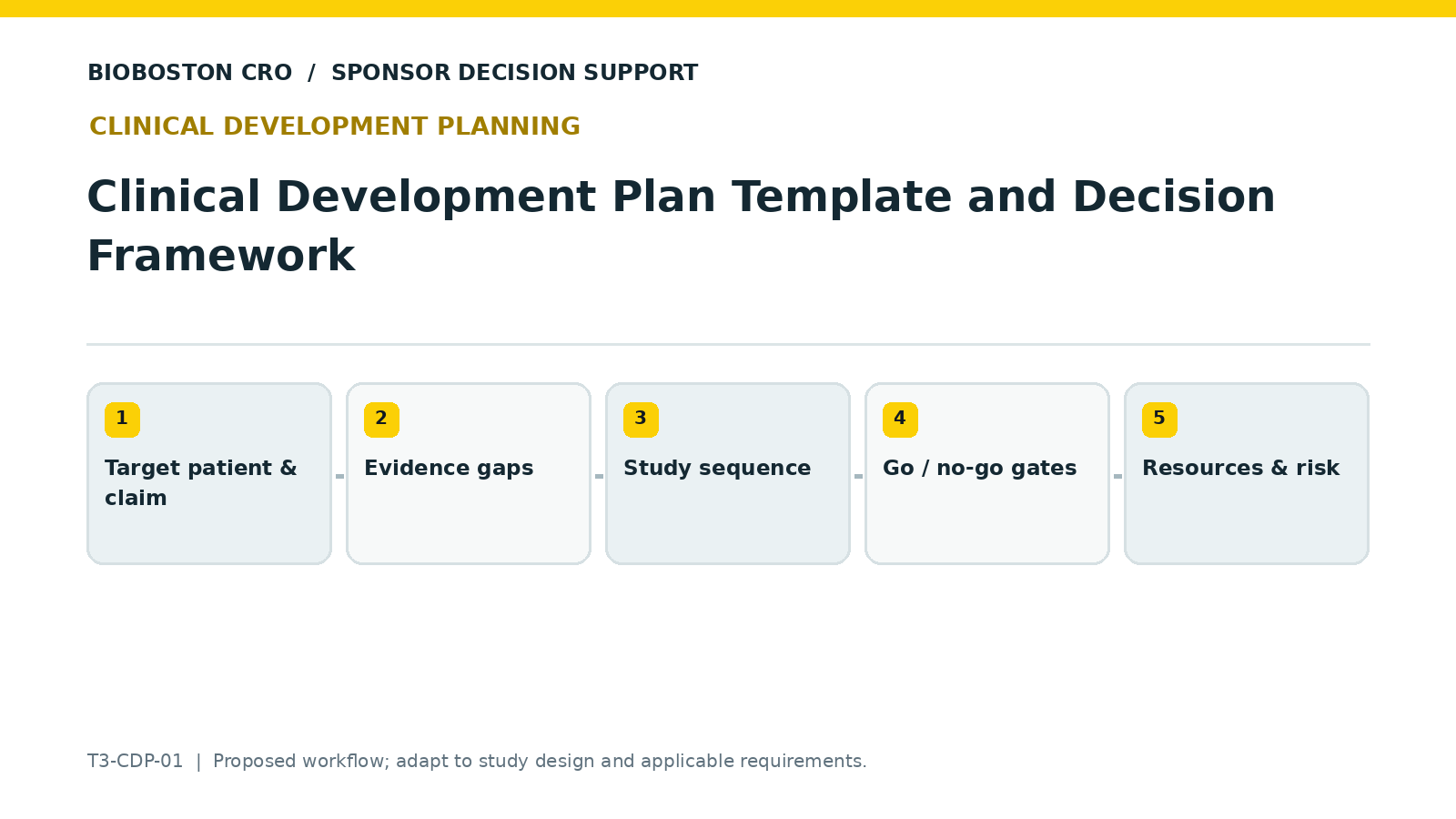
A clinical development plan template should show which evidence decisions the sponsor must make, what studies or analyses will answer them, and what triggers progression, redesign or termination. A simple list of trial dates does not make a development strategy. The plan must link intended patient benefit, dose and population choices, regulatory interactions, clinical evidence, operational capacity and investment gates.
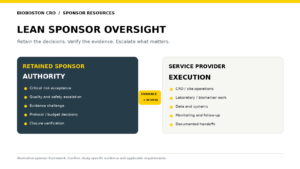
This template is intended for a funded emerging biotech or small pharma team coordinating Clinical Development, Medical, Regulatory, Biostatistics and Clinical Operations. It is a working decision register that evolves with evidence; it is not a fixed promise of success or a substitute for product-specific regulatory advice.
What the sponsor needs to decide
Build the plan in two layers: a concise management roadmap showing the next irreversible decisions, and a controlled evidence register showing how every proposed milestone is justified. If a decision has no evidence threshold or authority, it is only an activity.
Clinical Development Plan Template and Decision Framework: evidence and decision matrix
| Review point | Evidence to collect | Sponsor decision or acceptance criterion |
|---|---|---|
| Target product and patient problem | Proposed indication, unmet need, target population, benefit-risk hypothesis | State the patient and regulatory decision each planned study should inform. |
| Development evidence inventory | Nonclinical, CMC, clinical, safety, PK/PD and external evidence with maturity | Record gaps, assumptions and evidence that can change program direction. |
| Study sequence and alternatives | Phase I/II concepts, populations, endpoints, controls and dependency options | Show both the preferred route and credible alternative if key data disappoint. |
| Regulatory engagement | Interaction questions, authority, timing and decision topics | Seek advice on specific unresolved issues; avoid implying feedback guarantees acceptance. |
| Decision gates | Go/no-go metrics, safety boundaries, efficacy signals, information thresholds | Define who decides and what evidence is sufficient before results arrive. |
| Operating and financial critical path | Drug supply, sites, vendors, systems, budget, recruiting and contracting | Connect dates and spend to study assumptions, not arbitrary milestones. |
| Risk and change control | Scientific, recruitment, safety, CMC and regulatory risk register | Assign early signals, mitigations and triggers for replanning. |
How to apply this framework to a real sponsor decision
State the intended evidence claim
Write what a next-stage investor, clinical lead or regulator must learn at each milestone. Separate learning objectives from confirmatory claims; not every study supports the same standard of inference.
Compare two plausible paths
For the major stage transition, model a preferred and fallback sequence with different data, time and cost implications. Record the evidence and decision that would make the sponsor choose one over the other.
Convert program milestones into decision gates
Replace vague items such as “complete Phase I” with observable gates: accepted safety review, relevant exposure information, dose decision, feasibility of the next population and qualified supply availability.
Tie assumptions to resource reality
Add owners, procurement lead times, regulatory interaction windows, sites and sample-size assumptions. When one changes, update the development sequence and commercial forecast together.
Maintain a living strategic record
Version the plan after major data readouts, authority advice, program priority changes and safety developments. Mark decisions superseded rather than overwriting the evidence behind them.
Warning signs that need intervention
- A timeline is mistaken for a complete development strategy.
- The next trial is planned before target population and clinical question are settled.
- The roadmap assumes a favorable regulator response as a guaranteed milestone.
- Budget estimates hide uncertainty in recruitment, manufacturing or analysis.
- A stage-gate has a date but no objective evidence threshold.
First-week sponsor action plan
- Define the next three clinical decisions and accountable owners.
- Create an evidence/gap matrix for each decision and a fallback option.
- Link every study milestone to protocol readiness, supply, sites, statistics and budget.
- Approve a review trigger for new data, FDA advice and material risk changes.
To connect this decision framework to actual study responsibilities, see BioBoston CRO Clinical Development Planning support. The service team can help structure sponsor oversight and the evidence needed to make a documented decision; site-facing or other specialized execution may be coordinated with qualified partners where appropriate.
Frequently asked sponsor questions
Should the plan contain a full regulatory strategy?
It should integrate the questions and interactions that drive clinical decisions, but detailed submission and regional strategy may need dedicated workstreams.
How detailed should a pre-IND plan be?
Detailed enough to support the next evidence and investment decisions, with explicit uncertainties. Avoid false precision for later-stage dates.
What is the most useful sponsor output?
A decision register connecting an evidence question, acceptance threshold, owner, timing dependency and fallback action.
Technical and regulatory context
The framework reflects relevant FDA/ICH principles, including ICH E8(R1), ICH E9, ICH E9(R1). Guidance documents contain nonbinding recommendations and should not be described as universal legal requirements. Applicable binding obligations and study-specific authority expectations should be assessed separately; retain current source/version records in the internal quality file.
Next step for the sponsor
If your team is resolving the decisions above, explore BioBoston CRO Clinical Development Planning services for a scoped assessment, responsibility map or expert-supported working plan. Keep the decision record and supporting evidence even if you ultimately use another delivery model.