Clinical Trial Vendor Governance Plan Template for Sponsors helps clinical development sponsors turn an unstable operating situation into a controlled sequence of evidence, accountability, and explicit decisions. The purpose is to assess what is known, identify what remains uncertain, and choose actions that protect participants and data while making the project executable.
Why sponsors need a decision tool
Clinical Trial Vendor Governance Plan Template for Sponsors helps clinical development sponsors turn an unstable operating situation into a controlled sequence of evidence, accountability, and explicit decisions. The purpose is to assess what is known, identify what remains uncertain, and choose actions that protect participants and data while making the project executable. A vendor governance plan is a working operating agreement between sponsor functions and service providers, not merely a procurement checklist. Define delegated tasks precisely while preserving the sponsor’s applicable oversight responsibilities.
Who should use it
This framework is intended for sponsor clinical operations leaders, quality and regulatory staff, vendor owners, and executives responsible for outsourced development. It is a working governance aid rather than a substitute for a protocol, contract, safety procedure, CAPA system, or legal assessment.
Start with containment and verifiable facts
Classify any immediate participant-safety, critical-quality, or serious data-integrity concern first and apply existing urgent escalation procedures. Then establish a reporting cut-off, freeze a dated current-state snapshot, and identify the authoritative source for each unresolved issue. Separate an issue that has occurred from a future risk and from a decision requiring authority.
Use the working framework
Copy the matrix below into a controlled sponsor document or project workspace. For every row record status (green/amber/red), source evidence and date, a single accountable owner, dependency, next action, decision-maker, and the next review date. Status colors are suggested internal conventions, not regulatory classifications.
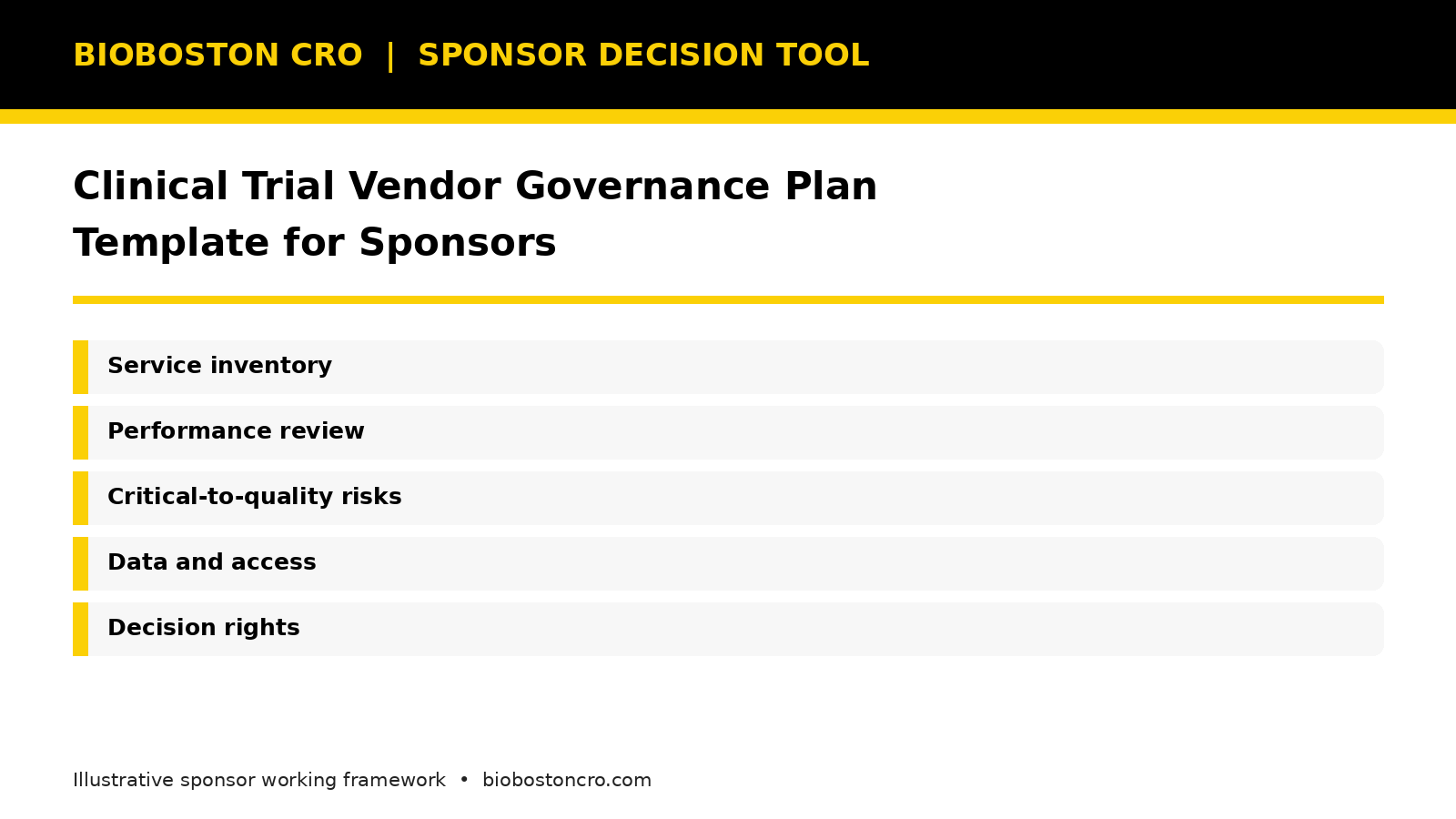
| Workstream / criterion | Trigger or question | Evidence to check | Accountable owner | Next action / decision |
|---|---|---|---|---|
| Service inventory | Which vendor owns each deliverable and regulated activity? | Signed agreement, service description, RACI and interfaces | Clinical operations owner | Update at onboarding and every scope change |
| Performance review | What service and quality signals show whether delivery is reliable? | Acceptance evidence, milestones, issue and quality logs | Vendor relationship lead | Weekly operational and monthly sponsor review as risk warrants |
| Critical-to-quality risks | Which factors could affect participant protection or reliable results? | Risk assessment, contingency planning, escalation instructions | QA and sponsor medical | Immediate escalation for urgent concerns |
| Data and access | What data are transferred, by whom, with what controls? | Access matrix, specifications, transfer checks, system owners | Data management | Verify controls at onboarding and changes |
| Decision rights | Who may approve deviations, scope changes, rebaseline and spend? | Governance charter, authorized delegates, decision log | Sponsor executive | Document before decisions are required |
| Exit and continuity | How can service be transferred without losing study oversight? | Handover package, essential documents, record access, responsibilities | Sponsor vendor lead | Rehearse high-risk transitions before termination |
Field-by-field instructions
Define the trigger in observable terms; cite its source document, not a recollection from a meeting. Record severity and participant/data implications separately from schedule or budget impact. Distinguish responsible task owner from authorized approver. State the decision deadline as the last date action can be taken without affecting an irreversible milestone.
How to interpret confidence and urgency
Green requires recent, corroborated evidence that an action is complete or a milestone remains plausible. Amber means a specific dependency could jeopardize the commitment; it needs a named mitigation and decision date. Red indicates an actual critical failure or a material miss requiring sponsor action. Do not downgrade a patient-safety concern simply because the broader timeline appears healthy.
Review cadence and governance
Use more frequent operational reviews while instability persists; tailor frequency to actual risks. Keep decisions in a dated log with options, approving authority, rationale, implementation owner, and effectiveness check. Escalate to a different decision route when contracts, budget, protocol changes, data systems, quality or patient safety exceed the current forum’s authority.
A worked example, not a client case
Hypothetical multi-vendor study: the central lab changes sample collection instructions while the EDC build is frozen. A functioning governance plan requires the lab, CRO, data lead, and sponsor medical owner to assess protocol and data consequences before implementation, with documented approval and a verified release date.
Failure modes to avoid
Do not accept percentage-complete statements without deliverable evidence. Avoid assigning multiple people as jointly accountable without one clear decision owner. Do not silently revise baselines, treat an unsigned change order as authorized work, replace a vendor before defining continuity controls, or defer urgent quality escalations until a routine meeting.
Practical next-action checklist
Confirm: (1) current-state evidence is dated; (2) critical risks are separated; (3) open decisions have names and deadlines; (4) mitigations address root causes rather than optics; (5) the receiving team and budget authority can execute; (6) verification criteria are agreed; and (7) the updated plan is communicated to dependent teams.
Regulatory perspective
ICH E6(R3) discusses proportionate, risk-based quality management and service-provider oversight. FDA guidance is nonbinding; actual sponsor, investigator, human-subject protection, and other responsibilities depend on the study and applicable law, such as relevant provisions of 21 CFR Part 312. Use current approved procedures and expert regulatory review for program-specific decisions.
When to seek outside support
Seek independent cross-functional help when source information conflicts, governance has stalled, quality concerns affect participant protection or reliable results, the vendor cannot provide a credible action plan, or transition decisions would create significant operational risk. External support should provide facts and options, not displace sponsor decision authority.
Sponsor oversight evidence package
Maintain a one-page executive summary, source-system extracts, an issue and decision log, a record of dated forecast changes, vendor deliverable acceptance criteria, and a current responsibility matrix. Keep a link to the authoritative document rather than copying uncontrolled versions into emails. When a finding changes priority, record what evidence changed and who approved the new action. This package allows a newly appointed sponsor executive or independent reviewer to reconstruct the decision history without depending on verbal recollection.
An operational 30-minute review agenda
Minute 0–5: confirm immediate safety and data-integrity issues have reached their proper escalation routes. Minute 5–10: review new material facts and changed confidence. Minute 10–20: decide action on the top critical-path or contractual dependencies. Minute 20–25: review forecast, resourcing and budget authority. Minute 25–30: read back approved decisions, their accountable owners, expected evidence and next checkpoint. Meeting times are illustrative; select a cadence appropriate to risk.
What to measure after action
Choose a small number of objective leading indicators. Examples include overdue critical actions, age of unresolved issues, percentage of high-risk vendor deliverables with accepted evidence, days of unapproved forecast variance, data-transfer reconciliation exceptions, and completion of effectiveness checks. Define numerator, denominator, evidence source, owner and threshold. A trend without a stable definition can appear reassuring while the underlying work deteriorates.
Document control and update triggers
Archive prior versions with a reporting date. Update the framework when the protocol, vendor scope, project baseline, risk profile, ownership, approval status, or critical system changes. Validate the revision through the sponsor authority required by its procedures. Keep factual sponsor documentation separate from hypothetical illustrations or advisory examples, and never represent a draft risk decision as an approved action.
For coordinated sponsor oversight and execution, explore BioBoston CRO Vendor Governance.