Investigator brochure checklist use should start with source readiness, not with a blank document. For an initial IB, the sponsor needs a controlled, stage-appropriate set of product, nonclinical, clinical, and safety information that allows investigators to understand the investigational product, the rationale for the trial, the known and potential risks, and the precautions or monitoring needed for safe study conduct.
The strongest initial IBs also make uncertainty visible. Early programs will not have complete human data, mature safety characterization, or answers for every future section. The goal is not to make the brochure look more complete than the development program actually is; it is to present the available evidence accurately, identify what is not yet known, and maintain consistency with the protocol and current safety strategy.
Quick answer: what belongs in an initial Investigator’s Brochure?
At a minimum, the initial IB should cover the investigational product and formulation, relevant nonclinical pharmacology/toxicology and disposition, available human pharmacokinetic, safety, and efficacy information, known and potential risks, and precautions or special monitoring. ICH E6(R3) Appendix A expands that into a practical structure: title/version information, confidentiality statement where used, table of contents, concise summary, introduction, product properties and formulation, nonclinical studies, effects in humans, Reference Safety Information where applicable, and an integrated summary of data and guidance for investigators.
Who this investigator brochure checklist is for
This resource is designed for Clinical Development, Medical Writing, Safety/Pharmacovigilance, Regulatory Affairs, Nonclinical, CMC, and program leaders preparing an initial IB or rebuilding an early draft. It is especially useful when multiple functions own source documents and one writer or document lead must turn those inputs into a controlled, investigator-facing narrative.
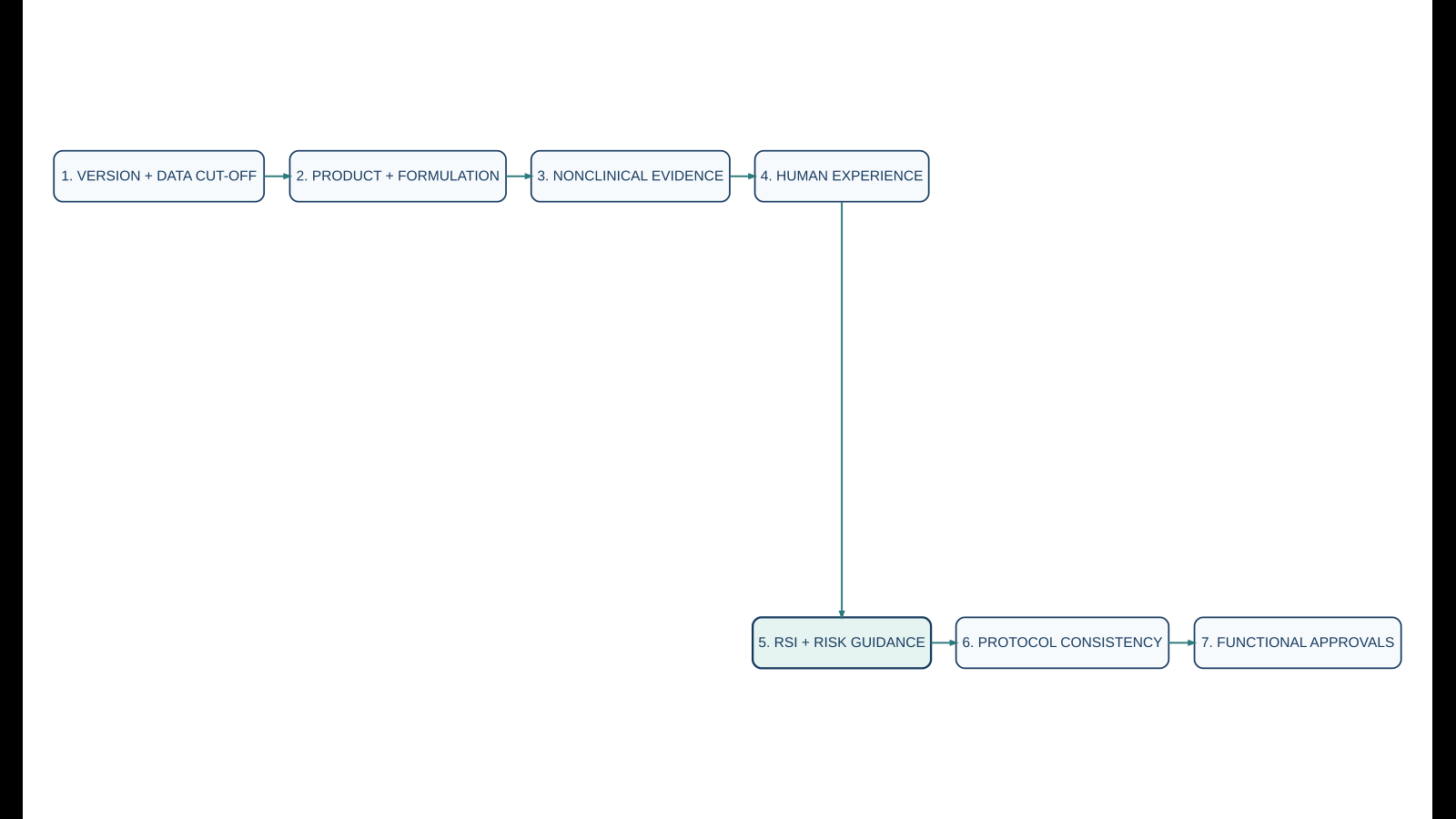
1. Lock document identity, versioning, and the data cut-off
| Checklist item | Evidence/source | Primary owner | Red flag |
|---|---|---|---|
| Sponsor and investigational product identity are correct | Current development records / product naming convention | Regulatory + CMC | Different product names or codes appear across sources |
| Edition/version and release date are defined | Document-control record | Document owner | No unambiguous version history |
| Superseded edition is identified when applicable | Controlled document history | Document control | Team cannot confirm which version is current |
| Data cut-off date is explicit | IB authoring plan / source register | Program lead | Different sections use different unstated cut-offs |
ICH E6(R3) specifically recommends including the edition number, the edition/date superseded, and the cut-off date for data included in the version. Even for an initial IB, defining the cut-off early prevents a moving target during integrated review.
2. Build the summary and introduction from approved source positions
The opening sections should orient the investigator quickly. ICH E6(R3) describes a concise summary of the significant physical, chemical, pharmaceutical, pharmacological, toxicological, pharmacokinetic, metabolic, and clinical information relevant to the current stage of development.
| Content | Source evidence | Primary owner | Readiness test |
|---|---|---|---|
| Research/generic/trade name and active ingredient(s) | CMC/product records | CMC | Matches protocol and regulatory documents |
| Pharmacological class and rationale | Nonclinical/clinical development strategy | Clinical + Nonclinical | Claims are evidence-based, not promotional |
| Anticipated indication and development context | Current clinical development plan | Clinical Development | Consistent with the protocol and intended population |
| Current benefit-risk framing | Integrated source review | Medical + Safety | Known limitations and uncertainties are visible |
3. Confirm product, formulation, storage, and handling information
The IB should describe the investigational product substance and formulation at a level useful for safe clinical use. Under 21 CFR 312.23(a)(5), the U.S. minimum includes a brief description of the drug substance and formulation. ICH E6(R3) additionally addresses relevant physical, chemical, and pharmaceutical properties, excipients where clinically relevant, and storage and handling instructions.
- Confirm active substance and formulation descriptions match the current CMC source.
- Include relevant dosage-form, excipient, storage, stability, handling, and administration information.
- Check whether structural similarity to known compounds has safety relevance.
- Reconcile all product descriptions with the current protocol and pharmacy/site instructions.
4. Summarize the nonclinical evidence for human use
Do not convert the IB into a collection of study reports. The nonclinical sections should synthesize the findings that matter for clinical interpretation: pharmacology, pharmacokinetics/product metabolism, toxicology, dose/exposure relationships, reversibility, and relevance to the proposed human study.
| Workstream | Evidence to have ready | Owner | Red flag |
|---|---|---|---|
| Pharmacology | Primary/secondary pharmacology and relevant safety pharmacology summaries | Nonclinical | Mechanistic claims exceed available evidence |
| PK / disposition | Absorption, distribution, metabolism, exposure and species comparisons as applicable | Nonclinical / DMPK | Exposure language is inconsistent with dose rationale |
| Toxicology | Relevant single/repeat-dose and other toxicity findings appropriate to program stage | Nonclinical / Toxicology | Clinically important findings are buried or disconnected from monitoring |
| Human relevance | Interpretation of findings for starting dose, escalation, monitoring, or risk controls | Nonclinical + Clinical | IB summarizes findings but never explains clinical relevance |
5. Present human experience at the maturity the program actually has
For first-in-human development, human data may be limited or absent. That is acceptable. The IB should clearly distinguish what is known from humans, what is inferred from nonclinical data or related products, and what remains unknown.
As data accumulate, the human section should address relevant pharmacokinetics/metabolism, pharmacodynamics, dose-response, safety, efficacy, prior clinical trials, and marketing experience when applicable. If a section is not yet supported by data, use controlled, transparent language rather than filling the gap with speculation.
6. Use the investigator brochure checklist to control RSI and investigator guidance
ICH E6(R3) identifies the Reference Safety Information (RSI) in the IB as an important reference point for determining expectedness of suspected unexpected serious adverse reactions. FDA also uses the IB as a basis for determining whether a suspected adverse reaction is unexpected for IND safety reporting.
For initial authoring, Safety/Pharmacovigilance and the medically qualified reviewer should establish:
- Which adverse reactions are considered expected based on the available evidence.
- The nature and, where supportable, frequency of those reactions.
- Known or potential risks that require investigator attention.
- Precautions, contraindication-like considerations, dose modifications, stopping rules, or special monitoring that should be reflected in trial conduct.
- How urgent new safety information will be communicated outside the normal IB revision cycle.
Do not inflate the risk section with every adverse event observed during development. FDA has cautioned that listing events unlikely to be caused by the drug can dilute clinically meaningful risk information.
7. Reconcile the IB with the protocol and related clinical documents
An IB should not be approved in isolation. Before finalization, cross-check its product description, dose, route, schedule, population, known risks, safety monitoring, stopping logic, and investigator guidance against the protocol and other current clinical documents.
If the protocol is still evolving, BioBoston CRO’s Protocol Writing support can help align the protocol narrative and IB assumptions before both documents enter final review.
| Cross-document check | What must agree | Escalate when |
|---|---|---|
| IB ↔ Protocol | Product, dose, route, population, risk controls and safety monitoring | A protocol decision is not supported by current IB evidence |
| IB ↔ CMC/product information | Formulation, strength, handling, storage and product identity | Operational instructions reflect an obsolete product configuration |
| IB ↔ safety strategy | Expected reactions, key risks, monitoring and urgent communication process | RSI/risk language is not owned by Safety/Medical |
| IB ↔ regulatory submissions | Current development stage, key source facts and version references | Submission materials rely on a different source version |
8. Assign authoring, technical approval, and medical review deliberately
ICH E6(R3) states that a medically qualified person should be involved in generating an IB and that the contents should be approved by the disciplines that generated the described data. In practice, that means one writer can integrate the document, but Clinical, Nonclinical, CMC, Safety, and other source owners still need defined technical approval responsibilities.
A useful RACI-lite structure is:
- Document lead/writer: owns structure, integration, consistency, references, and comment resolution.
- Functional source owners: approve technical accuracy of data derived from their functions.
- Safety/Medical: owns clinical risk interpretation, RSI strategy where applicable, and investigator guidance.
- Regulatory: confirms regional requirements, submission alignment, and controlled version status.
- Program leadership: resolves cross-functional disagreements that affect the development position.
9. Final investigator brochure checklist before approval
- Title page, sponsor/product identity, edition, release date, and data cut-off are controlled.
- The summary is concise, balanced, and appropriate to the current development stage.
- Product/formulation information matches the current CMC source and protocol.
- Nonclinical findings are synthesized for clinical relevance rather than copied from reports.
- Human data are current, clearly distinguished from inference, and not overstated.
- Known/potential risks, expected adverse reactions, precautions, and monitoring are medically reviewed.
- RSI content, where applicable, has clear Safety/Medical ownership and a traceable evidence basis.
- Protocol, IB, safety strategy, and regulatory submission assumptions are consistent.
- References and source versions are traceable to controlled records.
- Functional approvals and medical review are documented.
- The document is objective, balanced, non-promotional, and useful to investigators.
- A process exists to review the IB at least annually and earlier when important new information warrants revision.
What should trigger escalation before the initial IB is released?
This investigator brochure checklist should trigger escalation rather than forcing document completion when a key safety position lacks an owner, the clinical protocol depends on a product or dose assumption not supported by the current evidence, major source documents are still changing without a defined cut-off, the team disagrees on the interpretation of a nonclinical finding, or the proposed RSI/risk language cannot be defended from the available data.
When IB preparation is part of a larger IND sequence, Submission Planning support can help align document timing and source readiness. If an identified quality breakdown requires formal remediation, GCP CAPA Support may be relevant.
Need help preparing the initial Investigator’s Brochure?
Explore BioBoston CRO Investigator Brochure Support for initial authoring, controlled updates, substantial revision, rescue of an existing draft, or independent review of a source-supported IB.