labeling review checklist planning should help the sponsor make a controlled decision, not merely create another document. A cross-functional labeling review checklist for regulated life-science products. It clarifies who reviews what, which evidence should support the wording, and what must be resolved before release.
Quick answer: what should the review cover?
A useful labeling review checklist should confirm the labeling object and market, intended use or indication, exact claims, evidence support, risk statements, instructions, product configuration, consistency with the regulatory position, approval ownership, and implementation controls. The review should also make disagreement visible instead of burying it in tracked changes.
For sponsors that need hands-on support applying this framework, BioBoston CRO Labeling Support can support the underlying regulatory and cross-functional work.
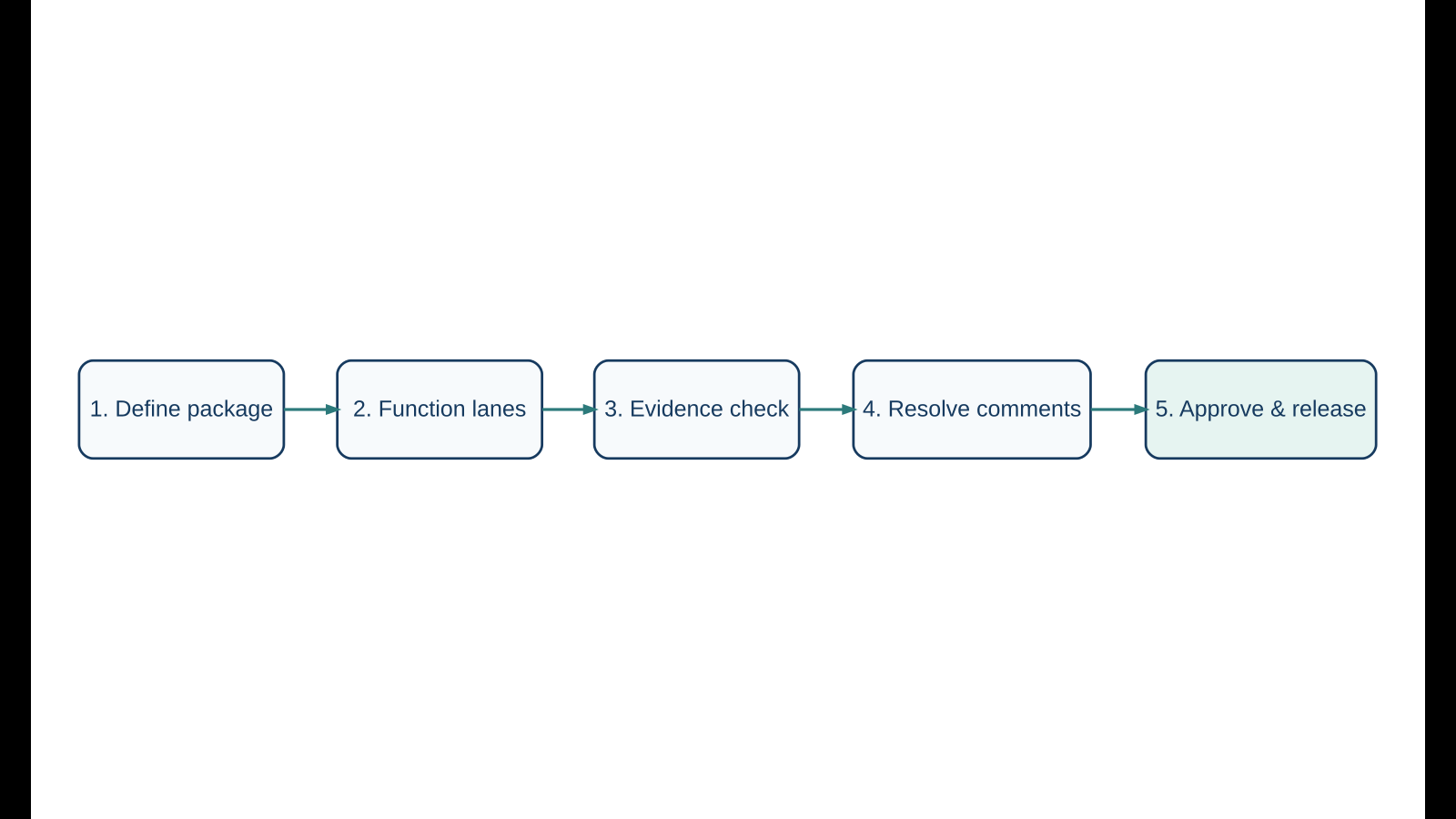
1. Define the review package before comments begin
| Field | Record before review | Why it matters |
|---|---|---|
| Labeling object | Label, carton, IFU, package insert, electronic labeling, or other controlled component | Different components can have different requirements and owners |
| Product / market | Product type, classification, development or marketing status, jurisdiction | Prevents the wrong regulatory framework from being applied |
| Source version | Controlled draft, source evidence cutoff, artwork or content version | Keeps reviewers on the same baseline |
| Decision owner | Named Regulatory approver and escalation path | Prevents unresolved cross-functional comments from cycling indefinitely |
2. Give each function a defined review lane
| Function | Primary questions | Evidence / output |
|---|---|---|
| Regulatory | Is the wording within the supported regulatory position and applicable requirements? | Regulatory strategy, submission/authorization, applicable labeling requirements |
| Clinical / Medical | Is the clinical meaning accurate and appropriately qualified? | Clinical reports, analyses, literature, medical rationale |
| Safety | Are risks, warnings, precautions, contraindications, and limitations current and consistent? | Safety database, risk assessment, signal evaluation, product safety information |
| Quality / Product | Does labeling match the released configuration, storage, handling, manufacturing, and change controls? | Specifications, design/manufacturing records, change control |
| Commercial / Legal where applicable | Are promotional or comparative statements within the approved review process? | Approved claims framework and applicable review standards |
3. Review exact claims against exact evidence
Do not approve a claim because the team agrees with the general concept. Capture the exact proposed wording, the population or use condition it implies, the source evidence and version, important limitations, and the final disposition. Small modifiers can materially change what the statement communicates.
- Flag wording that broadens population, intended use, performance, or benefit beyond the evidence.
- Confirm comparative statements have an appropriate basis and review path.
- Record when a statement is supported only under specific conditions, configurations, or subgroups.
4. Run a consistency check across controlled documents
- Intended use / indication matches the relevant regulatory record.
- Risk language is aligned across label, IFU, package insert, electronic content, and other user-facing materials.
- Product identity, configuration, storage, and handling match the released product.
- Terminology is consistent across labeling components.
- Any new evidence or product change has been assessed for downstream labeling impact.
5. Use a disposition log instead of comment ping-pong
| Disposition | Meaning | Required next step |
|---|---|---|
| Approve | Wording and evidence are acceptable | Route to controlled approval |
| Revise | Concept is supportable but wording or qualification is not | Rewrite and re-review affected functions |
| Hold | Evidence, regulatory decision, or product information is pending | Assign owner and re-review trigger |
| Reject | Wording is not supportable or conflicts with the regulatory/product basis | Remove from the release package |
6. Red flags before approval
- Different functions reviewed different versions.
- A claim has no traceable source or uses an obsolete data cut.
- Safety language changed without downstream consistency review.
- Product or manufacturing changes were approved without labeling impact assessment.
- The team cannot identify who has final authority on unresolved comments.
- Implementation timing, inventory, digital content, or training is not synchronized.
Labeling review checklist: approval gate
- Applicable product and market requirements identified.
- Exact claims traced to evidence.
- Risk information reconciled.
- Instructions and product configuration verified.
- Cross-functional comments resolved or dispositioned.
- Final approver documented.
- Effective version and implementation plan controlled.
For complex or product-specific reviews, BioBoston CRO can support the controlled review through Labeling Support, including evidence alignment, change assessment, and approval controls.