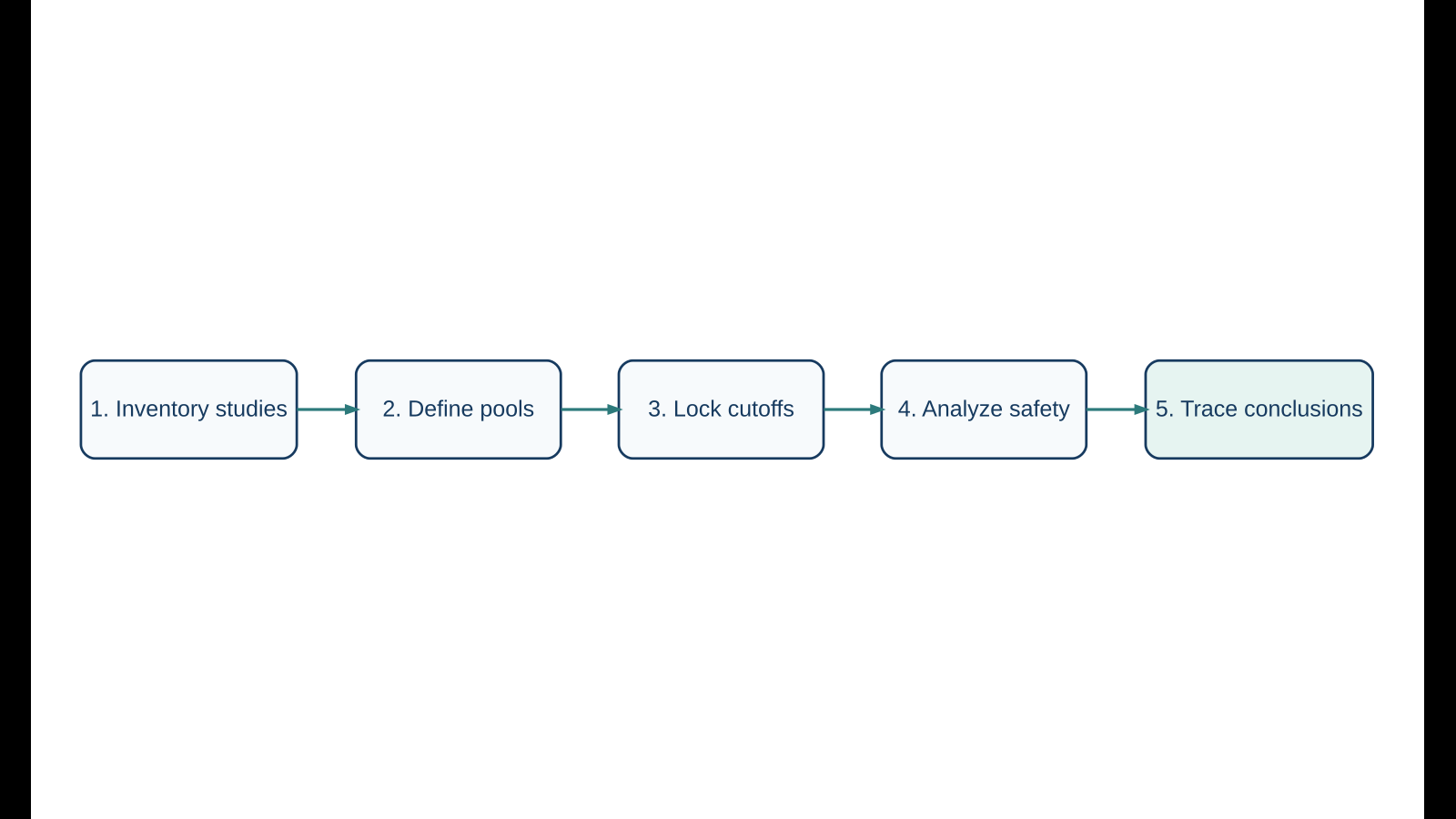
integrated summary of safety checklist planning should help the sponsor make a controlled decision, not merely create another document. A practical planning checklist for an Integrated Summary of Safety. It focuses on study inventory, exposure, pooling rules, coding, special topics, traceability, and cross-functional decisions.
Quick answer: what should be locked before ISS authoring?
- Study and dataset inventory.
- Safety population and exposure conventions.
- Data cutoff and reconciliation plan.
- Pooling and non-pooling rationale.
- Coding dictionaries and versioning.
- Core safety outputs, AESIs, deaths, SAEs, discontinuations, labs and special populations.
- Narrative ownership and escalation rules.
1. Build the safety evidence inventory
| Field | Record |
|---|---|
| Study | Identifier, phase, design, population, dose, duration |
| Dataset | Safety population, cutoff, database status |
| Exposure | Dose, duration, cumulative exposure conventions |
| Coding | Dictionary and version for events/medications |
| Known limitations | Collection differences, follow-up, missingness, protocol changes |
2. Define pooling groups before tables
Group studies only when the comparison is clinically and analytically defensible. Document why a pool exists, which studies are excluded, and which questions require study-level presentation. A single “all studies” pool can hide meaningful differences in exposure or population.
For sponsors that need hands-on support applying this framework, BioBoston CRO Safety and Efficacy Summaries can support the underlying regulatory and cross-functional work.
3. Align the safety topic plan
- Overall exposure and demographics.
- Deaths, serious adverse events, discontinuations, and dose modifications.
- Treatment-emergent adverse events and severity.
- Adverse events of special interest and mechanism-related risks.
- Laboratory, vital-sign, ECG, and other objective safety findings as relevant.
- Special populations, long-term exposure, and clinically important subgroups.
- Important post-treatment or follow-up findings when relevant.
4. Create one cutoff and reconciliation register
| Control | Owner question |
|---|---|
| Clinical database cutoff | Is the safety population final enough for integrated analysis? |
| Safety database reconciliation | Are serious events and key cases reconciled? |
| Coding freeze | Are dictionary versions locked and documented? |
| Narrative cutoff | Which late cases or updates must still be incorporated? |
| Labeling cut | Which safety conclusions may affect proposed wording? |
5. Make traceability visible
Every headline safety conclusion should be traceable to a defined output or analysis, and every material table should have a known source dataset and version. The goal is not to duplicate programming specifications in the narrative; it is to make the evidence chain reproducible.
6. Planning red flags
- Study inventory changes after integrated programming has started.
- Different teams use different data cutoffs or coding versions.
- AESI definitions are not frozen before analysis.
- Narrative writers cannot identify the table or dataset supporting a conclusion.
- Pooling obscures an exposure or population difference that matters clinically.
ISS readiness gate
- Study inventory approved.
- Pooling rationale documented.
- Data cutoffs and coding versions controlled.
- Core analyses and special topics agreed.
- Narrative owners assigned.
- Cross-study inconsistencies logged.
- Traceability and labeling interfaces defined.
BioBoston CRO Safety and Efficacy Summaries support can help build or independently review this integrated safety plan.