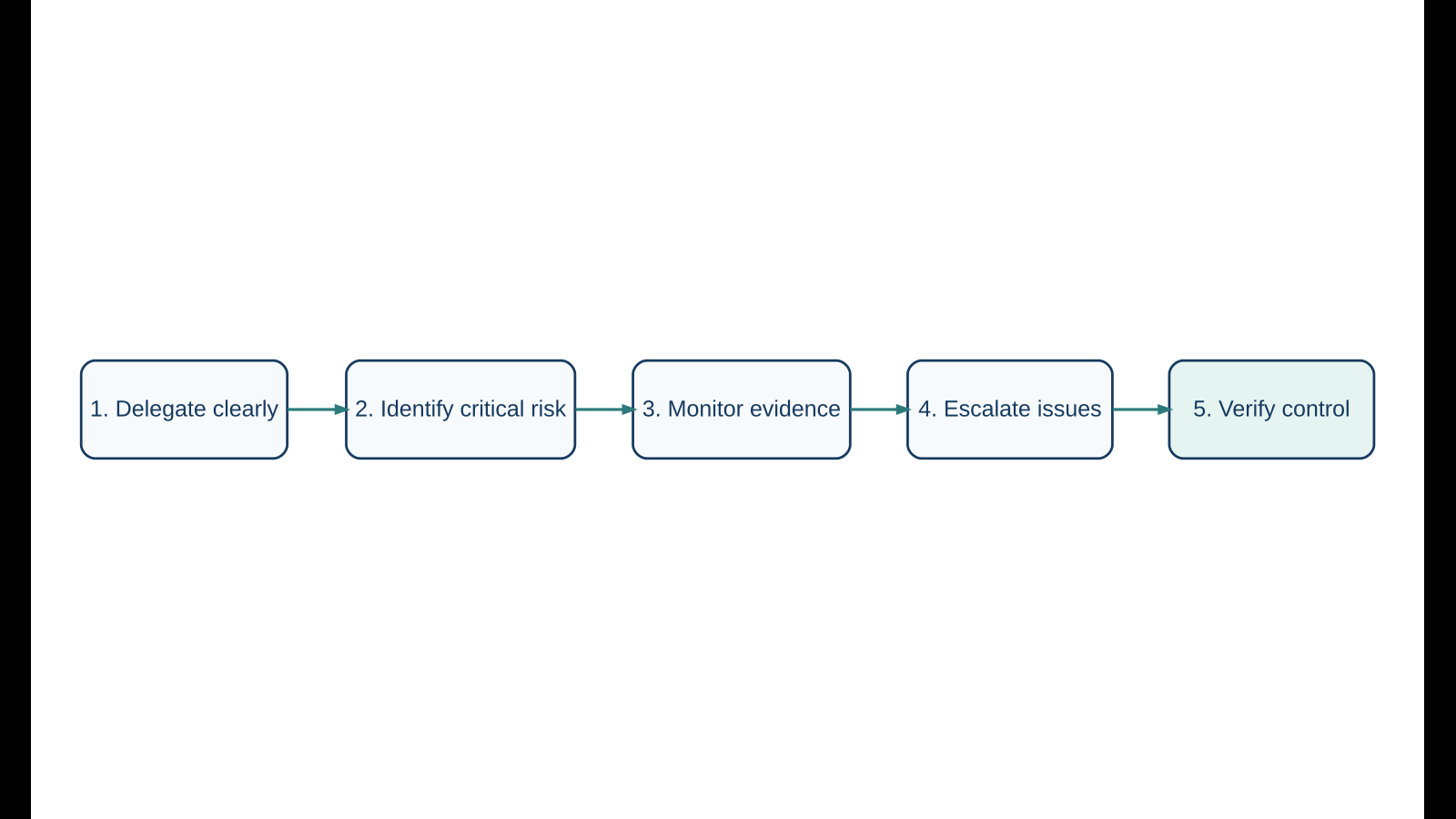
A sponsor oversight checklist should make delegated trial activities, sponsor decision rights, and oversight evidence visible. Aligned with the risk-proportionate approach in ICH E6(R3), this tool focuses on critical-to-quality factors, service-provider performance, and timely escalation.
Quick answer: what should sponsor oversight cover?
- Documented transfer/delegation of activities and responsibilities.
- Qualification and selection of service providers.
- Critical-to-quality factors and risk controls.
- Governance cadence and decision rights.
- Performance and quality indicators.
- Issue, deviation, CAPA, and escalation handling.
- Access to records, data, and trial status.
- Change control, subcontractor awareness, and closeout evidence.
1. Start with a responsibility map
| Activity | Sponsor role | Provider role | Evidence of oversight |
|---|---|---|---|
| Site monitoring | Approve strategy and review performance | Execute monitoring per plan | Metrics, issue review, escalation records |
| Data management | Define expectations and accept key plans | Operate database/data processes | Plan review, query/data-cleaning metrics, issue decisions |
| Safety interfaces | Define reporting/governance expectations | Execute delegated safety activities | Reconciliation, timeliness, escalation evidence |
| TMF | Define filing/quality expectations | Create/maintain delegated records | Completeness/quality review, access and closeout checks |
2. Focus effort on critical-to-quality factors
ICH E6(R3) emphasizes quality by design and proportionate, risk-based approaches. Oversight should therefore be more intensive where failure could affect participant protection or the reliability of trial results, rather than applying the same review depth to every vendor activity.
For sponsors that need hands-on support applying this framework, BioBoston CRO Sponsor Oversight can support the underlying regulatory and cross-functional work.
3. Define evidence, not just meetings
- Approved plans and documented responsibilities.
- Periodic performance/quality review with decisions.
- Issue and escalation logs.
- CAPA and remediation follow-through.
- Audit or targeted verification where risk warrants it.
- Access to essential records and relevant vendor/subcontractor information.
4. Set escalation thresholds before problems occur
| Signal | Example threshold logic | Action |
|---|---|---|
| Recurring protocol deviations | Trend exceeds expected range or repeats after mitigation | Root-cause review and corrective plan |
| Monitoring backlog | Critical visits/reports exceed agreed window | Escalate resourcing and participant/data risk |
| Data-cleaning delay | Critical queries or reconciliations threaten milestone | Recovery plan and milestone reforecast |
| Vendor quality issue | Repeated missed commitments or ineffective CAPA | Executive governance / remediation / replacement assessment |
5. Red flags
- Delegation log exists but nobody reviews performance.
- Metrics are reported without thresholds or decisions.
- Sponsor learns about subcontractors only after an issue.
- Critical issues remain in meeting minutes without owners or due dates.
- Provider systems contain essential records that the sponsor cannot access.
Sponsor oversight evidence gate
- Responsibilities documented.
- Critical risks identified.
- Governance and thresholds defined.
- Performance and quality evidence reviewed.
- Issues/CAPAs tracked to effectiveness.
- Records accessible and retained.
- Changes and subcontracting controlled.
BioBoston CRO Sponsor Oversight support can help build or remediate a documented, risk-based oversight model.