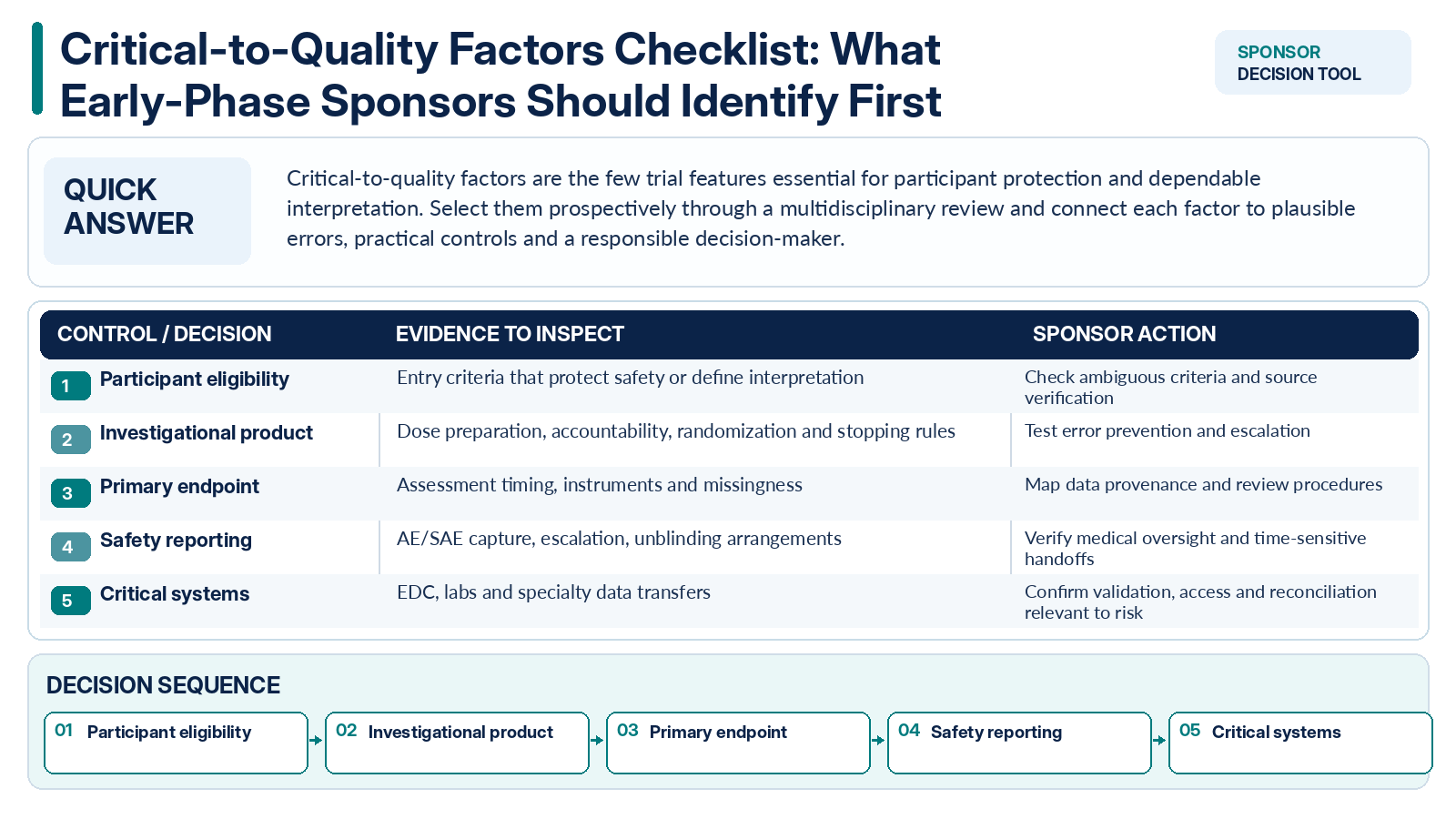
Critical-to-quality factors are the few trial features essential for participant protection and dependable interpretation. Select them prospectively through a multidisciplinary review and connect each factor to plausible errors, practical controls and a responsible decision-maker.
Checklist: controls and supporting evidence
Begin with the most consequential control and the evidence needed to resolve it. The following matrix connects each decision to records and an accountable action, rather than treating the list as a generic compliance checkbox.
| Control / question | Evidence to examine | Sponsor action |
|---|---|---|
| Participant eligibility | Entry criteria that protect safety or define interpretation | Check ambiguous criteria and source verification |
| Investigational product | Dose preparation, accountability, randomization and stopping rules | Test error prevention and escalation |
| Primary endpoint | Assessment timing, instruments and missingness | Map data provenance and review procedures |
| Safety reporting | AE/SAE capture, escalation, unblinding arrangements | Verify medical oversight and time-sensitive handoffs |
| Critical systems | EDC, labs and specialty data transfers | Confirm validation, access and reconciliation relevant to risk |
For teams that need support implementing this across functions, BioBoston CRO Quality Management can help adapt the controls to the study, vendors, and decision calendar.
Working through the controls
1. Participant eligibility
Evidence: Entry criteria that protect safety or define interpretation. Decision: Check ambiguous criteria and source verification. Record the responsible function and the approved source version, and keep any remaining exceptions visible to the sponsor before this item is closed.
2. Investigational product
Evidence: Dose preparation, accountability, randomization and stopping rules. Decision: Test error prevention and escalation. Record the responsible function and the approved source version, and keep any remaining exceptions visible to the sponsor before this item is closed.
3. Primary endpoint
Evidence: Assessment timing, instruments and missingness. Decision: Map data provenance and review procedures. Record the responsible function and the approved source version, and keep any remaining exceptions visible to the sponsor before this item is closed.
4. Safety reporting
Evidence: AE/SAE capture, escalation, unblinding arrangements. Decision: Verify medical oversight and time-sensitive handoffs. Record the responsible function and the approved source version, and keep any remaining exceptions visible to the sponsor before this item is closed.
5. Critical systems
Evidence: EDC, labs and specialty data transfers. Decision: Confirm validation, access and reconciliation relevant to risk. Record the responsible function and the approved source version, and keep any remaining exceptions visible to the sponsor before this item is closed.
Red flags that should change the plan
- Treating every operational metric as CtQ.
- Leaving CtQ factors unlinked to actionable controls.
- Selecting CtQ factors without Clinical and Statistics input.
Decision gate and governance
If a factor has no credible consequence for participant welfare or trial interpretation, consider managing it as normal operations instead of CtQ. The control owner should record the decision, evidence version, date, residual uncertainty and next re-review trigger. Where delegated providers perform the work, the sponsor should retain the relevant oversight and acceptance evidence.
Regulatory note: Applicable regulations, trial commitments and agreements must be distinguished from nonbinding FDA and ICH guidance. Apply this framework to the actual product, jurisdiction and study.
Need practical support?
Use BioBoston CRO Quality Management to review the evidence, define decision rights, and build a study-specific action plan for the next milestone.