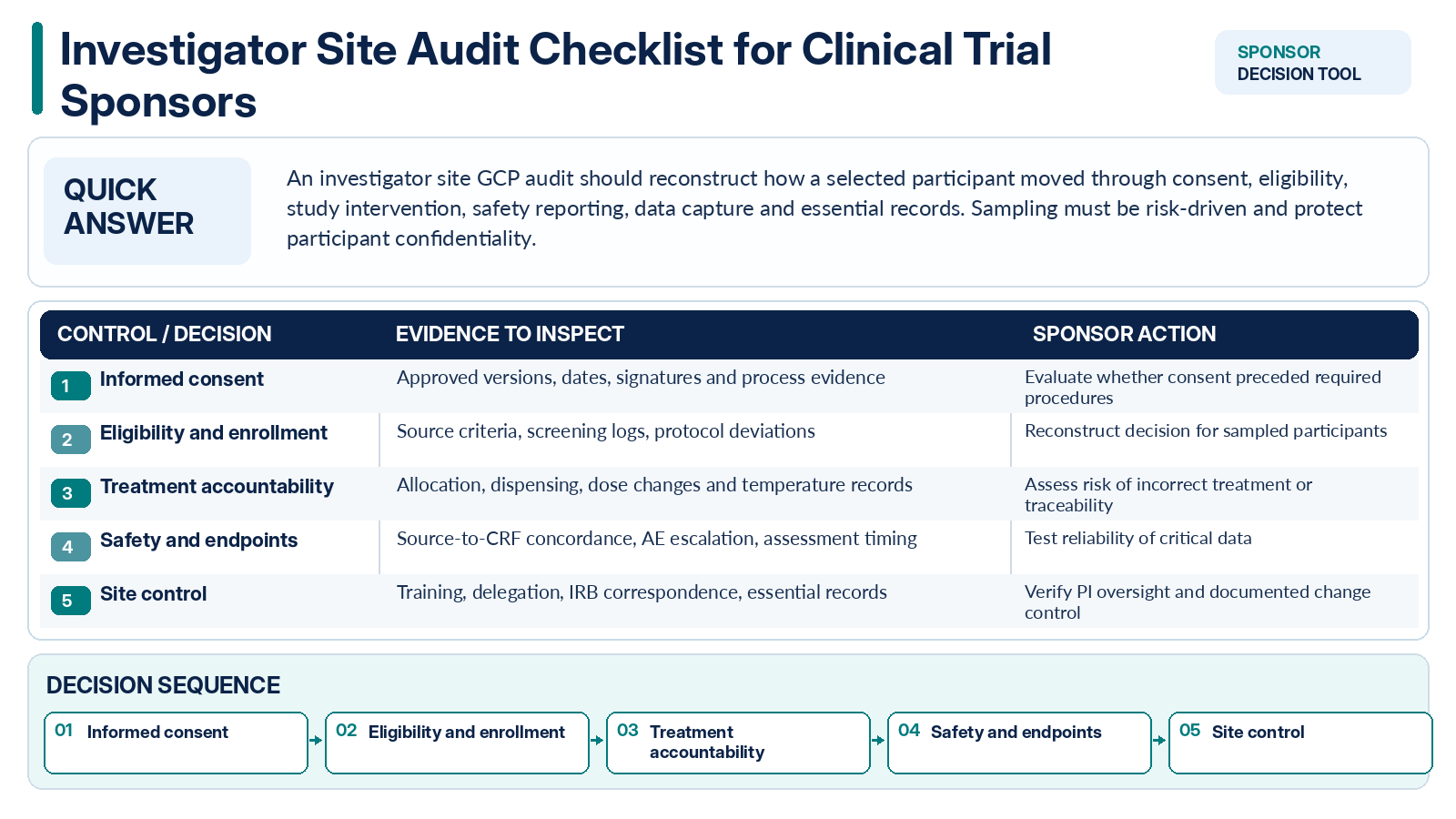
An investigator site GCP audit should reconstruct how a selected participant moved through consent, eligibility, study intervention, safety reporting, data capture and essential records. Sampling must be risk-driven and protect participant confidentiality.
Checklist: controls and supporting evidence
Begin with the most consequential control and the evidence needed to resolve it. The following matrix connects each decision to records and an accountable action, rather than treating the list as a generic compliance checkbox.
| Control / question | Evidence to examine | Sponsor action |
|---|---|---|
| Informed consent | Approved versions, dates, signatures and process evidence | Evaluate whether consent preceded required procedures |
| Eligibility and enrollment | Source criteria, screening logs, protocol deviations | Reconstruct decision for sampled participants |
| Treatment accountability | Allocation, dispensing, dose changes and temperature records | Assess risk of incorrect treatment or traceability |
| Safety and endpoints | Source-to-CRF concordance, AE escalation, assessment timing | Test reliability of critical data |
| Site control | Training, delegation, IRB correspondence, essential records | Verify PI oversight and documented change control |
For teams that need support implementing this across functions, BioBoston CRO GCP Audits can help adapt the controls to the study, vendors, and decision calendar.
Working through the controls
1. Informed consent
Evidence: Approved versions, dates, signatures and process evidence. Decision: Evaluate whether consent preceded required procedures. Record the responsible function and the approved source version, and keep any remaining exceptions visible to the sponsor before this item is closed.
2. Eligibility and enrollment
Evidence: Source criteria, screening logs, protocol deviations. Decision: Reconstruct decision for sampled participants. Record the responsible function and the approved source version, and keep any remaining exceptions visible to the sponsor before this item is closed.
3. Treatment accountability
Evidence: Allocation, dispensing, dose changes and temperature records. Decision: Assess risk of incorrect treatment or traceability. Record the responsible function and the approved source version, and keep any remaining exceptions visible to the sponsor before this item is closed.
4. Safety and endpoints
Evidence: Source-to-CRF concordance, AE escalation, assessment timing. Decision: Test reliability of critical data. Record the responsible function and the approved source version, and keep any remaining exceptions visible to the sponsor before this item is closed.
5. Site control
Evidence: Training, delegation, IRB correspondence, essential records. Decision: Verify PI oversight and documented change control. Record the responsible function and the approved source version, and keep any remaining exceptions visible to the sponsor before this item is closed.
Red flags that should change the plan
- Relying only on completed checklists.
- Selecting only clean participant records.
- Ignoring remote source/system access arrangements.
Decision gate and governance
Summarize each sampled pathway with a concrete evidence citation and distinguish isolated errors from systemic control failures. The control owner should record the decision, evidence version, date, residual uncertainty and next re-review trigger. Where delegated providers perform the work, the sponsor should retain the relevant oversight and acceptance evidence.
Regulatory note: Applicable regulations, trial commitments and agreements must be distinguished from nonbinding FDA and ICH guidance. Apply this framework to the actual product, jurisdiction and study.
Need practical support?
Use BioBoston CRO GCP Audits to review the evidence, define decision rights, and build a study-specific action plan for the next milestone.