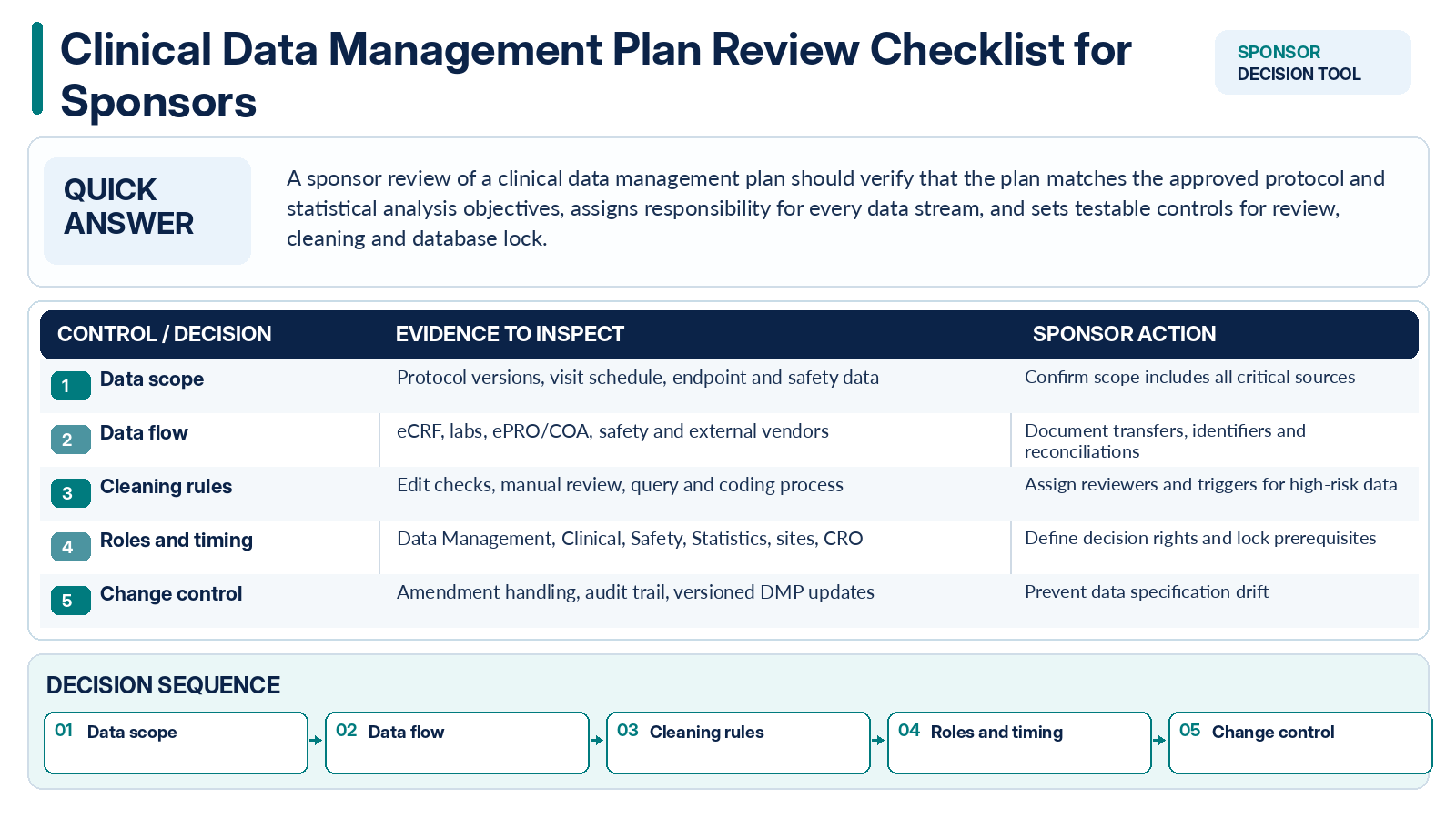
A sponsor review of a clinical data management plan should verify that the plan matches the approved protocol and statistical analysis objectives, assigns responsibility for every data stream, and sets testable controls for review, cleaning and database lock.
Checklist: controls and supporting evidence
Begin with the most consequential control and the evidence needed to resolve it. The following matrix connects each decision to records and an accountable action, rather than treating the list as a generic compliance checkbox.
| Control / question | Evidence to examine | Sponsor action |
|---|---|---|
| Data scope | Protocol versions, visit schedule, endpoint and safety data | Confirm scope includes all critical sources |
| Data flow | eCRF, labs, ePRO/COA, safety and external vendors | Document transfers, identifiers and reconciliations |
| Cleaning rules | Edit checks, manual review, query and coding process | Assign reviewers and triggers for high-risk data |
| Roles and timing | Data Management, Clinical, Safety, Statistics, sites, CRO | Define decision rights and lock prerequisites |
| Change control | Amendment handling, audit trail, versioned DMP updates | Prevent data specification drift |
For teams that need support implementing this across functions, BioBoston CRO Data Management Plan Review can help adapt the controls to the study, vendors, and decision calendar.
Working through the controls
1. Data scope
Evidence: Protocol versions, visit schedule, endpoint and safety data. Decision: Confirm scope includes all critical sources. Record the responsible function and the approved source version, and keep any remaining exceptions visible to the sponsor before this item is closed.
2. Data flow
Evidence: eCRF, labs, ePRO/COA, safety and external vendors. Decision: Document transfers, identifiers and reconciliations. Record the responsible function and the approved source version, and keep any remaining exceptions visible to the sponsor before this item is closed.
3. Cleaning rules
Evidence: Edit checks, manual review, query and coding process. Decision: Assign reviewers and triggers for high-risk data. Record the responsible function and the approved source version, and keep any remaining exceptions visible to the sponsor before this item is closed.
4. Roles and timing
Evidence: Data Management, Clinical, Safety, Statistics, sites, CRO. Decision: Define decision rights and lock prerequisites. Record the responsible function and the approved source version, and keep any remaining exceptions visible to the sponsor before this item is closed.
5. Change control
Evidence: Amendment handling, audit trail, versioned DMP updates. Decision: Prevent data specification drift. Record the responsible function and the approved source version, and keep any remaining exceptions visible to the sponsor before this item is closed.
Red flags that should change the plan
- Copying a vendor standard DMP without protocol fit.
- No owner for external data anomalies.
- Lock criteria undefined.
Decision gate and governance
Ask the team to walk through one endpoint and one SAE from origin to final analysis dataset before approving the DMP. The control owner should record the decision, evidence version, date, residual uncertainty and next re-review trigger. Where delegated providers perform the work, the sponsor should retain the relevant oversight and acceptance evidence.
Regulatory note: Determine which electronic records and signatures are regulated before applying 21 CFR Part 11 controls; FDA guidance supports risk- and intended-use-based implementation.
Need practical support?
Use BioBoston CRO Data Management Plan Review to review the evidence, define decision rights, and build a study-specific action plan for the next milestone.