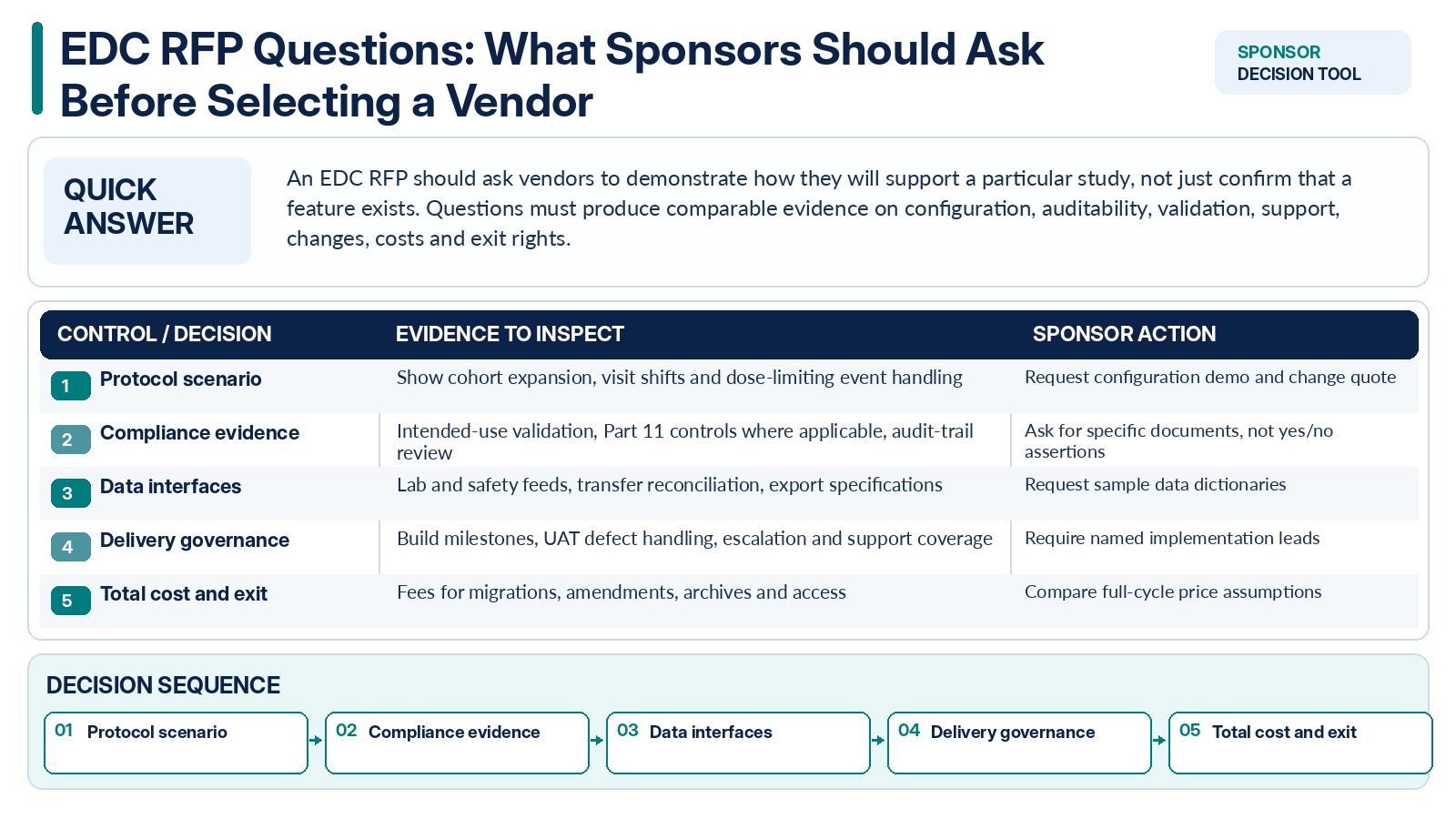
An EDC RFP should ask vendors to demonstrate how they will support a particular study, not just confirm that a feature exists. Questions must produce comparable evidence on configuration, auditability, validation, support, changes, costs and exit rights.
Checklist: controls and supporting evidence
Begin with the most consequential control and the evidence needed to resolve it. The following matrix connects each decision to records and an accountable action, rather than treating the list as a generic compliance checkbox.
| Control / question | Evidence to examine | Sponsor action |
|---|---|---|
| Protocol scenario | Show cohort expansion, visit shifts and dose-limiting event handling | Request configuration demo and change quote |
| Compliance evidence | Intended-use validation, Part 11 controls where applicable, audit-trail review | Ask for specific documents, not yes/no assertions |
| Data interfaces | Lab and safety feeds, transfer reconciliation, export specifications | Request sample data dictionaries |
| Delivery governance | Build milestones, UAT defect handling, escalation and support coverage | Require named implementation leads |
| Total cost and exit | Fees for migrations, amendments, archives and access | Compare full-cycle price assumptions |
For teams that need support implementing this across functions, BioBoston CRO EDC Vendor Qualification can help adapt the controls to the study, vendors, and decision calendar.
Working through the controls
1. Protocol scenario
Evidence: Show cohort expansion, visit shifts and dose-limiting event handling. Decision: Request configuration demo and change quote. Record the responsible function and the approved source version, and keep any remaining exceptions visible to the sponsor before this item is closed.
2. Compliance evidence
Evidence: Intended-use validation, Part 11 controls where applicable, audit-trail review. Decision: Ask for specific documents, not yes/no assertions. Record the responsible function and the approved source version, and keep any remaining exceptions visible to the sponsor before this item is closed.
3. Data interfaces
Evidence: Lab and safety feeds, transfer reconciliation, export specifications. Decision: Request sample data dictionaries. Record the responsible function and the approved source version, and keep any remaining exceptions visible to the sponsor before this item is closed.
4. Delivery governance
Evidence: Build milestones, UAT defect handling, escalation and support coverage. Decision: Require named implementation leads. Record the responsible function and the approved source version, and keep any remaining exceptions visible to the sponsor before this item is closed.
5. Total cost and exit
Evidence: Fees for migrations, amendments, archives and access. Decision: Compare full-cycle price assumptions. Record the responsible function and the approved source version, and keep any remaining exceptions visible to the sponsor before this item is closed.
Red flags that should change the plan
- Unweighted questionnaire with hundreds of generic questions.
- Vendor answers accepted without demonstration.
- Contract silent on post-termination data retrieval.
Decision gate and governance
Give vendors the same realistic study use cases and score the quality of evidence, not marketing adjectives. The control owner should record the decision, evidence version, date, residual uncertainty and next re-review trigger. Where delegated providers perform the work, the sponsor should retain the relevant oversight and acceptance evidence.
Regulatory note: Determine which electronic records and signatures are regulated before applying 21 CFR Part 11 controls; FDA guidance supports risk- and intended-use-based implementation.
Need practical support?
Use BioBoston CRO EDC Vendor Qualification to review the evidence, define decision rights, and build a study-specific action plan for the next milestone.