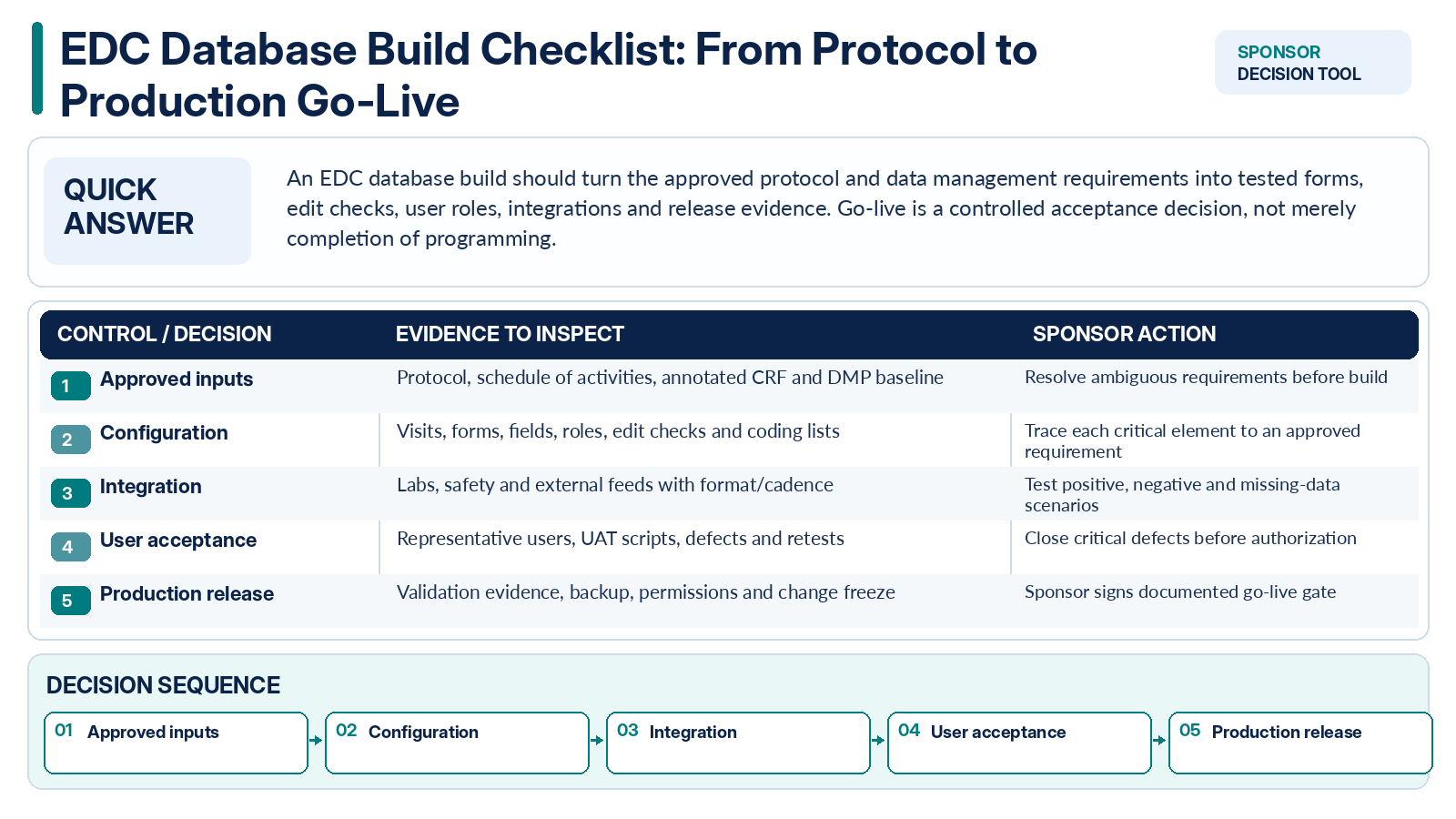
An EDC database build should turn the approved protocol and data management requirements into tested forms, edit checks, user roles, integrations and release evidence. Go-live is a controlled acceptance decision, not merely completion of programming.
Checklist: controls and supporting evidence
Begin with the most consequential control and the evidence needed to resolve it. The following matrix connects each decision to records and an accountable action, rather than treating the list as a generic compliance checkbox.
| Control / question | Evidence to examine | Sponsor action |
|---|---|---|
| Approved inputs | Protocol, schedule of activities, annotated CRF and DMP baseline | Resolve ambiguous requirements before build |
| Configuration | Visits, forms, fields, roles, edit checks and coding lists | Trace each critical element to an approved requirement |
| Integration | Labs, safety and external feeds with format/cadence | Test positive, negative and missing-data scenarios |
| User acceptance | Representative users, UAT scripts, defects and retests | Close critical defects before authorization |
| Production release | Validation evidence, backup, permissions and change freeze | Sponsor signs documented go-live gate |
For teams that need support implementing this across functions, BioBoston CRO EDC Build and Database Design can help adapt the controls to the study, vendors, and decision calendar.
Working through the controls
1. Approved inputs
Evidence: Protocol, schedule of activities, annotated CRF and DMP baseline. Decision: Resolve ambiguous requirements before build. Record the responsible function and the approved source version, and keep any remaining exceptions visible to the sponsor before this item is closed.
2. Configuration
Evidence: Visits, forms, fields, roles, edit checks and coding lists. Decision: Trace each critical element to an approved requirement. Record the responsible function and the approved source version, and keep any remaining exceptions visible to the sponsor before this item is closed.
3. Integration
Evidence: Labs, safety and external feeds with format/cadence. Decision: Test positive, negative and missing-data scenarios. Record the responsible function and the approved source version, and keep any remaining exceptions visible to the sponsor before this item is closed.
4. User acceptance
Evidence: Representative users, UAT scripts, defects and retests. Decision: Close critical defects before authorization. Record the responsible function and the approved source version, and keep any remaining exceptions visible to the sponsor before this item is closed.
5. Production release
Evidence: Validation evidence, backup, permissions and change freeze. Decision: Sponsor signs documented go-live gate. Record the responsible function and the approved source version, and keep any remaining exceptions visible to the sponsor before this item is closed.
Red flags that should change the plan
- Programming against uncontrolled protocol version.
- UAT tests only happy paths.
- Production access enabled before role testing.
Decision gate and governance
Use a requirements-to-test traceability table and release checklist with explicit critical-defect stop conditions. The control owner should record the decision, evidence version, date, residual uncertainty and next re-review trigger. Where delegated providers perform the work, the sponsor should retain the relevant oversight and acceptance evidence.
Regulatory note: Applicable regulations, trial commitments and agreements must be distinguished from nonbinding FDA and ICH guidance. Apply this framework to the actual product, jurisdiction and study.
Need practical support?
Use BioBoston CRO EDC Build and Database Design to review the evidence, define decision rights, and build a study-specific action plan for the next milestone.