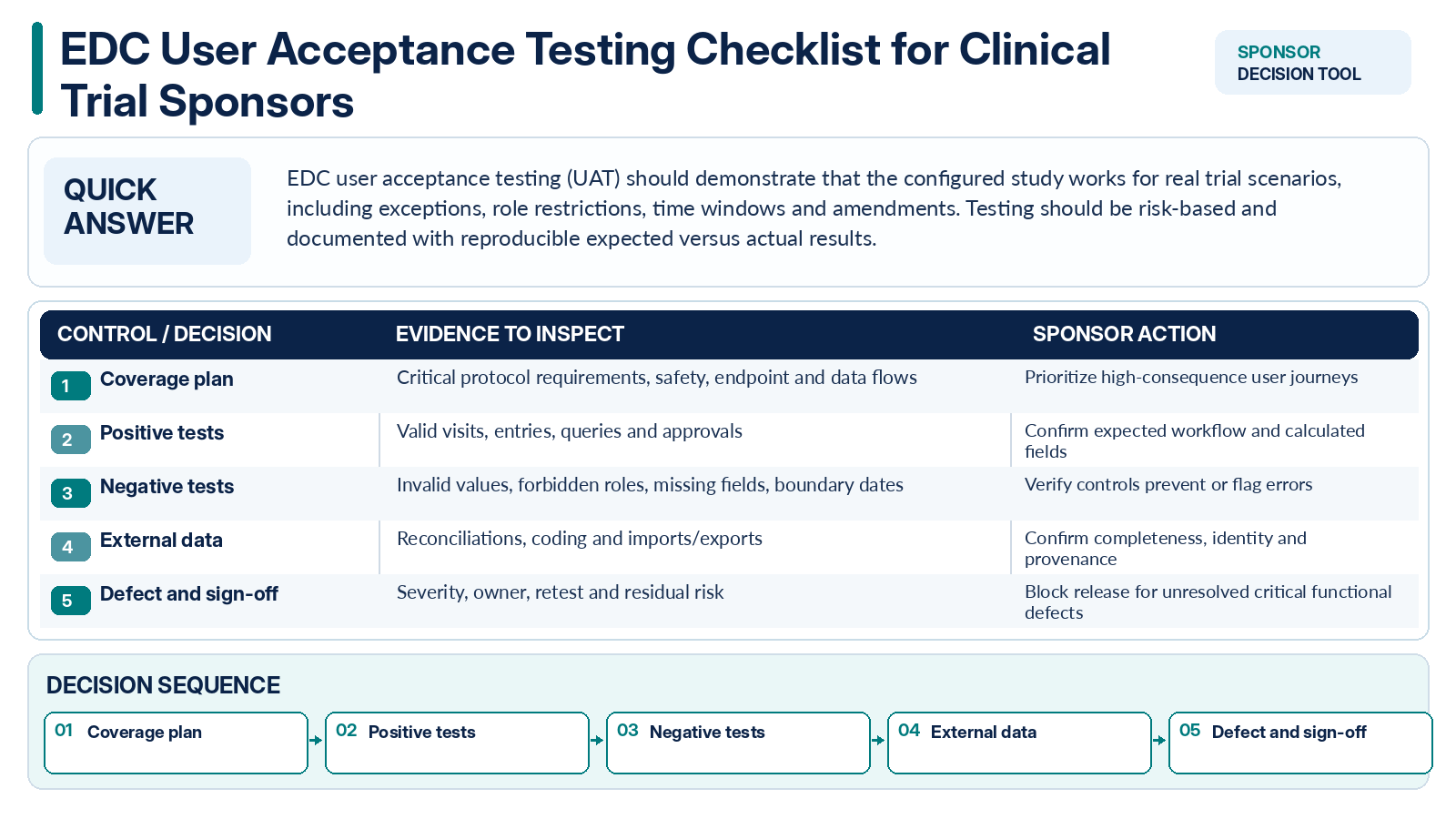
EDC user acceptance testing (UAT) should demonstrate that the configured study works for real trial scenarios, including exceptions, role restrictions, time windows and amendments. Testing should be risk-based and documented with reproducible expected versus actual results.
Checklist: controls and supporting evidence
Begin with the most consequential control and the evidence needed to resolve it. The following matrix connects each decision to records and an accountable action, rather than treating the list as a generic compliance checkbox.
| Control / question | Evidence to examine | Sponsor action |
|---|---|---|
| Coverage plan | Critical protocol requirements, safety, endpoint and data flows | Prioritize high-consequence user journeys |
| Positive tests | Valid visits, entries, queries and approvals | Confirm expected workflow and calculated fields |
| Negative tests | Invalid values, forbidden roles, missing fields, boundary dates | Verify controls prevent or flag errors |
| External data | Reconciliations, coding and imports/exports | Confirm completeness, identity and provenance |
| Defect and sign-off | Severity, owner, retest and residual risk | Block release for unresolved critical functional defects |
For teams that need support implementing this across functions, BioBoston CRO EDC Build and Database Design can help adapt the controls to the study, vendors, and decision calendar.
Working through the controls
1. Coverage plan
Evidence: Critical protocol requirements, safety, endpoint and data flows. Decision: Prioritize high-consequence user journeys. Record the responsible function and the approved source version, and keep any remaining exceptions visible to the sponsor before this item is closed.
2. Positive tests
Evidence: Valid visits, entries, queries and approvals. Decision: Confirm expected workflow and calculated fields. Record the responsible function and the approved source version, and keep any remaining exceptions visible to the sponsor before this item is closed.
3. Negative tests
Evidence: Invalid values, forbidden roles, missing fields, boundary dates. Decision: Verify controls prevent or flag errors. Record the responsible function and the approved source version, and keep any remaining exceptions visible to the sponsor before this item is closed.
4. External data
Evidence: Reconciliations, coding and imports/exports. Decision: Confirm completeness, identity and provenance. Record the responsible function and the approved source version, and keep any remaining exceptions visible to the sponsor before this item is closed.
5. Defect and sign-off
Evidence: Severity, owner, retest and residual risk. Decision: Block release for unresolved critical functional defects. Record the responsible function and the approved source version, and keep any remaining exceptions visible to the sponsor before this item is closed.
Red flags that should change the plan
- Tester only watches vendor demo.
- No evidence of negative test results.
- Waiver of critical defects without sponsor rationale.
Decision gate and governance
Require a test-to-requirement map, retained screenshots/logs and acceptance by sponsor Data Management and clinical owners. The control owner should record the decision, evidence version, date, residual uncertainty and next re-review trigger. Where delegated providers perform the work, the sponsor should retain the relevant oversight and acceptance evidence.
Regulatory note: Applicable regulations, trial commitments and agreements must be distinguished from nonbinding FDA and ICH guidance. Apply this framework to the actual product, jurisdiction and study.
Need practical support?
Use BioBoston CRO EDC Build and Database Design to review the evidence, define decision rights, and build a study-specific action plan for the next milestone.