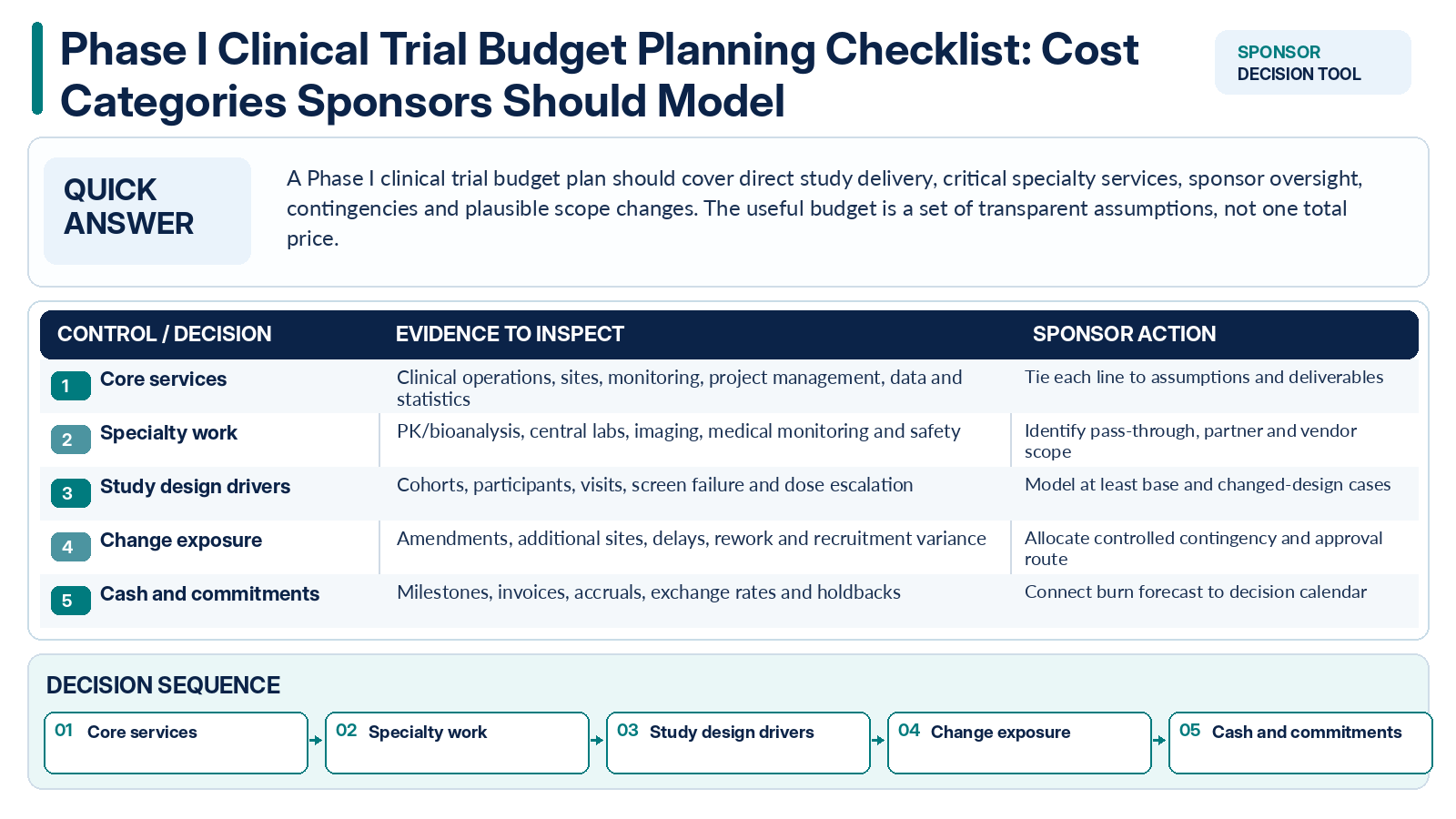
A Phase I clinical trial budget plan should cover direct study delivery, critical specialty services, sponsor oversight, contingencies and plausible scope changes. The useful budget is a set of transparent assumptions, not one total price.
Checklist: controls and supporting evidence
Begin with the most consequential control and the evidence needed to resolve it. The following matrix connects each decision to records and an accountable action, rather than treating the list as a generic compliance checkbox.
| Control / question | Evidence to examine | Sponsor action |
|---|---|---|
| Core services | Clinical operations, sites, monitoring, project management, data and statistics | Tie each line to assumptions and deliverables |
| Specialty work | PK/bioanalysis, central labs, imaging, medical monitoring and safety | Identify pass-through, partner and vendor scope |
| Study design drivers | Cohorts, participants, visits, screen failure and dose escalation | Model at least base and changed-design cases |
| Change exposure | Amendments, additional sites, delays, rework and recruitment variance | Allocate controlled contingency and approval route |
| Cash and commitments | Milestones, invoices, accruals, exchange rates and holdbacks | Connect burn forecast to decision calendar |
For teams that need support implementing this across functions, BioBoston CRO Budget Tracking can help adapt the controls to the study, vendors, and decision calendar.
Working through the controls
1. Core services
Evidence: Clinical operations, sites, monitoring, project management, data and statistics. Decision: Tie each line to assumptions and deliverables. Record the responsible function and the approved source version, and keep any remaining exceptions visible to the sponsor before this item is closed.
2. Specialty work
Evidence: PK/bioanalysis, central labs, imaging, medical monitoring and safety. Decision: Identify pass-through, partner and vendor scope. Record the responsible function and the approved source version, and keep any remaining exceptions visible to the sponsor before this item is closed.
3. Study design drivers
Evidence: Cohorts, participants, visits, screen failure and dose escalation. Decision: Model at least base and changed-design cases. Record the responsible function and the approved source version, and keep any remaining exceptions visible to the sponsor before this item is closed.
4. Change exposure
Evidence: Amendments, additional sites, delays, rework and recruitment variance. Decision: Allocate controlled contingency and approval route. Record the responsible function and the approved source version, and keep any remaining exceptions visible to the sponsor before this item is closed.
5. Cash and commitments
Evidence: Milestones, invoices, accruals, exchange rates and holdbacks. Decision: Connect burn forecast to decision calendar. Record the responsible function and the approved source version, and keep any remaining exceptions visible to the sponsor before this item is closed.
Red flags that should change the plan
- Treating vendor quote as total cost.
- No scope assumptions around cohorts.
- Counting contingency as automatically spendable.
Decision gate and governance
Ask each supplier for assumptions, exclusions, pass-through rules, change fees and decision points before comparing totals. The control owner should record the decision, evidence version, date, residual uncertainty and next re-review trigger. Where delegated providers perform the work, the sponsor should retain the relevant oversight and acceptance evidence.
Scope note: The planning and budget fields above are sponsor-side operating recommendations. They are not FDA-prescribed schedules, prices, or numeric thresholds.
Need practical support?
Use BioBoston CRO Budget Tracking to review the evidence, define decision rights, and build a study-specific action plan for the next milestone.