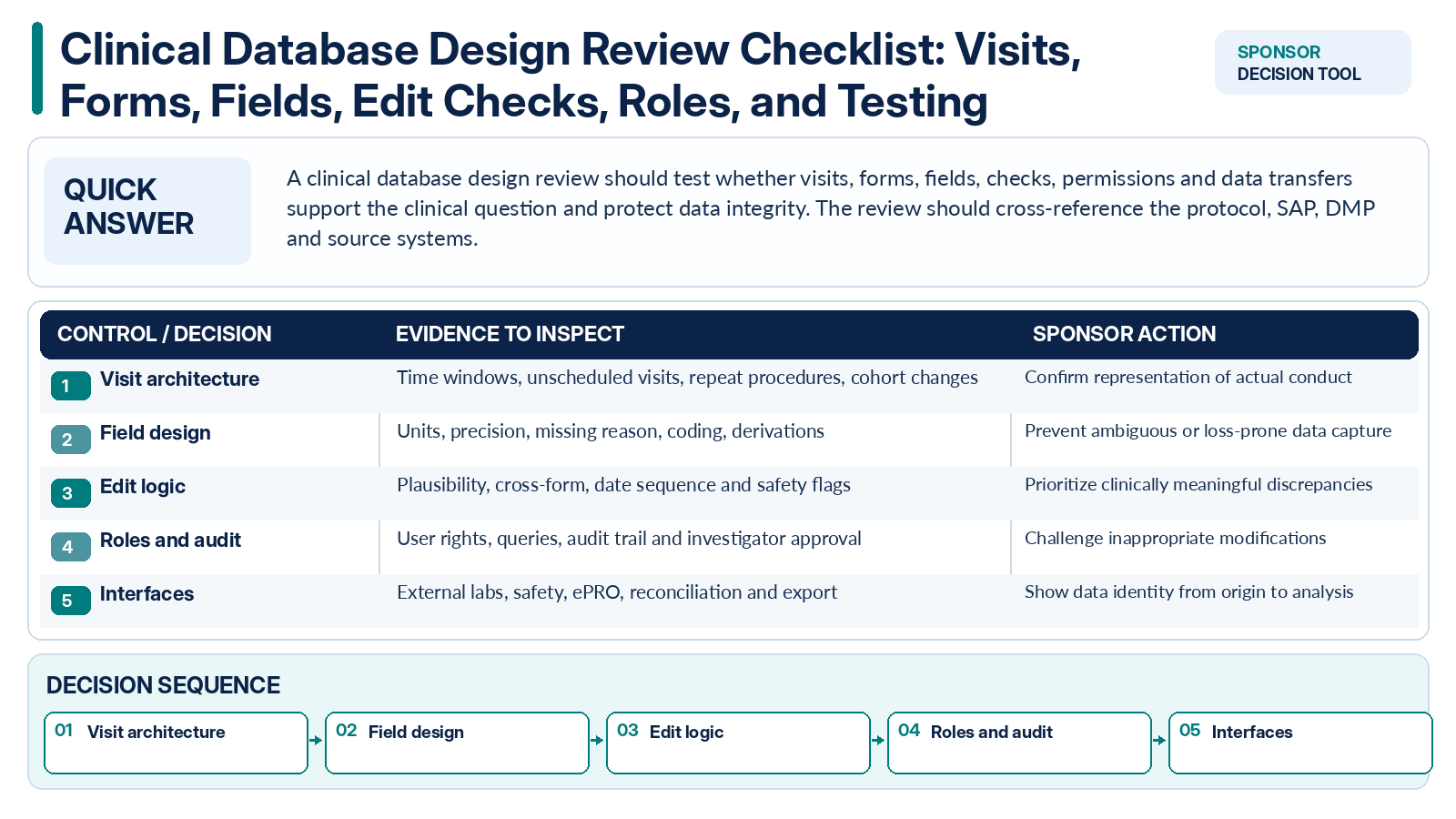
A clinical database design review should test whether visits, forms, fields, checks, permissions and data transfers support the clinical question and protect data integrity. The review should cross-reference the protocol, SAP, DMP and source systems.
Checklist: controls and supporting evidence
Begin with the most consequential control and the evidence needed to resolve it. The following matrix connects each decision to records and an accountable action, rather than treating the list as a generic compliance checkbox.
| Control / question | Evidence to examine | Sponsor action |
|---|---|---|
| Visit architecture | Time windows, unscheduled visits, repeat procedures, cohort changes | Confirm representation of actual conduct |
| Field design | Units, precision, missing reason, coding, derivations | Prevent ambiguous or loss-prone data capture |
| Edit logic | Plausibility, cross-form, date sequence and safety flags | Prioritize clinically meaningful discrepancies |
| Roles and audit | User rights, queries, audit trail and investigator approval | Challenge inappropriate modifications |
| Interfaces | External labs, safety, ePRO, reconciliation and export | Show data identity from origin to analysis |
For teams that need support implementing this across functions, BioBoston CRO EDC Build and Database Design can help adapt the controls to the study, vendors, and decision calendar.
Working through the controls
1. Visit architecture
Evidence: Time windows, unscheduled visits, repeat procedures, cohort changes. Decision: Confirm representation of actual conduct. Record the responsible function and the approved source version, and keep any remaining exceptions visible to the sponsor before this item is closed.
2. Field design
Evidence: Units, precision, missing reason, coding, derivations. Decision: Prevent ambiguous or loss-prone data capture. Record the responsible function and the approved source version, and keep any remaining exceptions visible to the sponsor before this item is closed.
3. Edit logic
Evidence: Plausibility, cross-form, date sequence and safety flags. Decision: Prioritize clinically meaningful discrepancies. Record the responsible function and the approved source version, and keep any remaining exceptions visible to the sponsor before this item is closed.
4. Roles and audit
Evidence: User rights, queries, audit trail and investigator approval. Decision: Challenge inappropriate modifications. Record the responsible function and the approved source version, and keep any remaining exceptions visible to the sponsor before this item is closed.
5. Interfaces
Evidence: External labs, safety, ePRO, reconciliation and export. Decision: Show data identity from origin to analysis. Record the responsible function and the approved source version, and keep any remaining exceptions visible to the sponsor before this item is closed.
Red flags that should change the plan
- One-size forms create excessive entry burden.
- Lost time-zone or unit context.
- No way to capture protocol exceptions.
Decision gate and governance
Test a participant journey end-to-end, including an unexpected event, and ensure every critical field has an identifiable analysis purpose. The control owner should record the decision, evidence version, date, residual uncertainty and next re-review trigger. Where delegated providers perform the work, the sponsor should retain the relevant oversight and acceptance evidence.
Regulatory note: Applicable regulations, trial commitments and agreements must be distinguished from nonbinding FDA and ICH guidance. Apply this framework to the actual product, jurisdiction and study.
Need practical support?
Use BioBoston CRO EDC Build and Database Design to review the evidence, define decision rights, and build a study-specific action plan for the next milestone.