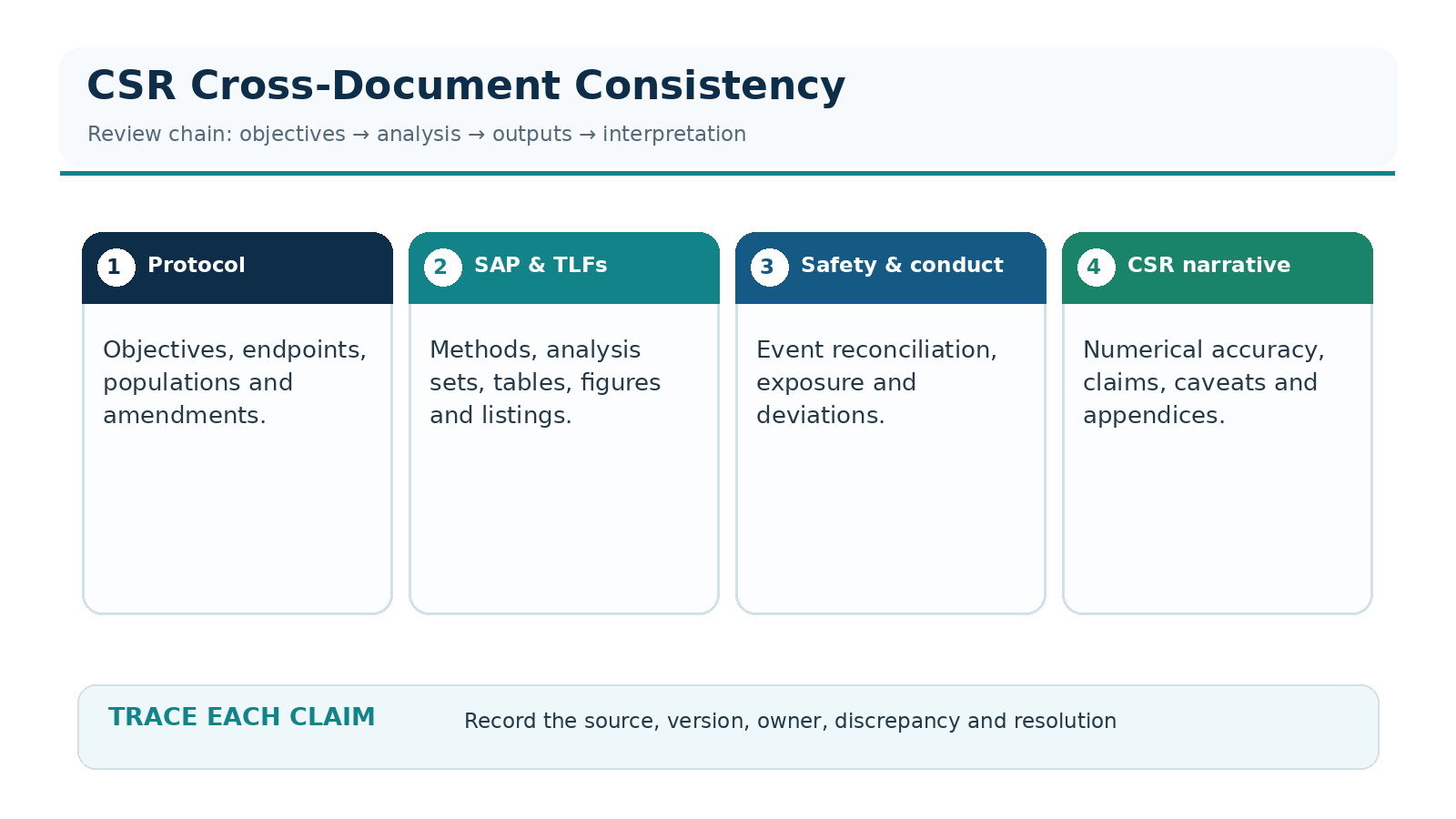
A clinical study report review checklist should test whether the final report tells one scientifically coherent story from the protocol and statistical analysis plan (SAP) through the tables, listings and figures (TLFs), safety data, patient disposition, and conclusions. A grammatical edit is not enough: reviewers need to verify the right source version, data cutoff, denominator, analysis population, and medical interpretation for each important claim.
This is a post-draft, pre-approval QC tool for sponsor Medical Writing, Clinical Development, Biostatistics, Safety and Regulatory Affairs. It complements, rather than duplicates, an authoring-readiness checklist. Its central device is a cross-document discrepancy register that records the claim, controlling source, owner, resolution, and final verification.
Start with a traceability rule
Every material numerical or interpretive statement in a CSR should be traceable to a controlled source and a named reviewer. For a result, that usually means the approved SAP definition and a specific released table, figure or listing. For a safety interpretation, it may also require a validated safety dataset, relevant exposure data, medical review, and adjudicated narratives. Where a result cannot be reproduced, leave it open until the responsible team resolves the issue.
ICH E3 describes an integrated clinical and statistical report; the ICH E3 Q&A confirms that sponsors can adapt its structure. Adaptable structure does not mean optional scientific consistency. Product- and submission-specific regulatory requirements must be assessed separately.
Cross-document CSR quality review matrix
| Consistency check | Source comparison | Owner / action | Hold signal |
|---|---|---|---|
| Protocol objectives | Final approved protocol and amendments vs CSR objectives | Clinical / Medical Writing | Primary endpoint wording has changed |
| Statistical methods | SAP version, estimand, populations vs CSR methods | Statistics | Analysis set or method misstated |
| Efficacy numbers | Released TLF table, population, unit, denominator and footnote | Statistics / Clinical | Results use a prior output version |
| Participant flow | Enrollment, treated and analyzed totals vs flow diagram | Clinical Ops / Data | Counts do not reconcile |
| Exposure | Dose, treatment duration, participants exposed vs safety denominator | Clinical / Safety | AE rates use inconsistent denominator |
| Safety events | Reconciled AE/SAE data, deaths, important events and narratives | Safety / Medical | Case interpretation changes without trace |
| Protocol deviations | Classification, major deviations and impact on analysis | Clinical Ops / Statistics | Deviation total conflicts with study conduct |
| Data changes | Lock, cutoff, post-lock changes and analysis reruns | Data Management | No approved impact assessment |
| Conclusions | All supported results, caveats and limitations | Clinical / Regulatory | Causality or efficacy overstated |
| Appendices | Protocol/SAP versions, outputs, references and listings | Writing / QC | Missing appendix or stale cross-reference |
A five-pass QC process
Pass 1 — Structural and identity check. Verify study identifier, investigational product, indication, population, site list, reporting dates, report status, and document references. Check that the synopsis and body refer to the same analysis cutoff and study status. Mismatched titles may look trivial but signal uncontrolled versions.
Pass 2 — Methods-to-analysis reconciliation. Trace every central objective and endpoint from the final protocol to the SAP and the CSR. Record prespecified analyses, changes, exploratory work, missing data handling and analysis sets. Where a statistical choice changed, explain the reason and impact with the statistician’s approval instead of quietly editing the methods paragraph.
Pass 3 — Quantitative results verification. Select all primary and key secondary results, major safety findings, patient counts, exposure summaries and any decision-critical subgroup results. Compare numbers, units, timepoints, denominators, confidence intervals and footnotes to released output files. Confirm that narrative language matches what was analyzed; a non-significant comparison should not be presented as proof of equivalence.
Pass 4 — Clinical, safety and operational reconciliation. Verify exposure and participant disposition; compare events and narratives with pharmacovigilance records; check protocol deviations, unblinding, interruptions, rescue medication and any operational limitations. Medical reviewers own interpretation, while Medical Writing maintains integrated consistency.
Pass 5 — Finalization controls. Reconcile outstanding comments, establish the final report and appendix versions, confirm that every accepted late change was propagated to the synopsis, results, conclusions and references, then perform independent cross-reference and hyperlink QC. Capture sponsor approval and archive according to the applicable quality system.
Copyable discrepancy and closure log
| Field | Required entry | Why it matters |
|---|---|---|
| Issue ID and severity | Stable identifier; critical / major / editorial | Enables risk-based review |
| CSR location | Section, paragraph, table or appendix | Avoids vague comments |
| Controlling source | File, version, cutoff, table or listing | Enables reproducibility |
| Problem and proposed resolution | Exact discrepancy and proposed correction | Makes the decision auditable |
| Decision owner and date | Statistics, Medical, Safety or sponsor approver | Prevents unowned closure |
| Final check | Revised text, version and verifier | Confirms downstream consistency |
A discrepancy is not closed merely because a reviewer comment has been marked resolved. It is closed when the current report, related sections and controlling evidence agree, or an approved scientific explanation is documented.
Red flags during sponsor approval
Look closely when a table has been regenerated after the last medical review, an AE denominator differs from exposure totals, a synopsis says one population while the methods specify another, or a conclusion relies on an exploratory analysis without qualification. Also flag a missing protocol amendment, an unresolved post-lock change, or a clinical claim whose statistical source cannot be found. These issues can affect interpretation, not just presentation.
For upstream controls, see BioBoston CRO Data Management Plan Review and Clinical Project Management. These services can help establish the evidence and decision chain before the report enters final QC.
Need an independent CSR consistency review?
BioBoston CRO Clinical Study Report Writing support can organize cross-document QC, review and adjudication, source traceability, and a controlled final approval package.