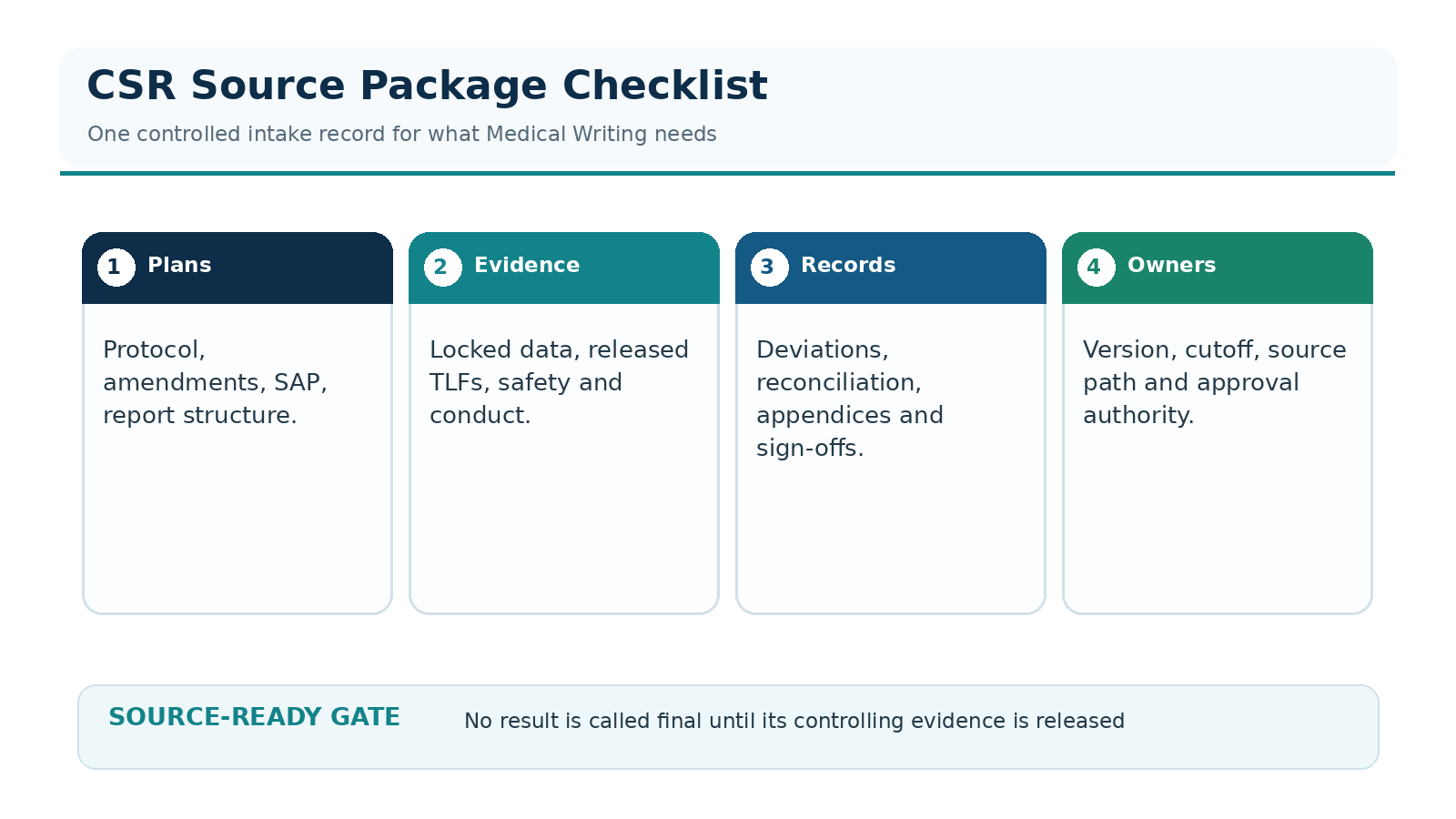
Clinical study report source documents are the approved records and datasets that let a medical writer describe a trial’s design, conduct, analysis, safety, and results without guessing. A good source package is not a folder of every file produced during the study. It is a controlled inventory identifying the authoritative version, data cutoff, scientific owner, and intended CSR use of each source.
This sponsor-side checklist is designed for Medical Writing, Clinical Development, Biostatistics, Safety, Clinical Operations and Data Management teams preparing a CSR. Unlike a general readiness gate, it concentrates on source package intake, document provenance and a reproducible handoff to writers and reviewers.
Build a single source register before requesting files
Assign a source-package coordinator. For every requested file, capture: unique source ID; study and report ID; purpose/CSR destination; current approved title and version; location; data cutoff; owner; status; access permissions; unresolved issue; and last verification date. Distinguish a document that is available from one that is approved for reporting. Writers may use controlled drafts to develop shells, but final claims should use the appropriate released source and approved interpretation.
Maintain separate flags for not applicable, requested, received, quality checked, approved, superseded and blocked. A file should never move to approved solely because it arrived by email. A link to an unversioned shared-drive copy is not sufficient provenance for a critical result.
CSR source package inventory
| Source package group | Required or relevant source | Custodian | Intake check |
|---|---|---|---|
| Protocol | Protocol, approved amendments, synopsis and change chronology | Clinical / Regulatory | Current version and dates reconcile |
| Analysis | SAP, changes, estimands, population definitions, TLF specs | Biostatistics | Methods and population agreement |
| Data | Lock memo, cutoffs, external transfers, reconciliation, data changes | Data Management | Release and traceability confirmed |
| Results | Final TLFs, output index, datasets/program references | Statistics / Programming | Version and QC status recorded |
| Safety | AE/SAE data, coding convention, deaths, key-event narratives, exposure | Safety / Medical | Reconciliation and medical interpretation |
| Conduct | Enrollment, withdrawals, deviations, monitoring and treatment changes | Clinical Operations | Counts and dates match sources |
| Product / investigational plan | Dose, comparator, formulation, regimen and accountability records | Clinical / Supply | Consistent across text and tables |
| Administrative | Investigator/site details, ethics, sponsor contacts, audit trail | Clinical / Quality | Appropriate records available |
| Appendices | Protocol/SAP copies, listings, tables, references and regional items | Writing / Regulatory Ops | Required items identified by intended use |
| Approvals | Review roster, controlled comment log, sign-offs, archive plan | Sponsor / Quality | Sponsor decision authority documented |
Not every item is equally relevant for every study. A simple dose-escalation trial may require a different level of output detail from a large randomized efficacy study. The matrix is a working collection guide, not a blanket claim that every source listed is mandated in the same form for every report.
The five fields writers most often cannot resolve alone
1. Source of numerical truth. An output file may be named “final” while an updated analysis run exists elsewhere. Record approved run IDs, data cutoffs, and a single owner for release.
2. Authorized interpretation. The statistician can verify a number but may not own a clinical conclusion. The clinical or medical owner should approve the interpretation and limitations of findings, including safety and benefit-risk framing as applicable.
3. Study conduct chronology. The final report needs to reflect amended conduct, interruptions, dosing changes and deviations where relevant. Collect decision logs and approved summaries rather than asking a writer to infer intent from raw visit data.
4. Safety case reconciliation. Serious events, deaths, coding changes, narrative versions and exposure denominators must agree with the approved safety source. Record where a medically reviewed narrative can be found and which events require specific discussion.
5. Submission-use decisions. The appendices and level of detail must suit the intended reporting purpose. ICH E3 helps organize report content but is not a rigid template, as confirmed by E3 Q&A (R1). The regulatory owner should specify jurisdiction- or application-specific requirements separately.
A copyable source handoff table
| Source ID | CSR section | Controlled version / cutoff | Owner | Readiness |
|---|---|---|---|---|
| P-001 | Methods / study design | Protocol v[ ], date [ ] | Clinical | Approved / open |
| S-002 | Statistical methods | SAP v[ ], date [ ] | Statistics | Approved / open |
| O-003 | Efficacy / safety outputs | TLF release [ ], cutoff [ ] | Programming | Approved / open |
| M-004 | Safety interpretation | Review memo v[ ], date [ ] | Medical | Approved / open |
| A-005 | Appendices | Inventory v[ ], date [ ] | Regulatory Ops | Approved / open |
The rows above are fill-in placeholders, not a real sponsor data record. Add a column for location and discrepancy ID in the live working spreadsheet, with links to controlled documents rather than unmanaged duplicates.
What to do when a source is missing
Avoid inventing a number, inferring patient disposition, or copying an earlier study’s conclusions. Mark the CSR paragraph or table as blocked, record the responsible owner, set a due date, and determine which other sections depend on the answer. For large reports, prioritize missing items by impact on patient safety, key analysis, interpretation, and regulatory use, not by the volume of files outstanding.
Before the final report freeze, make a snapshot of the approved register and relevant source versions. A later reviewer should be able to reproduce the evidence trail even if vendor systems or personnel change.
For source systems and milestone dependencies, explore Data Management Plan Review and Clinical Project Management support.
Need a controlled CSR source package?
BioBoston CRO Clinical Study Report Writing support can create the source inventory, identify reporting gaps, coordinate clinical and statistical owner reviews, and prepare an auditable handoff to final authoring and approval.