Clinical study report checklist planning should begin before database lock, even when the final efficacy and safety results are not yet available. A sponsor can prepare the report outline, confirm controlled source documents, nominate reviewers, and decide which sections depend on final analysis. The objective is to prevent writers from producing polished text that must be rewritten when the protocol, statistical outputs, or safety interpretation changes.
This sponsor-side checklist is intended for Clinical Development, Medical Writing, Biostatistics, Clinical Operations, and Regulatory Affairs leaders approaching a study reporting milestone. It separates ready to outline, ready for controlled drafting, and ready for final interpretation rather than pretending every document must be final on day one.
Three readiness gates before authoring
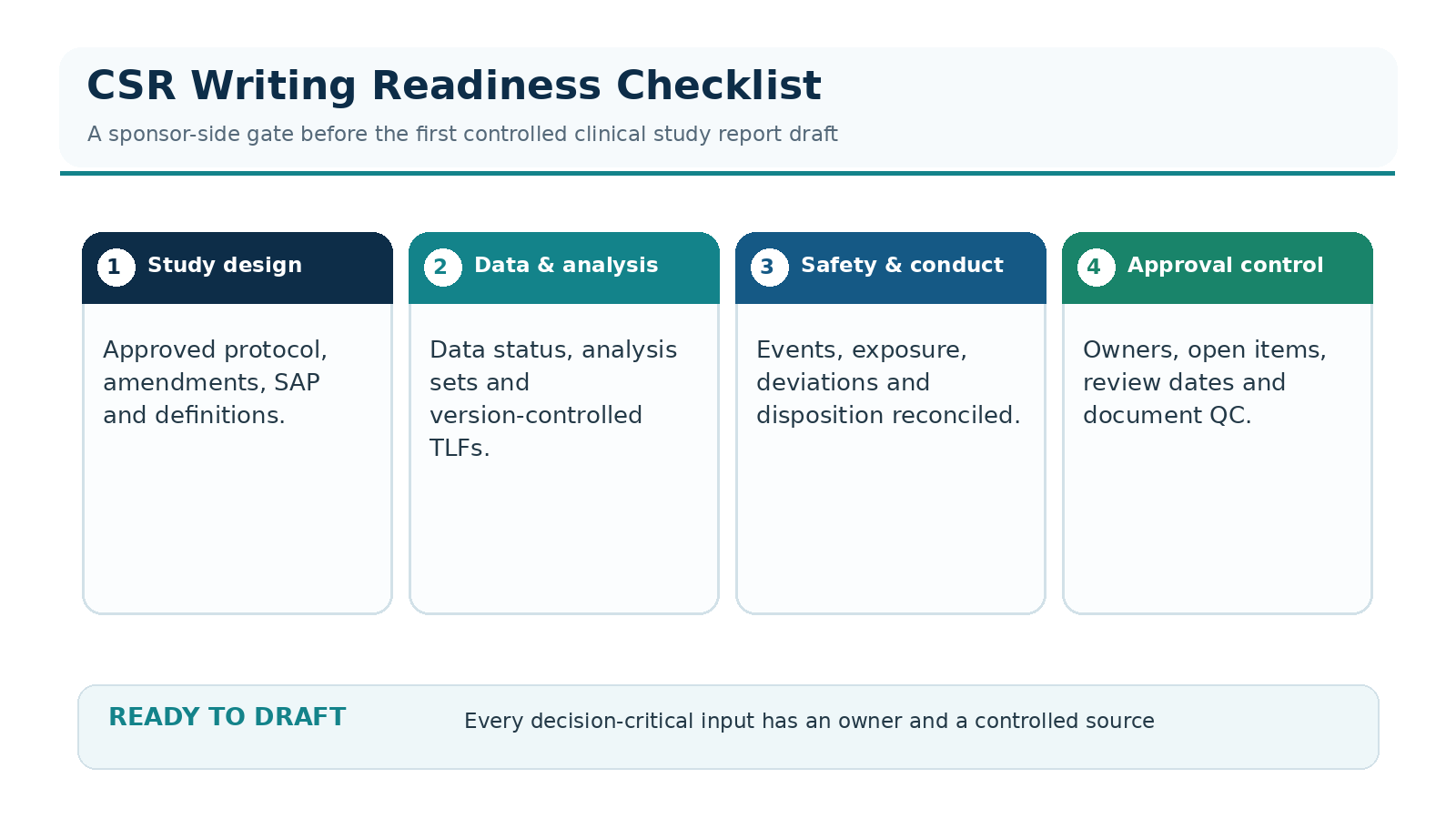
Gate A — Outline ready. Study identifiers, approved protocol and amendments, analysis strategy, report structure, responsibility map, and review calendar have owners. The writer can draft background, design, methods, and administrative sections with clearly identified provisional fields.
Gate B — Results drafting ready. Database status and planned unblinding are understood; the approved SAP and analysis populations are controlled; tables, listings, and figures (TLFs) have an agreed version/release process; medically important safety information is being reconciled. Results may only be described against traceable released data.
Gate C — Sponsor approval ready. Final statistical outputs, source-reconciled safety and conduct narratives, protocol deviations, supporting appendices, and approval comments are resolved. The final report is quality-controlled against its supporting files and the sponsor’s approval process.
These are practical project controls, not three regulatory stages prescribed by ICH.
Clinical study report checklist with ownership and evidence
Use this as a working register. For every row record the controlled evidence location, named owner, version, and target decision date. The red flags identify where the CSR can appear complete while its underlying basis is not stable.
| Workstream / item | Evidence to request | Responsible owner | Red flag / hold |
|---|---|---|---|
| Study design | Approved protocol, all amendments, final study synopsis | Clinical / Regulatory | Current text cites a superseded amendment |
| Analysis specification | Approved SAP, version log, analysis population definitions | Biostatistics | Endpoint or population differs from protocol |
| Database status | Lock/cleaning plan, external-data reconciliation, cutoff memo | Data Management | External labs or safety feeds still unresolved |
| Statistical outputs | TLF inventory, approved shells, final datasets and output version | Biostatistics / Programming | Tables from different runs are mixed |
| Participant disposition | Enrollment, discontinuation, and analysis-set reconciliation | Clinical Operations / Statistics | Counts do not agree across flow and TLFs |
| Exposure and conduct | Dosing, treatment compliance, deviation and rescue-medication records | Clinical Operations | Operational narrative has no source owner |
| Safety | AE/SAE reconciliation, coding versions, deaths and key-event narratives | Pharmacovigilance / Medical | A serious event appears under different terms |
| Efficacy/PK | Endpoint definitions, outputs, approved interpretation and caveats | Clinical / Statistics | Claim outruns prespecified analysis |
| Report mechanics | ICH E3-informed outline, style guide, title-page data, appendices map | Lead writer | Sections created without source or owner |
| Governance | Review rounds, approvers, comment log, escalation and freeze dates | Sponsor PM / Regulatory | No single decision owner for disagreements |
| Quality and archive | QC plan, cross-reference checks, redline, signatures and version history | QC / Regulatory Ops | Last-minute edits bypass independent review |
What the writer can do before database lock
Writers need not wait for final data to contribute. A controlled work package can include an annotated outline, template sections with source citations, study conduct chronology, protocol-amendment history, a preliminary TLF-to-section map, an appendix inventory, a risk register, and a comments workflow. Mark every provisional statement or expected data point explicitly. Do not populate an efficacy or safety conclusion from anticipated results or a prior interim analysis without clear labeling and authorized interpretation.
A practical source-to-section index uses five fields: CSR section; controlling document and version; data cutoff; scientific owner; and current status (available, provisional, blocked, approved). The source index belongs beside the draft and must be refreshed when a source changes. This avoids treating document receipt as evidence of approval.
Cross-functional checks that prevent late rewrites
First, compare objectives and endpoints with the latest protocol and SAP. Confirm primary and secondary analyses, estimands where relevant, populations, data handling, and changes to planned analyses. Second, reconcile participant flow: randomized, treated, analyzed, completed, and withdrawn are distinct counts and should not silently substitute for one another. Third, reconcile safety against coding conventions, adverse-event data, exposure, deaths, serious events, and narrative criteria. Fourth, ensure treatment and protocol-deviation descriptions reflect actual conduct and amendments, not the original plan alone.
An integrated clinical and statistical report is the aim described by ICH E3. Its suggested structure can be adapted to the study; the E3 Q&A makes clear that it is a guideline, not a rigid mandatory template. The sponsor still has to meet the applicable requirements for the intended regulatory use and maintain evidence for every material claim.
If a readiness gate fails
Do not erase the date from the schedule and hope for a quick fix. Record the missing evidence, who can make the decision, what sections are affected, and the latest acceptable date to recover. A frozen methods section may proceed while a safety interpretation remains on hold. Conversely, if the SAP is not reconciled with the protocol, the apparent time saved by drafting results is likely false progress.
For a realistic writing plan, coordinate with BioBoston CRO Clinical Project Management and Data Management Plan Review services. Use the checklist at kickoff, again before first results drafting, and once more before sponsor approval.
Need an organized CSR authoring process?
BioBoston CRO Clinical Study Report Writing support can help build the source inventory, draft/review plan, cross-functional reconciliations, and controlled finalization process for your study.