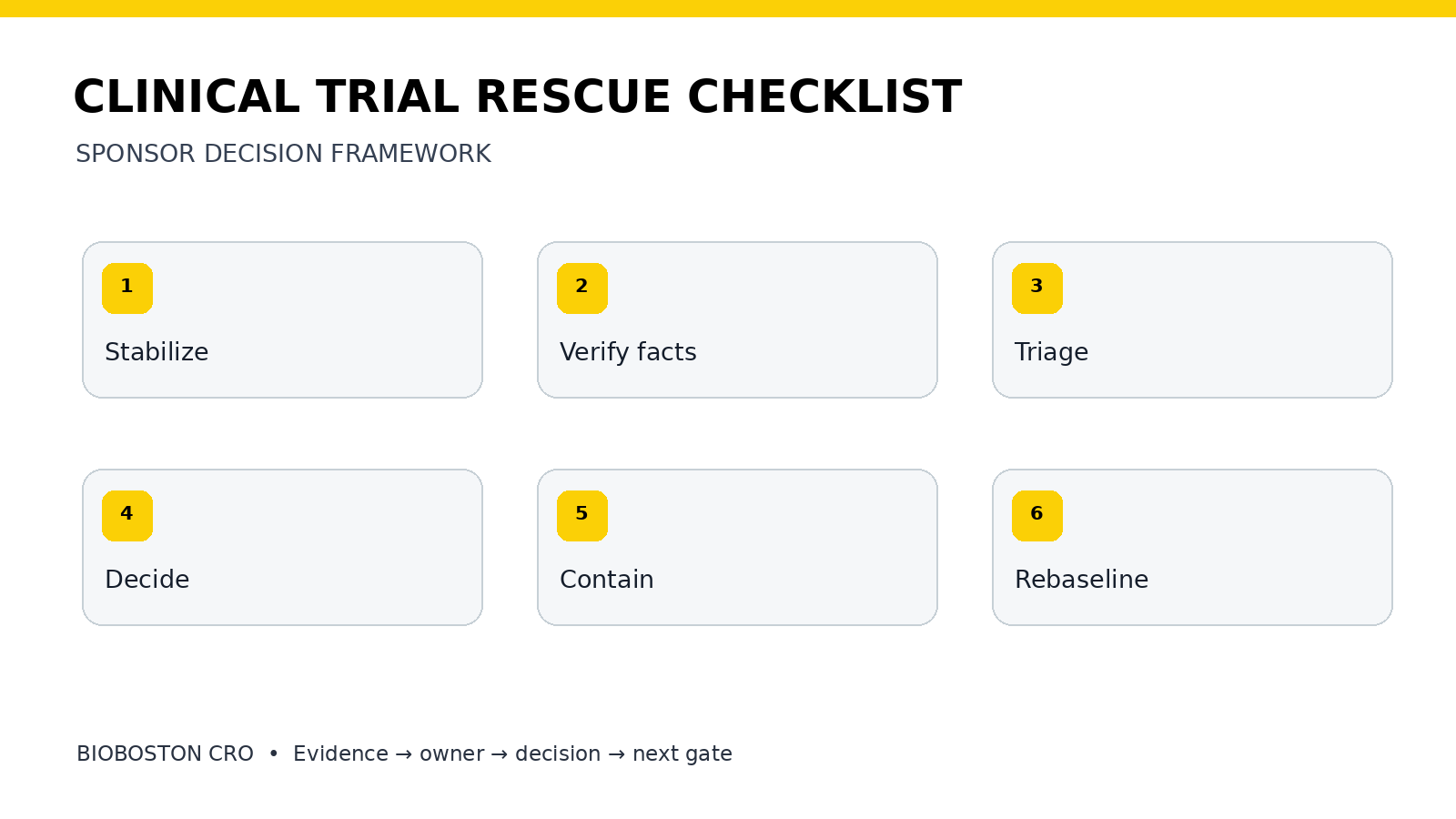
A clinical trial rescue checklist for the first 10 days should stabilize urgent safety or quality issues, recover trustworthy operating data, triage root causes, and establish a sponsor-approved action plan with evidence and decision owners. The sequence below is a practical operating model, not a regulatory deadline.
Why this matters to the sponsor
This checklist is designed for sponsors who have lost confidence in forecasts, vendor performance, enrollment, data cleanliness, quality signals or spending. First establish which matters require immediate escalation independently of the ten-day working plan. Then preserve records, build a common fact base and decide what to repair, replace, or rebaseline.
First 10 days: sponsor triage checklist
| Signal / timing | What to verify | Accountable owner | Evidence / escalation |
|---|---|---|---|
| Day 0–1 | Protect participants, data and essential records; activate urgent pathways as applicable | Sponsor Medical/QA | Safety/quality escalation log and hold decisions |
| Day 1–2 | Secure objective study status from CRO and critical vendors | Clinical PM | Latest plans, issue/risk logs, enrollment and financial data |
| Day 2–3 | Validate critical milestones and unsatisfied predecessors | Clinical Ops/Data | Evidence-based critical path |
| Day 3–4 | Separate confirmed issues, future risks and decisions | Program Lead | Classified triage register with accountable owners |
| Day 4–5 | Review site, enrollment, data, vendor and quality workstreams | Functional SMEs | Finding matrix with impact and source evidence |
| Day 5–6 | Determine whether remediation, augmentation or transition is viable | Sponsor leadership | Options, resourcing, transition risk, costs |
| Day 6–8 | Approve containment and prioritized corrective actions | Authorized sponsor | Signed action list, budget path and due dates |
| Day 8–10 | Agree recovery governance with stakeholders | Clinical PM | Weekly dashboard, escalation thresholds, review cadence |
| Day 10 | Verify first completed evidence and adjust forecast | Sponsor oversight team | Action closeout evidence and next decision gate |
How to put the framework into practice
Make safety and data integrity non-negotiable
A serious signal may require action within hours; do not delay safety, reporting or quality responses to follow a ten-day chart.
Reconstruct what is true
Request read-only or controlled access to relevant source systems; reconcile vendor narrative with records, site feedback and actual dates.
Use a five-domain triage
Evaluate timeline, enrollment/sites, data, quality/safety and finance/vendor capacity. Rank each by significance, controllability, and time to decision.
Assign a decision right
Specify who can approve work, release funds, change vendors or authorize protocol amendments; recommendations do not equal approval.
Retain traceability
Preserve original assumptions and superseded baselines with dated decisions and evidence so the sponsor can explain the rescue sequence.
Illustrative scenario (hypothetical)
Hypothetical: an early-phase study reports enrollment behind plan and clean-data output below target. The sponsor first confirms the accuracy of both measures, checks site activation and query-aging evidence, then selects a supported correction rather than accepting a vague commitment to catch up.
Sponsor action log fields
Issue/risk ID; source evidence; affected milestone; critical-to-quality impact; owner; action due; decision authority; approved recovery option; next verification; status.
Regulatory context and limitations
Clinical program decision-support materials. These matrices are operational examples that require protocol-, jurisdiction-, and study-specific adaptation. ICH E6(R3) is FDA guidance containing nonbinding recommendations; applicable requirements under 21 CFR Part 312 remain binding for covered IND studies. Escalate participant safety, protocol deviations, and data integrity matters through the appropriate established processes rather than waiting for a weekly meeting.
Apply to your program
Make these controls work across teams with BioBoston CRO Trial Rescue Management.
Discuss sponsor-side Clinical trial rescue checklist support