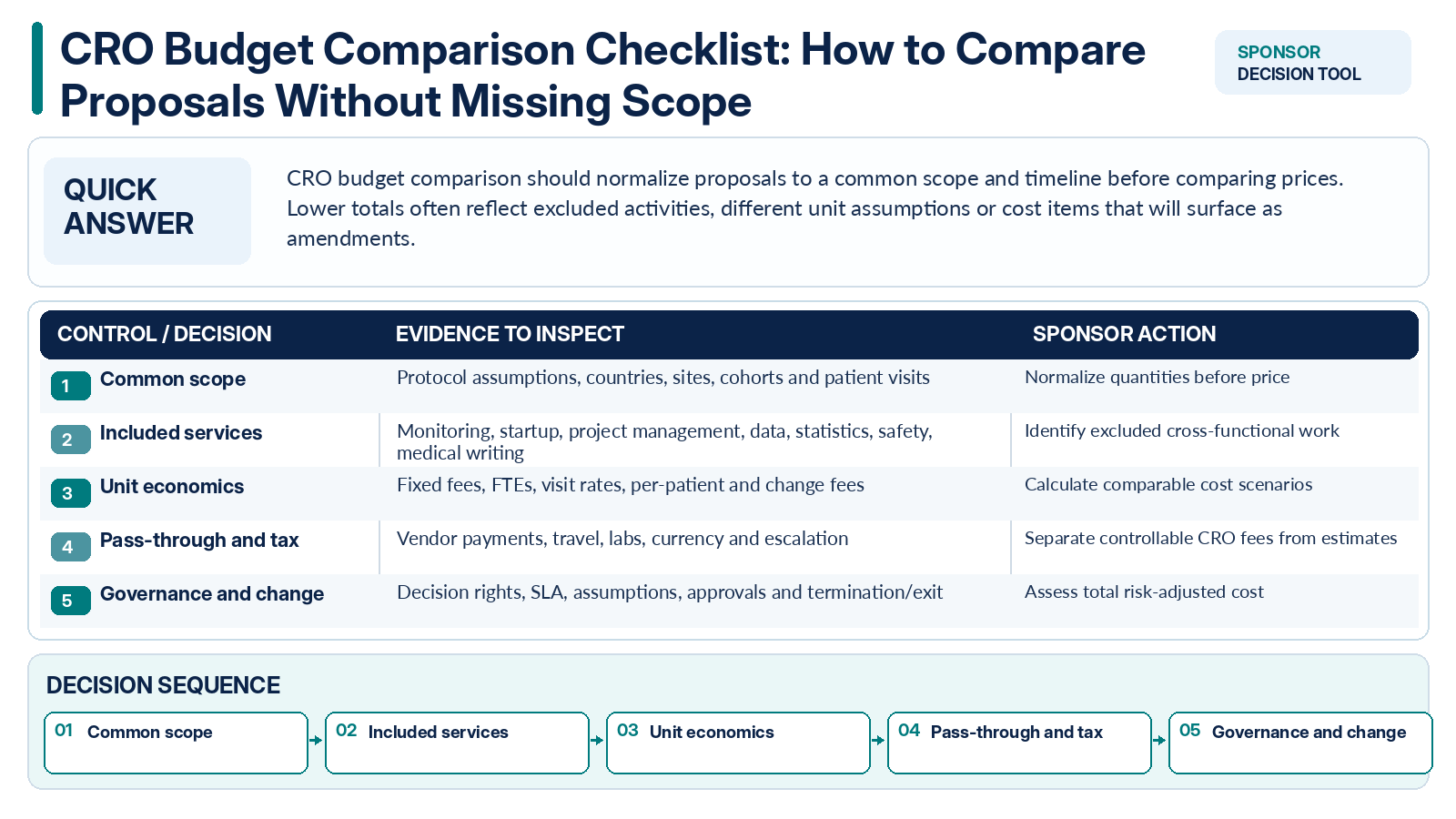
CRO budget comparison should normalize proposals to a common scope and timeline before comparing prices. Lower totals often reflect excluded activities, different unit assumptions or cost items that will surface as amendments.
Checklist: controls and supporting evidence
Begin with the most consequential control and the evidence needed to resolve it. The following matrix connects each decision to records and an accountable action, rather than treating the list as a generic compliance checkbox.
| Control / question | Evidence to examine | Sponsor action |
|---|---|---|
| Common scope | Protocol assumptions, countries, sites, cohorts and patient visits | Normalize quantities before price |
| Included services | Monitoring, startup, project management, data, statistics, safety, medical writing | Identify excluded cross-functional work |
| Unit economics | Fixed fees, FTEs, visit rates, per-patient and change fees | Calculate comparable cost scenarios |
| Pass-through and tax | Vendor payments, travel, labs, currency and escalation | Separate controllable CRO fees from estimates |
| Governance and change | Decision rights, SLA, assumptions, approvals and termination/exit | Assess total risk-adjusted cost |
For teams that need support implementing this across functions, BioBoston CRO Budget Tracking can help adapt the controls to the study, vendors, and decision calendar.
Working through the controls
1. Common scope
Evidence: Protocol assumptions, countries, sites, cohorts and patient visits. Decision: Normalize quantities before price. Record the responsible function and the approved source version, and keep any remaining exceptions visible to the sponsor before this item is closed.
2. Included services
Evidence: Monitoring, startup, project management, data, statistics, safety, medical writing. Decision: Identify excluded cross-functional work. Record the responsible function and the approved source version, and keep any remaining exceptions visible to the sponsor before this item is closed.
3. Unit economics
Evidence: Fixed fees, FTEs, visit rates, per-patient and change fees. Decision: Calculate comparable cost scenarios. Record the responsible function and the approved source version, and keep any remaining exceptions visible to the sponsor before this item is closed.
4. Pass-through and tax
Evidence: Vendor payments, travel, labs, currency and escalation. Decision: Separate controllable CRO fees from estimates. Record the responsible function and the approved source version, and keep any remaining exceptions visible to the sponsor before this item is closed.
5. Governance and change
Evidence: Decision rights, SLA, assumptions, approvals and termination/exit. Decision: Assess total risk-adjusted cost. Record the responsible function and the approved source version, and keep any remaining exceptions visible to the sponsor before this item is closed.
Red flags that should change the plan
- Comparing totals from different protocol versions.
- Omitting sponsor-side staffing.
- Low initial fee with high change-order exposure.
Decision gate and governance
Produce a normalized bid matrix with explicit exclusions and scenario costs, and score delivery risk separately from price. The control owner should record the decision, evidence version, date, residual uncertainty and next re-review trigger. Where delegated providers perform the work, the sponsor should retain the relevant oversight and acceptance evidence.
Scope note: The planning and budget fields above are sponsor-side operating recommendations. They are not FDA-prescribed schedules, prices, or numeric thresholds.
Need practical support?
Use BioBoston CRO Budget Tracking to review the evidence, define decision rights, and build a study-specific action plan for the next milestone.