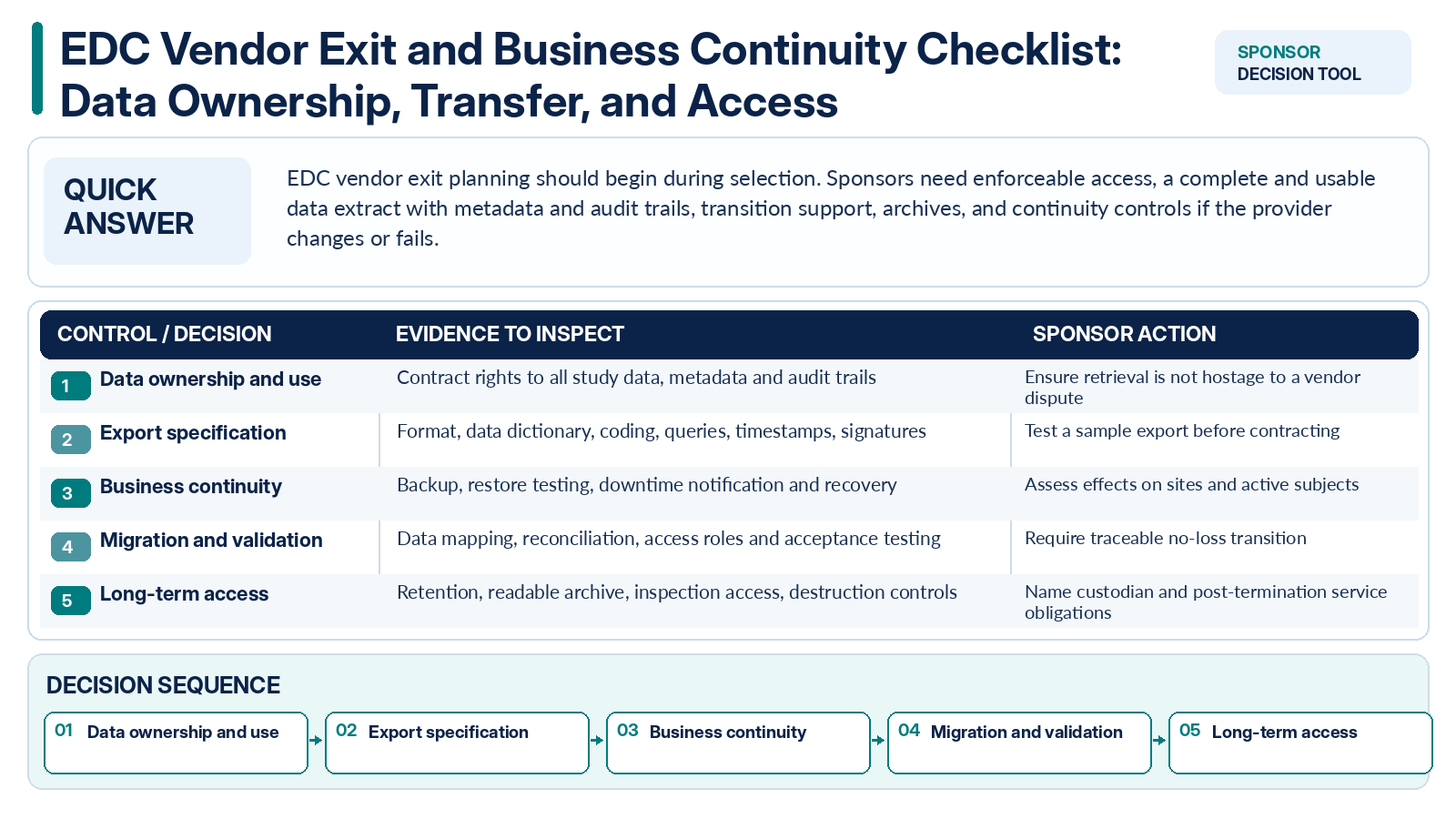
EDC vendor exit planning should begin during selection. Sponsors need enforceable access, a complete and usable data extract with metadata and audit trails, transition support, archives, and continuity controls if the provider changes or fails.
Checklist: controls and supporting evidence
Begin with the most consequential control and the evidence needed to resolve it. The following matrix connects each decision to records and an accountable action, rather than treating the list as a generic compliance checkbox.
| Control / question | Evidence to examine | Sponsor action |
|---|---|---|
| Data ownership and use | Contract rights to all study data, metadata and audit trails | Ensure retrieval is not hostage to a vendor dispute |
| Export specification | Format, data dictionary, coding, queries, timestamps, signatures | Test a sample export before contracting |
| Business continuity | Backup, restore testing, downtime notification and recovery | Assess effects on sites and active subjects |
| Migration and validation | Data mapping, reconciliation, access roles and acceptance testing | Require traceable no-loss transition |
| Long-term access | Retention, readable archive, inspection access, destruction controls | Name custodian and post-termination service obligations |
For teams that need support implementing this across functions, BioBoston CRO EDC Vendor Qualification can help adapt the controls to the study, vendors, and decision calendar.
Working through the controls
1. Data ownership and use
Evidence: Contract rights to all study data, metadata and audit trails. Decision: Ensure retrieval is not hostage to a vendor dispute. Record the responsible function and the approved source version, and keep any remaining exceptions visible to the sponsor before this item is closed.
2. Export specification
Evidence: Format, data dictionary, coding, queries, timestamps, signatures. Decision: Test a sample export before contracting. Record the responsible function and the approved source version, and keep any remaining exceptions visible to the sponsor before this item is closed.
3. Business continuity
Evidence: Backup, restore testing, downtime notification and recovery. Decision: Assess effects on sites and active subjects. Record the responsible function and the approved source version, and keep any remaining exceptions visible to the sponsor before this item is closed.
4. Migration and validation
Evidence: Data mapping, reconciliation, access roles and acceptance testing. Decision: Require traceable no-loss transition. Record the responsible function and the approved source version, and keep any remaining exceptions visible to the sponsor before this item is closed.
5. Long-term access
Evidence: Retention, readable archive, inspection access, destruction controls. Decision: Name custodian and post-termination service obligations. Record the responsible function and the approved source version, and keep any remaining exceptions visible to the sponsor before this item is closed.
Red flags that should change the plan
- Assuming CSV export alone preserves full provenance.
- No documented recovery exercise.
- Subscription lapse deletes access to essential records.
Decision gate and governance
Use a contractual exit acceptance checklist and run a simulated extraction before production go-live. The control owner should record the decision, evidence version, date, residual uncertainty and next re-review trigger. Where delegated providers perform the work, the sponsor should retain the relevant oversight and acceptance evidence.
Regulatory note: Determine which electronic records and signatures are regulated before applying 21 CFR Part 11 controls; FDA guidance supports risk- and intended-use-based implementation.
Need practical support?
Use BioBoston CRO EDC Vendor Qualification to review the evidence, define decision rights, and build a study-specific action plan for the next milestone.