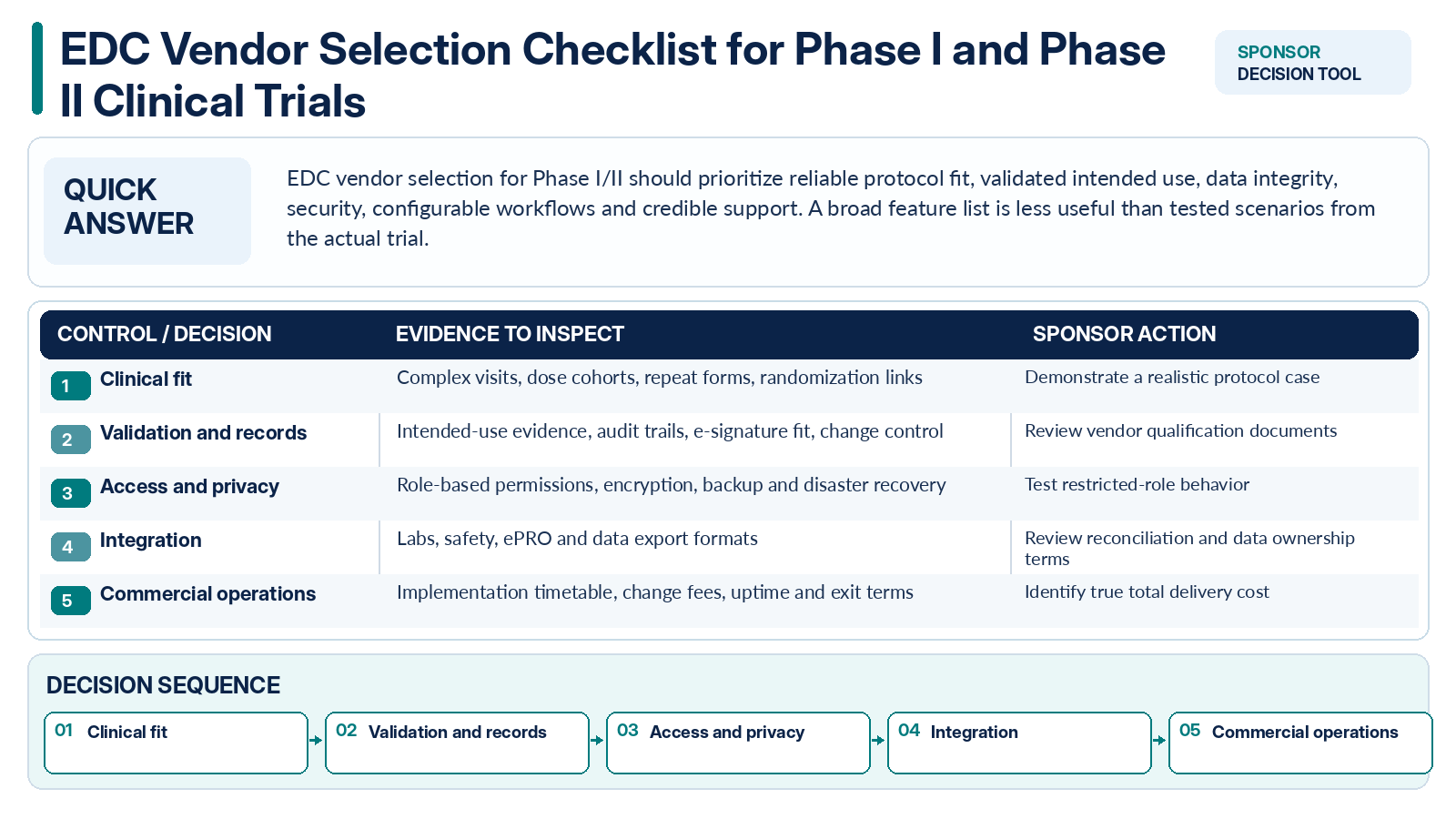
EDC vendor selection for Phase I/II should prioritize reliable protocol fit, validated intended use, data integrity, security, configurable workflows and credible support. A broad feature list is less useful than tested scenarios from the actual trial.
Checklist: controls and supporting evidence
Begin with the most consequential control and the evidence needed to resolve it. The following matrix connects each decision to records and an accountable action, rather than treating the list as a generic compliance checkbox.
| Control / question | Evidence to examine | Sponsor action |
|---|---|---|
| Clinical fit | Complex visits, dose cohorts, repeat forms, randomization links | Demonstrate a realistic protocol case |
| Validation and records | Intended-use evidence, audit trails, e-signature fit, change control | Review vendor qualification documents |
| Access and privacy | Role-based permissions, encryption, backup and disaster recovery | Test restricted-role behavior |
| Integration | Labs, safety, ePRO and data export formats | Review reconciliation and data ownership terms |
| Commercial operations | Implementation timetable, change fees, uptime and exit terms | Identify true total delivery cost |
For teams that need support implementing this across functions, BioBoston CRO EDC Vendor Qualification can help adapt the controls to the study, vendors, and decision calendar.
Working through the controls
1. Clinical fit
Evidence: Complex visits, dose cohorts, repeat forms, randomization links. Decision: Demonstrate a realistic protocol case. Record the responsible function and the approved source version, and keep any remaining exceptions visible to the sponsor before this item is closed.
2. Validation and records
Evidence: Intended-use evidence, audit trails, e-signature fit, change control. Decision: Review vendor qualification documents. Record the responsible function and the approved source version, and keep any remaining exceptions visible to the sponsor before this item is closed.
3. Access and privacy
Evidence: Role-based permissions, encryption, backup and disaster recovery. Decision: Test restricted-role behavior. Record the responsible function and the approved source version, and keep any remaining exceptions visible to the sponsor before this item is closed.
4. Integration
Evidence: Labs, safety, ePRO and data export formats. Decision: Review reconciliation and data ownership terms. Record the responsible function and the approved source version, and keep any remaining exceptions visible to the sponsor before this item is closed.
5. Commercial operations
Evidence: Implementation timetable, change fees, uptime and exit terms. Decision: Identify true total delivery cost. Record the responsible function and the approved source version, and keep any remaining exceptions visible to the sponsor before this item is closed.
Red flags that should change the plan
- Buying based on interface demos.
- No sponsor access to audit trails.
- Hidden export or amendment fees.
Decision gate and governance
Score evidence from a scripted vendor demonstration and require a usable data-export sample before final selection. The control owner should record the decision, evidence version, date, residual uncertainty and next re-review trigger. Where delegated providers perform the work, the sponsor should retain the relevant oversight and acceptance evidence.
Regulatory note: Determine which electronic records and signatures are regulated before applying 21 CFR Part 11 controls; FDA guidance supports risk- and intended-use-based implementation.
Need practical support?
Use BioBoston CRO EDC Vendor Qualification to review the evidence, define decision rights, and build a study-specific action plan for the next milestone.