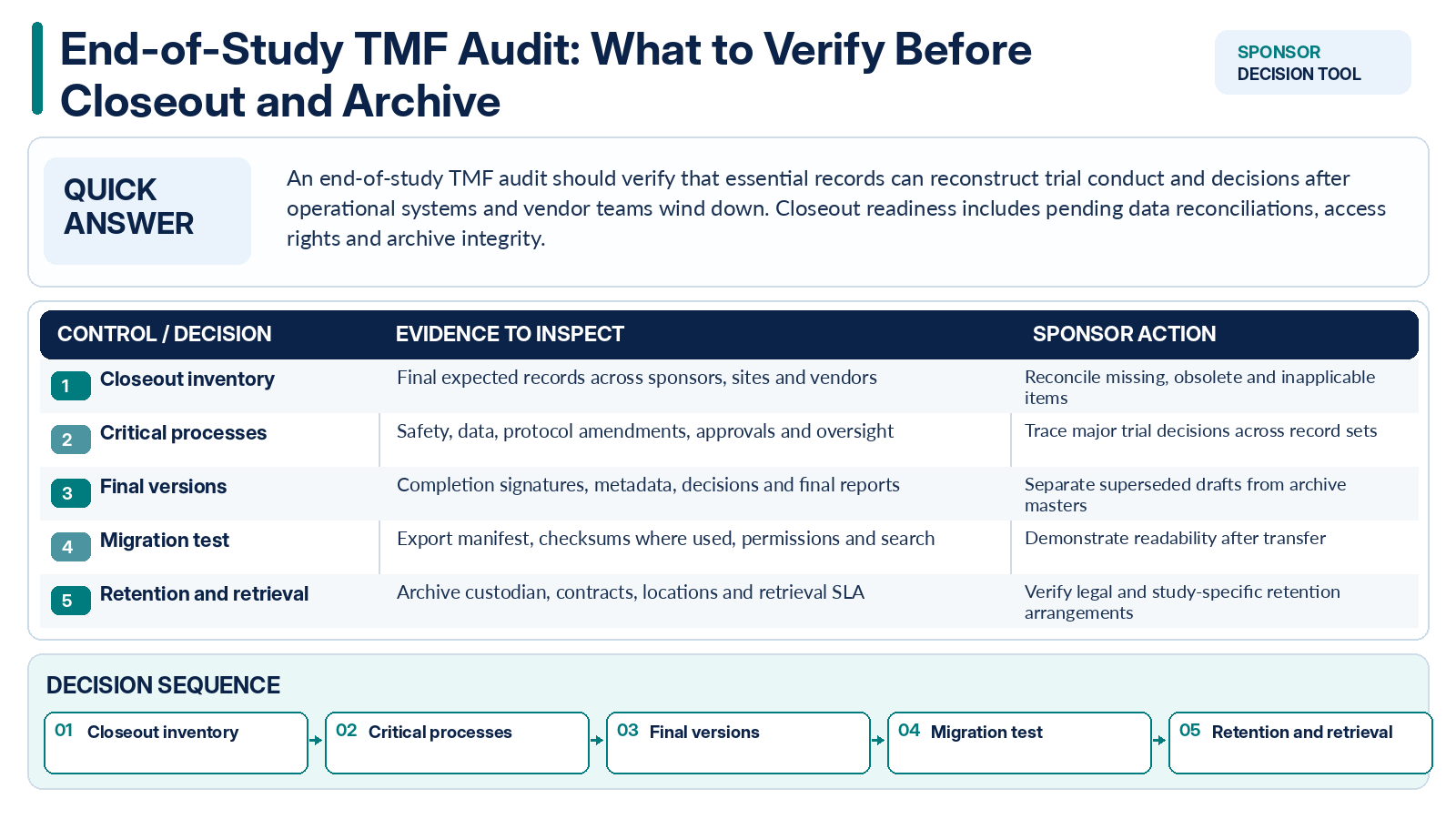
An end-of-study TMF audit should verify that essential records can reconstruct trial conduct and decisions after operational systems and vendor teams wind down. Closeout readiness includes pending data reconciliations, access rights and archive integrity.
Checklist: controls and supporting evidence
Begin with the most consequential control and the evidence needed to resolve it. The following matrix connects each decision to records and an accountable action, rather than treating the list as a generic compliance checkbox.
| Control / question | Evidence to examine | Sponsor action |
|---|---|---|
| Closeout inventory | Final expected records across sponsors, sites and vendors | Reconcile missing, obsolete and inapplicable items |
| Critical processes | Safety, data, protocol amendments, approvals and oversight | Trace major trial decisions across record sets |
| Final versions | Completion signatures, metadata, decisions and final reports | Separate superseded drafts from archive masters |
| Migration test | Export manifest, checksums where used, permissions and search | Demonstrate readability after transfer |
| Retention and retrieval | Archive custodian, contracts, locations and retrieval SLA | Verify legal and study-specific retention arrangements |
For teams that need support implementing this across functions, BioBoston CRO TMF Audits can help adapt the controls to the study, vendors, and decision calendar.
Working through the controls
1. Closeout inventory
Evidence: Final expected records across sponsors, sites and vendors. Decision: Reconcile missing, obsolete and inapplicable items. Record the responsible function and the approved source version, and keep any remaining exceptions visible to the sponsor before this item is closed.
2. Critical processes
Evidence: Safety, data, protocol amendments, approvals and oversight. Decision: Trace major trial decisions across record sets. Record the responsible function and the approved source version, and keep any remaining exceptions visible to the sponsor before this item is closed.
3. Final versions
Evidence: Completion signatures, metadata, decisions and final reports. Decision: Separate superseded drafts from archive masters. Record the responsible function and the approved source version, and keep any remaining exceptions visible to the sponsor before this item is closed.
4. Migration test
Evidence: Export manifest, checksums where used, permissions and search. Decision: Demonstrate readability after transfer. Record the responsible function and the approved source version, and keep any remaining exceptions visible to the sponsor before this item is closed.
5. Retention and retrieval
Evidence: Archive custodian, contracts, locations and retrieval SLA. Decision: Verify legal and study-specific retention arrangements. Record the responsible function and the approved source version, and keep any remaining exceptions visible to the sponsor before this item is closed.
Red flags that should change the plan
- Shutting down systems before export validation.
- Losing audit trails or document relationships.
- Relying on a single person for archive access.
Decision gate and governance
Treat closeout as an acceptance gate: Quality, TMF operations and sponsor owner approve the retrievable archive, not simply a percentage filed. The control owner should record the decision, evidence version, date, residual uncertainty and next re-review trigger. Where delegated providers perform the work, the sponsor should retain the relevant oversight and acceptance evidence.
Regulatory note: Applicable regulations, trial commitments and agreements must be distinguished from nonbinding FDA and ICH guidance. Apply this framework to the actual product, jurisdiction and study.
Need practical support?
Use BioBoston CRO TMF Audits to review the evidence, define decision rights, and build a study-specific action plan for the next milestone.