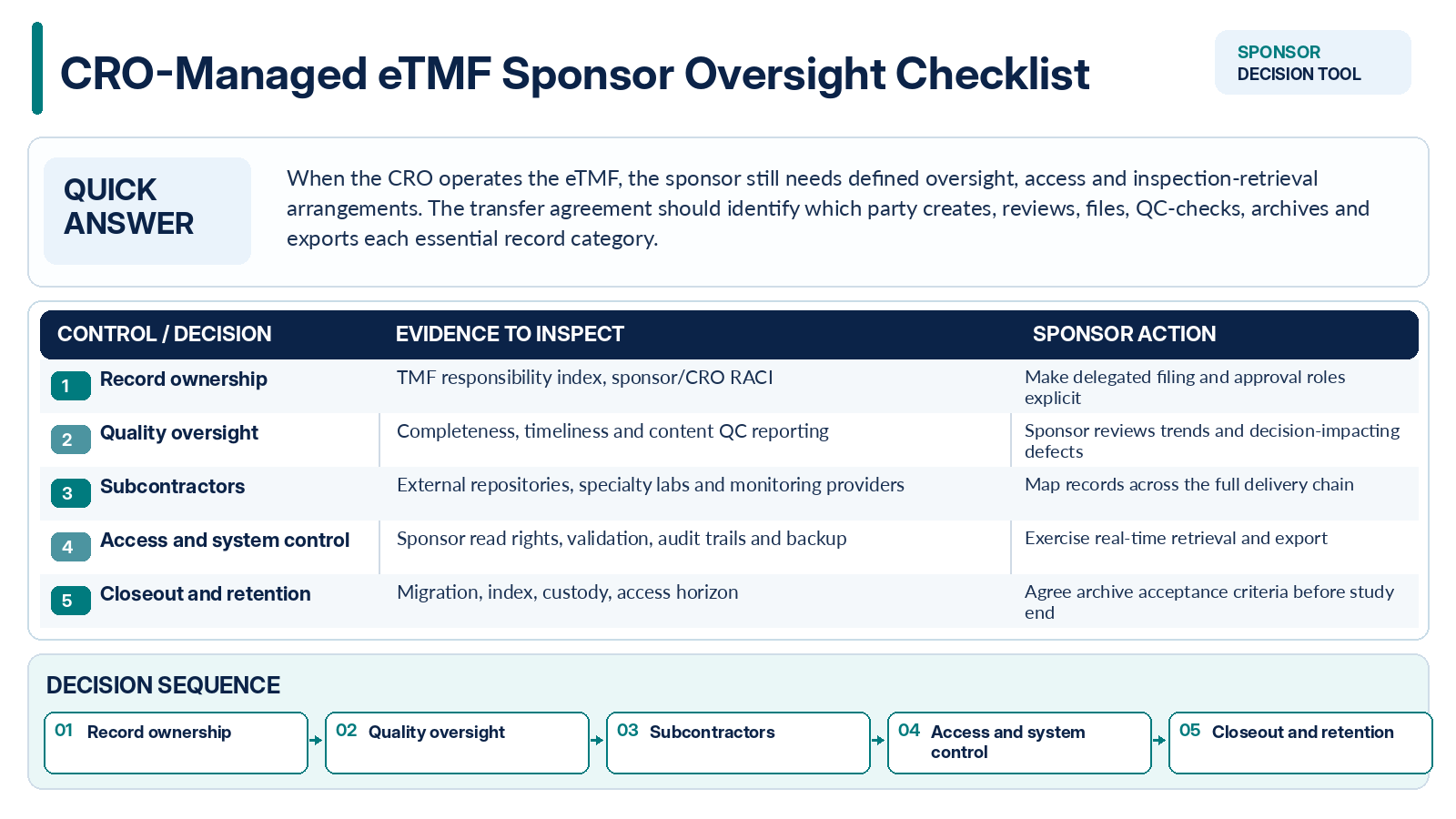
When the CRO operates the eTMF, the sponsor still needs defined oversight, access and inspection-retrieval arrangements. The transfer agreement should identify which party creates, reviews, files, QC-checks, archives and exports each essential record category.
Checklist: controls and supporting evidence
Begin with the most consequential control and the evidence needed to resolve it. The following matrix connects each decision to records and an accountable action, rather than treating the list as a generic compliance checkbox.
| Control / question | Evidence to examine | Sponsor action |
|---|---|---|
| Record ownership | TMF responsibility index, sponsor/CRO RACI | Make delegated filing and approval roles explicit |
| Quality oversight | Completeness, timeliness and content QC reporting | Sponsor reviews trends and decision-impacting defects |
| Subcontractors | External repositories, specialty labs and monitoring providers | Map records across the full delivery chain |
| Access and system control | Sponsor read rights, validation, audit trails and backup | Exercise real-time retrieval and export |
| Closeout and retention | Migration, index, custody, access horizon | Agree archive acceptance criteria before study end |
For teams that need support implementing this across functions, BioBoston CRO TMF Audits can help adapt the controls to the study, vendors, and decision calendar.
Working through the controls
1. Record ownership
Evidence: TMF responsibility index, sponsor/CRO RACI. Decision: Make delegated filing and approval roles explicit. Record the responsible function and the approved source version, and keep any remaining exceptions visible to the sponsor before this item is closed.
2. Quality oversight
Evidence: Completeness, timeliness and content QC reporting. Decision: Sponsor reviews trends and decision-impacting defects. Record the responsible function and the approved source version, and keep any remaining exceptions visible to the sponsor before this item is closed.
3. Subcontractors
Evidence: External repositories, specialty labs and monitoring providers. Decision: Map records across the full delivery chain. Record the responsible function and the approved source version, and keep any remaining exceptions visible to the sponsor before this item is closed.
4. Access and system control
Evidence: Sponsor read rights, validation, audit trails and backup. Decision: Exercise real-time retrieval and export. Record the responsible function and the approved source version, and keep any remaining exceptions visible to the sponsor before this item is closed.
5. Closeout and retention
Evidence: Migration, index, custody, access horizon. Decision: Agree archive acceptance criteria before study end. Record the responsible function and the approved source version, and keep any remaining exceptions visible to the sponsor before this item is closed.
Red flags that should change the plan
- Contract says CRO manages TMF but not who approves records.
- Sponsor cannot inspect vendor metadata.
- Archive format agreed only at termination.
Decision gate and governance
At startup, perform a sample retrieval using sponsor credentials and repeat after major vendor or platform changes. The control owner should record the decision, evidence version, date, residual uncertainty and next re-review trigger. Where delegated providers perform the work, the sponsor should retain the relevant oversight and acceptance evidence.
Regulatory note: Applicable regulations, trial commitments and agreements must be distinguished from nonbinding FDA and ICH guidance. Apply this framework to the actual product, jurisdiction and study.
Need practical support?
Use BioBoston CRO TMF Audits to review the evidence, define decision rights, and build a study-specific action plan for the next milestone.