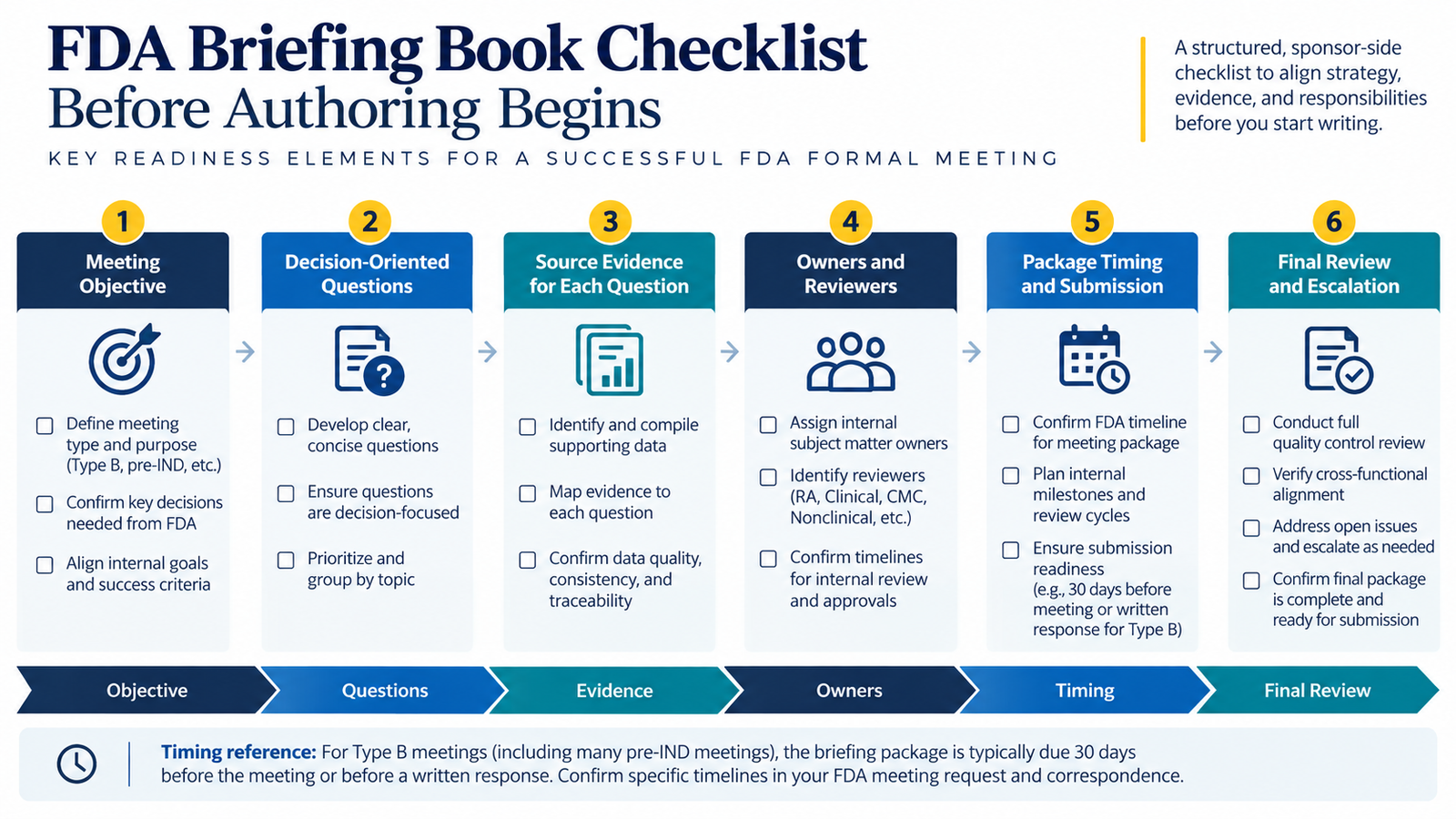
FDA briefing book checklist planning should begin before full authoring starts. The sponsor should first confirm what decision it needs from FDA, which questions will drive that decision, what evidence supports each question, who owns each input, and when the package must be stable enough for cross-functional review.
For a lean biotech team, the biggest risk is often not missing prose. It is starting to write while meeting objectives, sponsor positions, source data, or ownership are still moving. A readiness check makes those gaps visible before they turn into late rewrites.
Quick answer: what should be ready before authoring begins?
Before assigning sections, confirm seven things: the meeting purpose and type, final decision-oriented questions, approved sponsor positions, source evidence and data cutoffs, accountable owners, package timing, and a controlled review path.
Who this checklist is for
This resource is designed for a CEO, CMO, Head of Regulatory Affairs, Regulatory Operations lead, or clinical-development leader preparing for a pre-IND, Type B, Type C, Type D, end-of-phase, or other formal FDA interaction. It is especially useful when multiple functions are contributing material and one person needs to know whether the package is genuinely ready to enter a focused authoring cycle.
1. Lock the meeting objective before drafting the package
A briefing book is not a development-program encyclopedia. Its job is to give FDA the information needed to understand the issues and respond to the sponsor’s questions. Start by writing a one-sentence meeting objective that names the decision or feedback the sponsor needs.
| Readiness item | Evidence to confirm | Accountable owner | Red flag |
|---|---|---|---|
| Meeting purpose | One approved statement of why the interaction is needed now | Regulatory lead / executive sponsor | Different functions describe different reasons for the meeting |
| Meeting type and format | Proposed or granted type/format and current FDA correspondence | Regulatory lead | Authors are drafting against the wrong procedural assumptions |
| Decision sought | For each topic, the decision the sponsor needs after FDA feedback | Functional lead + Regulatory | Questions ask for general advice but do not connect to a program decision |
| Scope boundary | Topics intentionally included and deferred | Regulatory lead | The package keeps expanding because every open issue is being added |
2. Finalize questions before authors optimize prose
Questions are the organizing spine of the meeting package. FDA’s current PDUFA formal-meetings guidance says there should generally be no more than 10 total questions, including subquestions. That ceiling is not a target. Complex topics may require fewer questions so reviewers can evaluate the supporting information and provide useful feedback.
Each question should be specific enough that the sponsor can explain what it will do differently depending on FDA’s answer. If the team cannot identify the downstream decision, the question may still be too broad.
| Question check | Ready when | Not ready when |
|---|---|---|
| Decision relevance | The answer will change a defined clinical, nonclinical, CMC, statistical, or regulatory decision | The question is included because the topic is interesting or unresolved |
| Sponsor position | The team has an approved position or proposed approach | The package asks FDA to design the sponsor’s strategy from scratch |
| Context | A short rationale explains why the question matters | The reviewer must reconstruct the issue from background sections |
| Evidence | Supporting data and assumptions are identified and traceable | Authors are still searching for the basis of the sponsor position |
| Cross-functional alignment | Regulatory and affected functional leads agree on wording | The same question is interpreted differently by Clinical, CMC, Statistics, or Safety |
3. Build a source map for every question
Create a source map before assigning long-form sections. For each question, list the approved documents, analyses, tables, figures, prior FDA correspondence, data cutoffs, and unresolved evidence gaps that support the sponsor position.
The source map is also where the team should identify substantive changes from prior plans or prior FDA communications. FDA’s guidance recommends explaining departures from current guidance or precedent and raising known difficult design or evidence issues rather than hiding them inside a large package.
| Question / topic | Primary source | Data cutoff / version | Open gap | Owner |
|---|---|---|---|---|
| Question 1 | Prior FDA correspondence + current development plan | Confirmed date/version | None / describe | Regulatory |
| Question 2 | Protocol synopsis + nonclinical/clinical evidence summary | Confirmed date/version | Decision pending | Clinical / Nonclinical |
| Question 3 | CMC package or analytical summary | Confirmed date/version | Supporting analysis pending | CMC |
4. Confirm the package skeleton and navigation
FDA recommends organizing the meeting package around the proposed agenda and making it easy to navigate. Before full drafting, establish the document skeleton, question numbering, discipline grouping, section owners, table of contents, appendices, and cross-reference approach.
- attendee list with titles and affiliations;
- development-program background and relevant prior FDA communications;
- current development status and substantive changes in plan, when applicable;
- meeting purpose and meeting type;
- proposed agenda with estimated discussion time;
- final questions grouped by FDA discipline with concise context; and
- supporting data organized by discipline and question.
FDA’s guidance also emphasizes summary information. Full protocols, full study reports, or detailed data generally are not the default meeting-package format; the package should provide enough quantified evidence to support the questions without forcing reviewers to search through unnecessary material.
5. Check package timing before you commit the authoring schedule
The authoring plan should work backward from the applicable FDA timing, but the due date depends on meeting type. Use the current FDA grant letter and applicable guidance as the controlling procedural reference.
| Meeting type | Current FDA meeting-package timing in the August 2026 guidance |
|---|---|
| Type A, Type D, INTERACT | At the time of the meeting request |
| Type B, including pre-IND | No later than 30 calendar days before the scheduled meeting or WRO response time |
| Type B (EOP) | No later than 50 calendar days before the scheduled meeting or WRO response time, subject to the guidance’s early-scheduling proviso |
| Type C | Generally no later than 47 calendar days before the scheduled meeting or WRO response time; special timing applies to certain early surrogate-endpoint consultations |
Do not treat these dates as the internal writing schedule. The sponsor still needs time for source stabilization, cross-functional drafting, regulatory review, executive decisions, quality control, publishing/submission preparation, and contingency.
6. Define the review model and decision rights
A briefing book becomes difficult to control when every reviewer edits every section. Define who authors, who provides source content, who resolves technical comments, who approves sponsor positions, and who has final authority over question wording.
| Role | Primary responsibility |
|---|---|
| Regulatory lead | Meeting strategy, meeting type, objectives, questions, regulatory position, prior FDA commitments |
| Medical/regulatory writer | Package architecture, source-supported drafting, consistency, question-to-evidence traceability, comment integration |
| Functional SMEs | Accuracy of Clinical, CMC, Nonclinical, Safety, Statistics, Quality, and other discipline content |
| Executive / program decision owner | Resolve material tradeoffs and approve sponsor positions |
| QC reviewer | Cross-reference, terminology, data consistency, numbering, links, tables/figures, formatting, final readiness |
If the package requires a dedicated authoring and integration layer, BioBoston CRO provides FDA Briefing Book Writing support for complete packages, selected sections, existing-draft revision, cross-functional review, and independent quality control.
7. Run the authoring-readiness gate
A sponsor is ready to accelerate authoring when the following items can be answered without searching across multiple meetings or email threads:
- The meeting objective is approved and tied to a real development decision.
- The meeting type/format and procedural assumptions are confirmed from current FDA correspondence.
- Questions are decision-oriented, prioritized, and stable enough to draft against.
- Each question has an approved sponsor position or clearly identified decision still requiring leadership resolution.
- Source documents, analyses, data cutoffs, tables, and prior FDA communications are mapped to questions.
- Content owners and review/approval roles are named.
- The package outline and discipline structure are stable.
- The internal authoring, review, QC, and submission schedule fits inside the FDA timing.
- Known evidence gaps, deviations, and difficult design issues are visible rather than buried.
- A final QC owner is assigned for cross-section consistency and submission readiness.
Common briefing-book readiness red flags
- The team is polishing background sections while the questions are still changing.
- Different functions use different product descriptions, study identifiers, assumptions, or data cutoffs.
- The sponsor position exists only in meeting notes and has not been approved.
- Prior FDA advice is quoted selectively or is not reconciled with the current proposal.
- A question requires data that will not be stable by the planned package date.
- The package contains large appendices because the team has not decided what evidence is actually needed.
- Reviewers are editing wording instead of resolving the underlying scientific or regulatory decision.
- No single owner can explain the complete package timeline and dependencies.
What to do next if the checklist exposes gaps
If the gaps are strategic, resolve the regulatory path and decision sequence before pushing more text through review. BioBoston CRO’s Regulatory Pathway and Submission Planning services can support that work. If protocol design is one of the open issues, the Protocol Writing team can help connect the proposed study design to the meeting questions and downstream authoring package.
Need an experienced writing and integration layer for the package?
Explore BioBoston CRO FDA Briefing Book Writing support for sponsors that need a clear, source-supported package organized around defined objectives, questions, evidence, review ownership, and final submission readiness.