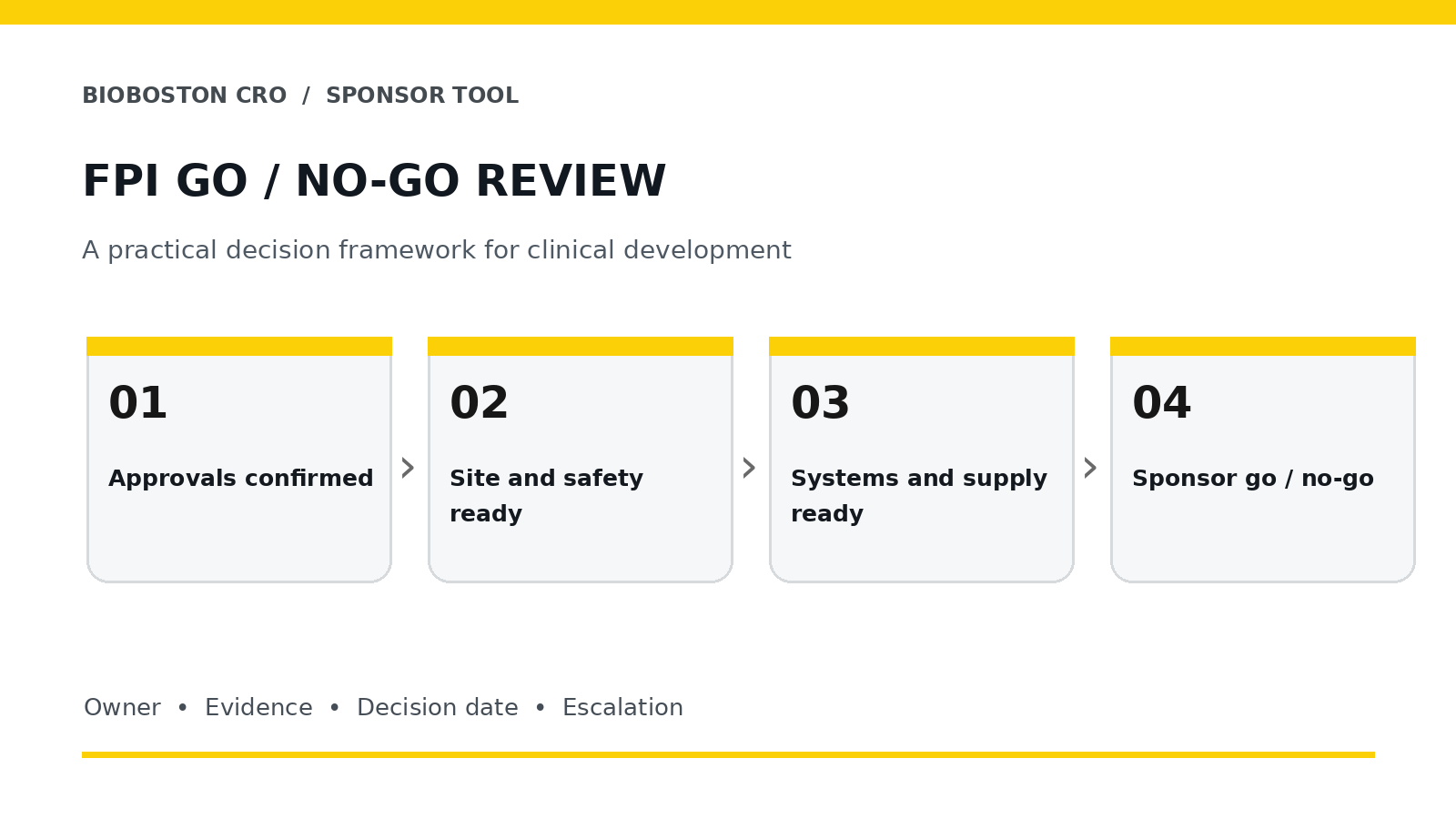
A first patient in checklist helps a sponsor confirm that a site can enroll and treat the first participant within the approved protocol, applicable approvals, trained staff, released systems, and safety arrangements. A calendar date alone is not evidence of readiness.
Copyable sponsor working matrix
| FPI gate | Evidence to inspect | Accountable owner | Hold indicator |
|---|---|---|---|
| Permissions | Applicable authorization and IRB/IEC approval | Regulatory | Approval absent / outdated |
| Site essential records | Protocol, consent, delegation, training | Clinical Operations | Missing critical record |
| Safety arrangements | Medical coverage and escalation contacts | Medical / Safety | Unmanaged safety gap |
| EDC and data tools | Released system, access and training | Data Management | Critical release defect |
| IMP and laboratory | Availability, storage, shipments, lab manual | Supply / Vendor | Missing supply or chain |
| Participant visit | Staff, screening, visits and documentation | Site / Clinical Ops | Site not ready |
How to use the first patient in checklist
For each gate, record the owner, source of evidence, approval date, outstanding issue and accountable go/no-go decision-maker. A conditional green without a defined contingency is not a completed readiness gate. Tailor this list to the protocol, country, site, investigational product and risk profile.
Sponsor-side FPI readiness matrix
Use the matrix as a meeting agenda and working register, not as a replacement for controlled site activation records. Confirm the actual status against the authoritative study systems and current approval documentation.
Approvals and essential records
Confirm the applicable regulatory, IRB/IEC and institutional permissions are effective before activities requiring them. Verify final protocol and consent versions at the site. The exact sequence depends on jurisdiction, product type and study design; do not assume that a single global approval authorizes every participating site.
Participant protection and safety
Verify investigator qualifications, delegation, protocol training, access to medical oversight, emergency unblinding where relevant, safety reporting pathways, pharmacy and investigational product handling, and relevant emergency procedures. A critical safety gap is an immediate no-go even if operational metrics are green.
Data, supplies and external services
Confirm production EDC access and validation/release evidence, relevant ePRO or device readiness, central-lab logistics, sample shipping, drug supply/temperature control, and vendor contacts. Review contingencies for outage, missing kit or late shipment. Some functions may be delivered by approved specialist partners; sponsor oversight still matters.
Enrollment and visit execution
Verify recruitment materials when needed, inclusion/exclusion interpretation, screening workflow, schedule-of-assessments logistics and first-visit staffing. Site activation is not automatically proof of enrollment readiness. Confirm operational readiness directly with the investigator/site team.
Hold / proceed decision
Use a named sponsor decision owner to record Proceed, Conditional Proceed or Hold, with time, evidence, rationale and follow-up. Conditional Proceed should never override a required permission or participant-safety control. Record the decision and communicate it to all parties who must act.
After the first participant
Confirm actual FPI with source-consistent documentation, reconcile deviations or start-up issues, update the next cohort/site ramp forecast, and carry open issues into the sponsor risk and decision logs. Do not close readiness findings because the first visit occurred.
Regulatory interpretation
ICH E6(R3) is FDA guidance containing nonbinding recommendations; its quality and oversight concepts inform this checklist. Country- and trial-specific legal approvals, protocol requirements, and agreements govern what must be satisfied. This matrix is an operational aid, not a regulatory sign-off.
Go/no-go evidence standard
Each gate needs a named accountable reviewer, document/version or system record, evidence date, finding severity, closure plan and decision authority. Red means a required permission, safety safeguard or critical system is absent; Amber means an unresolved dependency with a documented conditional plan; Green means the current evidence supports readiness. These traffic-light definitions are internal governance suggestions.
Consent and protocol version check
Compare approved protocol and consent versions at the site, subject eligibility flow, translations where relevant, visit schedule and training records. Confirm that any site-specific amendment or approval constraints are understood before participant-facing activities. A downloaded file or emailed assurance alone may not prove local implementation.
Medical and safety operations check
The investigator and sponsor should know how urgent clinical events are assessed and escalated. Validate relevant emergency contact coverage, unblinding arrangements if applicable, safety vendor handoffs, required reporting workflows and investigational product handling. Any missing participant-protection measure must use the appropriate immediate escalation route.
Systems and site execution rehearsal
Before an actual participant visit, walk through assignment of system access, equipment function, laboratory labels, sample transport, accountability logs, ePRO tasks and contingencies for downtime. Rehearsal may expose a “ready” vendor service that depends on a site-specific credential or shipment still missing.
A recorded sponsor decision
The sponsor go/no-go record should name the decision maker, decision time, evidence cut-off, site(s) covered, findings still open, rationale, any conditions and responsible owner. A conditional go cannot authorize work that applicable law, approvals or participant-safety controls prohibit. Share the approved decision with relevant site and vendor personnel.
After-first-visit reconciliation
Verify whether FPI actually occurred and what definition the program uses (first consent, first screened, first dosed, etc.). The tracker should specify its operational definition rather than treating those events as interchangeable. Review protocol deviations, system issues and shipment failures and roll any unresolved gap into the risk register.
Regional and product-specific applicability
This sponsor checklist is not a substitute for site-specific IRB/IEC, health-authority, institutional or product requirements. In US drug investigations, relevant sponsor and investigator responsibilities appear in 21 CFR Part 312, with IRB and consent requirements in Parts 56 and 50. FDA E6(R3) provides nonbinding risk-based GCP recommendations.
Apply to your program
For sponsor support with milestones, evidence and decision ownership, explore BioBoston CRO Study Timeline Management.