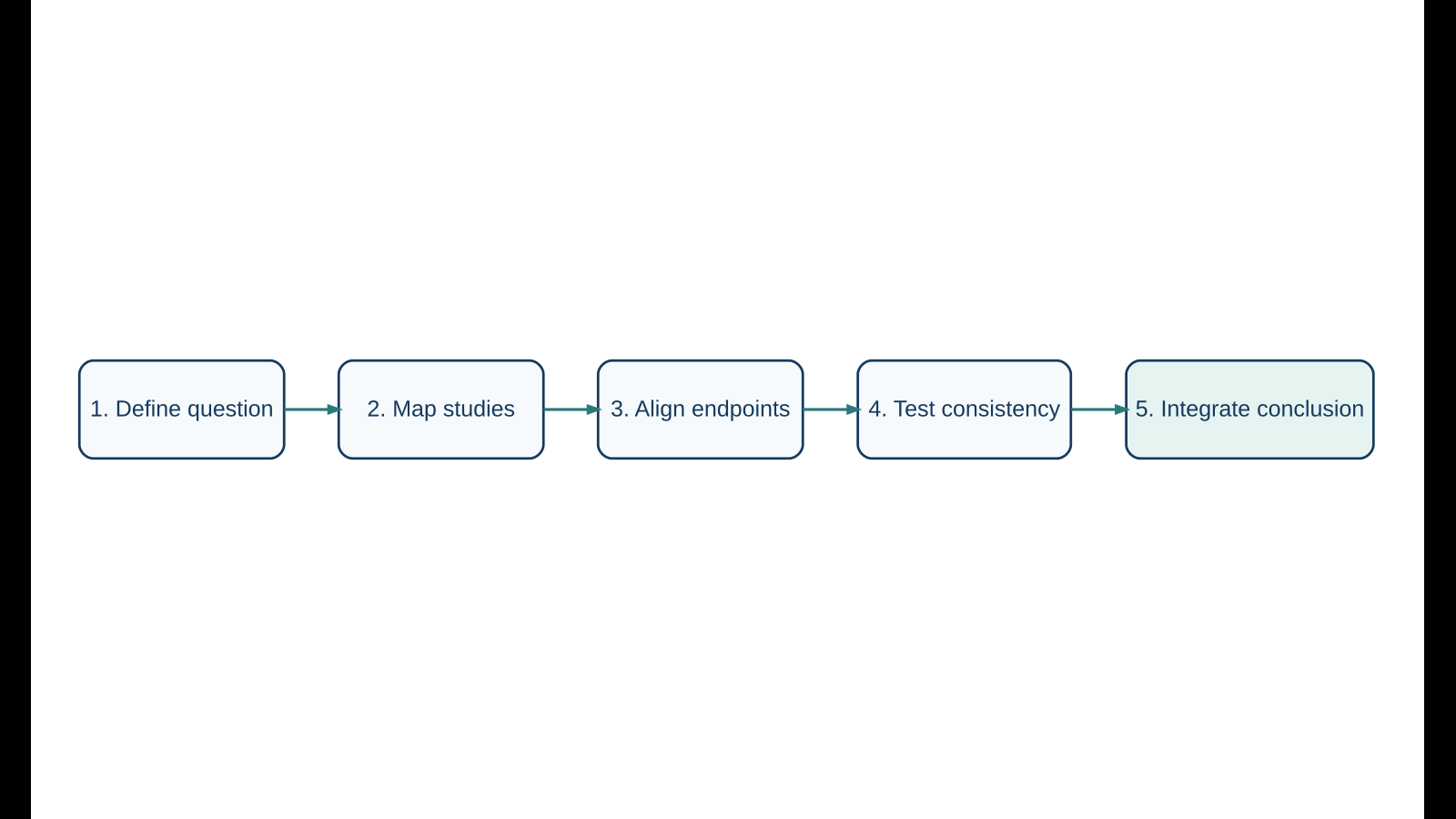
integrated summary of efficacy checklist planning should help the sponsor make a controlled decision, not merely create another document. A sponsor-side planning checklist for an Integrated Summary of Effectiveness. It aligns the clinical question, included studies, endpoints, analysis populations, sensitivity work, and cross-study consistency.
Quick answer: what should be locked before ISE authoring?
- Proposed indication and clinical decision question.
- Pivotal and supportive study roles.
- Endpoint hierarchy, definitions, and timepoints.
- Analysis populations and estimands.
- Cross-study comparison strategy.
- Sensitivity, subgroup, and missing-data analyses.
- Data cutoffs, table shells, and interpretation ownership.
1. Build an efficacy evidence map
| Study | Role | Primary evidence | Key limitation |
|---|---|---|---|
| Pivotal study | Primary support | Primary endpoint / estimand | Record design and population limits |
| Supportive study | Context or confirmation | Secondary endpoint / related setting | Explain differences from pivotal design |
| Early-phase study | Dose/biologic plausibility | PK/PD, response, durability signal | Usually not interchangeable with confirmatory evidence |
| External or historical evidence | Context when appropriate | Defined external source | Clearly separate from sponsor-generated evidence |
2. Normalize endpoint meaning before comparison
Two studies may use similar endpoint names but different definitions, windows, handling rules, or analysis populations. Create an endpoint concordance table that captures the exact definition, assessment method, timepoint, intercurrent-event strategy, and analysis set before cross-study conclusions are drafted.
For sponsors that need hands-on support applying this framework, BioBoston CRO Safety and Efficacy Summaries can support the underlying regulatory and cross-functional work.
3. Define what consistency means
- Direction of effect is similar across relevant studies.
- Magnitude is clinically interpretable in light of design and population.
- Important sensitivity analyses support the main interpretation.
- Subgroup findings do not reveal an unexplained contradiction.
- Durability and missing-data patterns are understood.
- Differences are explained rather than averaged away.
4. Pre-plan the difficult comparisons
| Issue | Planning question |
|---|---|
| Different populations | Can results be compared directly, stratified, or only described? |
| Different endpoints | Is there a common clinical construct or should evidence remain separate? |
| Different doses | What dose-response or exposure-response interpretation is supportable? |
| Different follow-up | How will durability be discussed without misleading comparison? |
| Conflicting result | What additional analysis or explanation is needed before narrative lock? |
5. Tie the ISE to the broader submission
The integrated effectiveness conclusion should be consistent with the Clinical Overview, proposed indication, benefit-risk discussion, and labeling strategy. Where the evidence supports only a narrower population or condition of use, the narrative should make that boundary explicit rather than bury it in limitations.
6. Red flags
- The proposed indication is still changing after integrated analyses are locked.
- Endpoint definitions differ across source documents.
- A supportive study is treated as confirmatory without explaining its role.
- Subgroup findings are selectively emphasized without a pre-specified rationale.
- Cross-study inconsistencies are solved by wording rather than analysis.
ISE readiness gate
- Indication and study roles agreed.
- Endpoint concordance complete.
- Analysis populations and estimands aligned.
- Sensitivity and subgroup work defined.
- Data cutoffs controlled.
- Cross-study differences logged and explained.
- Final conclusions mapped to submission and labeling.
BioBoston CRO Safety and Efficacy Summaries support can help coordinate integrated efficacy planning and review.