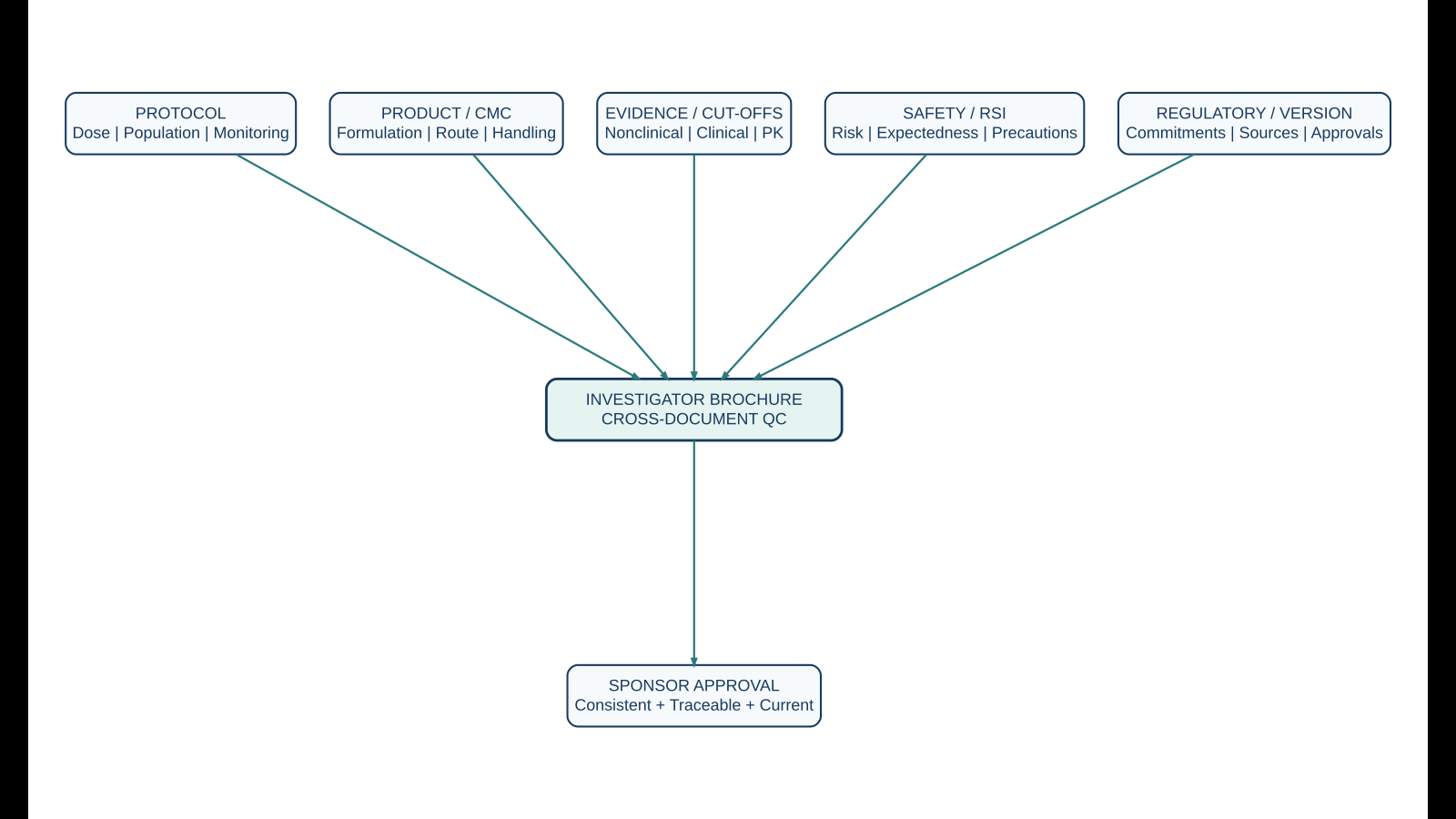
Investigator brochure review checklist use should go beyond checking whether each expected section exists. The highest-value final review asks whether the IB tells the same scientific and safety story as the current protocol, product configuration, nonclinical and clinical evidence, safety decisions, and regulatory position.
Cross-document inconsistencies are especially important because the IB is intended to help investigators understand and follow key protocol features such as dose, administration, and safety monitoring. A brochure can be well written and still be unreliable if it reflects an obsolete formulation, a superseded dose, an old safety interpretation, or a source version that no longer matches the active study.
Quick answer: what should an Investigator Brochure review compare?
A final IB review should compare the brochure against the current protocol, product/CMC information, nonclinical evidence, human data, safety and RSI decisions, prior regulatory feedback, and the controlled source register. The reviewer should confirm not only factual accuracy within each section, but also that the same dose, route, formulation, population, monitoring approach, risk interpretation, and data cut-off appear consistently across the documents that govern the active program.
Who this investigator brochure review checklist is for
This checklist is designed for Clinical Development, Medical Writing, Safety/Pharmacovigilance, Regulatory Affairs, CMC, Nonclinical, and program leaders reviewing an initial IB or controlled update. It is most useful after the integrated draft is substantially complete but before final approval, distribution, or regulatory submission.
1. Product identity, formulation, and handling consistency
| IB checkpoint | Compare against | Owner | Red flag |
|---|---|---|---|
| Product name/code and active ingredient | Current CMC/product records, protocol, labels | CMC + Regulatory | Different names, codes, or strengths appear across documents |
| Formulation and dosage form | Current product configuration and protocol | CMC | IB describes a superseded formulation |
| Storage, preparation, handling, administration | Pharmacy/site instructions and protocol | CMC + Clinical Supply | Operational instructions do not match what sites use |
| Clinically relevant product changes | Change-control record | CMC + Quality | A material product change was never assessed for IB impact |
Do not assume a product change is “CMC-only.” If it changes what investigators receive, prepare, administer, monitor, or explain to participants, it can create an investigator-facing inconsistency.
2. Protocol-to-IB consistency
The protocol and IB have different purposes, but the IB should support the investigator’s understanding of the active protocol rather than describe a different development scenario.
| Check | Must agree across IB and protocol | Primary owner | Escalate when |
|---|---|---|---|
| Dose and escalation | Starting dose, planned dose range, escalation logic where relevant | Clinical + Medical | Protocol uses a dose not supported by current IB rationale |
| Route and schedule | Route, frequency, interval, duration and administration method | Clinical | IB and protocol describe different clinical use |
| Population | Indication, disease context, key population assumptions | Clinical Development | IB benefit-risk framing is based on a different population |
| Monitoring and precautions | Key safety monitoring, dose modifications, stopping logic and precautions | Medical/Safety + Clinical | Protocol risk controls are missing or contradicted in the IB |
If the protocol is still changing, BioBoston CRO Protocol Writing support can help align the protocol and IB assumptions before both enter final approval.
3. Nonclinical evidence and clinical interpretation
The review should confirm that the IB’s nonclinical summaries use the current source reports and that the clinical interpretation is consistent with the dose, exposure, monitoring, and risk decisions in the active program.
- Check that pivotal pharmacology and toxicology findings match the final or approved source summaries.
- Confirm species, dose levels, exposure units, duration, target-organ findings, reversibility, and major conclusions are consistent across text and tables.
- Confirm human-relevance statements do not exceed the evidence.
- Reconcile exposure-margin or starting-dose rationale with the clinical protocol and current analyses.
- Verify that important nonclinical risks are reflected in investigator precautions or monitoring where applicable.
4. Human data, data cut-offs, and analysis versions
| Review item | Compare against | Owner | Red flag |
|---|---|---|---|
| PK/PD results | Current approved analysis or data cut | Clinical Pharmacology | IB table and narrative use different analysis versions |
| Safety data | Aggregate safety review / approved safety summary | Safety/Medical | Safety section uses an older cut-off than the RSI assessment |
| Efficacy/activity | Current study results or approved summary | Clinical Development | Preliminary activity is described as established benefit |
| Study status | Current program/trial status | Program Management | Completed/ongoing study descriptions are stale |
A single stated IB data cut-off is valuable only if the underlying sections actually follow it. Where certain analyses have different valid cut-offs, state and control those exceptions explicitly.
5. Safety narrative, RSI, and investigator guidance
Safety review requires more than confirming that adverse events are listed. The reviewer should verify that the narrative, RSI where applicable, risk-benefit interpretation, precautions, and protocol controls represent the same current medical decision.
| Cross-check | Evidence | Owner | Red flag |
|---|---|---|---|
| Expected adverse reactions / RSI | Approved expectedness decision record and aggregate safety evidence | Safety/Medical/Regulatory | RSI language differs from the approved safety decision |
| Known and potential risks | Current safety assessment | Safety/Medical | Important risk appears in one section but not in investigator guidance |
| Precautions / monitoring | Protocol and risk-management decisions | Medical + Clinical | Investigators are told to monitor differently across documents |
| Urgent safety information | Investigator communications since prior version | Safety + Regulatory | Prior safety letter is not reflected in the current draft |
Under 21 CFR 312.55, sponsors must keep investigators informed of new observations as development proceeds, particularly adverse effects and safe-use information. That ongoing obligation makes review of interim safety communications a critical part of IB QC, not an optional archive check.
6. Regulatory feedback and sponsor commitments
Review prior FDA or other health-authority correspondence that affects the product description, clinical strategy, safety interpretation, monitoring, or development position. The IB should not silently revert to an approach that the sponsor has already changed in response to regulatory feedback.
- Confirm relevant meeting minutes, written responses, and information requests are reflected accurately.
- Identify sponsor commitments that affect current investigator-facing content.
- Explain material strategy changes instead of leaving old assumptions embedded in the IB.
- Check that the IB does not imply regulatory agreement where none exists.
When the inconsistency is tied to a broader submission or regulatory sequence, BioBoston CRO Submission Planning support can help align source documents, commitments, and document timing.
7. Internal consistency inside the IB
A practical investigator brochure review checklist should pair cross-document QC with an internal consistency pass. Reviewers should search for the same fact wherever it appears and confirm that the value, wording, source, and interpretation agree.
| Repeat-value check | Common locations | Typical inconsistency |
|---|---|---|
| Dose / exposure | Summary, nonclinical, human PK, investigator guidance | Different units, dose levels, or analysis versions |
| Risk / adverse reaction | Summary, human safety, RSI, guidance | Severity or expectedness language changes by section |
| Product configuration | Introduction, product section, clinical sections | Different formulation/strength names |
| Study counts / participant exposure | Summary and effects-in-humans section | Numbers reflect different data cut-offs |
8. Version, references, change summary, and approval controls
Before approval, the investigator brochure review checklist should confirm that version/date controls match the scientific content actually reviewed. ICH E6(R3) recommends clear version information and at least annual review with revision as necessary.
- Edition/version, release date, superseded version, and data cut-off are correct.
- References resolve to the intended current source.
- Tables and figures are numbered and cited consistently.
- The change summary captures material scientific and safety changes, not only editorial edits.
- Functional reviewers approve the data and interpretations owned by their disciplines.
- A medically qualified reviewer is involved in the IB generation/review process.
- The final approved file is clearly distinguished from draft and superseded versions.
9. Investigator brochure review checklist: final approval gate
| Gate | Pass | Hold / escalate |
|---|---|---|
| Product consistency | Current product configuration matches protocol/site use | Obsolete formulation, strength, route, or handling remains |
| Protocol consistency | Dose, population, schedule, monitoring and precautions align | Active protocol conflicts with investigator guidance |
| Evidence consistency | Current controlled sources and data cut-offs are used | Sections rely on different or unstable source versions |
| Safety/RSI consistency | Approved safety decisions are reflected throughout | RSI, narrative, protocol controls, or safety letters conflict |
| Regulatory consistency | Current regulatory position and commitments are reflected | IB contradicts material prior feedback or sponsor commitments |
| Document control | Version, references, change summary and approvals are complete | Final reviewed version is ambiguous |
BioBoston CRO provides Investigator Brochure Support for independent review, cross-document consistency checks, controlled updates, source integration, and final quality control.
Red flags that should stop approval
- Protocol and IB disagree on dose, route, formulation, population, or monitoring.
- Safety/RSI wording is not traceable to an approved medical/safety decision.
- Important new investigator communication is missing from the draft.
- Sections use different source versions or data cut-offs without explanation.
- Prior regulatory feedback materially affecting the program has not been reconciled.
- The reviewer cannot identify the authoritative source for a key claim.
- Functional reviewers are approving wording outside their technical ownership without the responsible SME.
If recurring inconsistencies reveal a broader clinical quality or change-control failure, BioBoston CRO GCP CAPA Support may be relevant.
Need an independent IB quality review?
Explore BioBoston CRO Investigator Brochure Support for a structured review of protocol alignment, product configuration, source evidence, safety/RSI, regulatory commitments, version control, and final approval readiness.