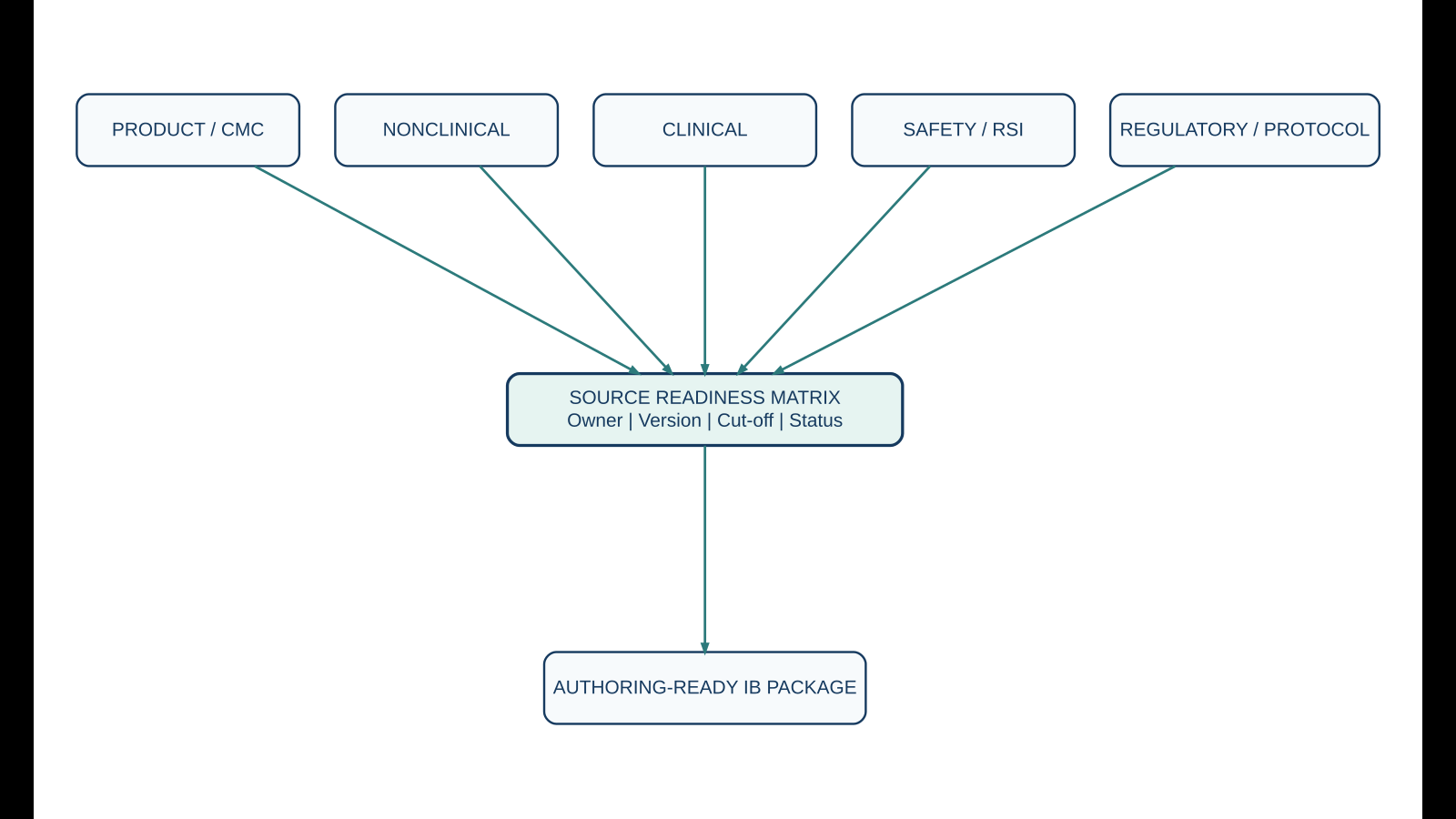
Investigator brochure source documents should be assembled and controlled before the writer begins full authoring. The exact source package depends on the product and development stage, but a strong sponsor package normally covers five evidence domains: product/CMC, nonclinical, clinical, safety/medical, and regulatory/program history.
The goal is not to collect every document ever generated. It is to identify the current, approved or sufficiently stable sources that support the investigator-facing statements the IB needs to make, define the data cut-off, name the technical owner for each source, and expose missing or conflicting evidence before it becomes an authoring problem.
Quick answer: what source documents are needed for an Investigator Brochure?
For initial authoring, the minimum useful package usually includes current product/formulation information; relevant nonclinical pharmacology, pharmacokinetic/disposition, and toxicology sources; available human PK/PD, safety, efficacy, and prior-study information; approved safety and RSI inputs where applicable; current protocols and development strategy; and prior regulatory correspondence that affects the program.
For an update, add the prior approved IB, change history, new evidence since the prior data cut-off, updated safety decisions, protocol/product changes, and any regulatory feedback that changes investigator-facing content.
Who this investigator brochure source documents checklist is for
This checklist is designed for Clinical Development, Medical Writing, Safety/Pharmacovigilance, Regulatory Affairs, CMC, Nonclinical, and program leaders preparing an initial IB or a controlled revision. It is most useful before authoring begins, when the team can still resolve source ownership, version conflicts, missing data, and cross-document inconsistencies without rewriting multiple sections later.
1. Establish the source-control rules before collecting documents
Before collecting investigator brochure source documents, define what counts as an authoring source. A writer should know whether a document is approved, final, draft-but-stable, or still changing; who owns it; what data cut-off it represents; and whether it can support final statements.
| Source-control field | What to capture | Red flag |
|---|---|---|
| Document / dataset | Exact title or controlled identifier | Source is described only as “latest” |
| Owner | Functional SME accountable for accuracy | No one can approve the interpretation |
| Version / date | Current controlled version | Different teams are using different versions |
| Data cut-off | Cut-off date represented by the source | Narrative and tables use different cut-offs |
| Readiness status | Approved / stable draft / pending | Writer is drafting final conclusions from unstable inputs |
| IB destination | Section(s) the source supports | Source is collected but has no defined use |
2. Product and CMC source package
The product section must give investigators enough information to understand what is being administered and any clinically relevant handling, formulation, or product characteristics. The source package should therefore be more than a high-level CMC summary if important operational or risk information sits elsewhere.
| Source/input | Why the IB needs it | Primary owner | Red flag |
|---|---|---|---|
| Current product description and composition | Product identity, formulation, dosage form, strength, active ingredient(s) | CMC | Does not match the active protocol |
| Storage, stability, handling and administration information | Investigator/site-use instructions and precautions | CMC / Clinical Supply | Operational instructions are based on an obsolete configuration |
| Relevant manufacturing/formulation change record | Explains clinically meaningful product changes | CMC / Quality | Change impact was never assessed for the IB |
| Clinically relevant excipient/device information | Supports risk, compatibility, preparation or administration guidance | CMC / Device SME | Known product risk is absent from investigator guidance |
3. Nonclinical source package
The nonclinical section should synthesize results rather than reproduce reports. The writer needs enough controlled evidence to describe the relevant pharmacology, disposition, toxicology, exposure relationships, and human relevance accurately.
| Source/input | What it supports | Primary owner | Red flag |
|---|---|---|---|
| Primary/secondary pharmacology reports or approved summaries | Mechanism, activity and pharmacologic rationale | Nonclinical / Pharmacology | Mechanistic claims exceed the source evidence |
| Safety pharmacology sources | Potential physiologic risks and monitoring relevance | Nonclinical | Important findings are not connected to clinical precautions |
| ADME / PK / toxicokinetic sources | Exposure, distribution, metabolism and species interpretation | DMPK / Nonclinical | Exposure language conflicts with dose rationale |
| Toxicology reports and integrated summaries | Target-organ findings, reversibility, exposure margins and risk context | Toxicology | Latest pivotal findings are missing or still disputed |
4. Clinical and human-experience source package
For a first-in-human IB, human experience may be absent or limited. Later versions may require several completed or ongoing study sources. The source package should distinguish controlled results from preliminary information and identify which analyses are mature enough for the brochure.
| Source/input | What it supports | Primary owner | Red flag |
|---|---|---|---|
| Current and prior clinical protocols | Population, dose, route, schedule, study context and monitoring | Clinical Development | IB reflects a superseded design |
| Clinical study reports / approved study summaries | Prior human safety, activity/efficacy, dose-response and study experience | Clinical / Medical Writing | Draft results are presented as final |
| PK/PD and clinical pharmacology analyses | Human exposure, metabolism, dose/exposure and interaction context | Clinical Pharmacology | Analysis version differs from the protocol rationale |
| Relevant publications or external human experience | Context when scientifically applicable and clearly attributable | Clinical / Regulatory | External evidence is presented as product-specific experience |
5. Safety, RSI, and investigator-guidance source package
Safety content requires explicit ownership. The writer can integrate approved decisions, but should not independently determine the RSI or convert raw adverse-event listings into expectedness decisions.
| Source/input | What it supports | Primary owner | Red flag |
|---|---|---|---|
| Current aggregate safety review / approved safety summary | Known and potential risks, patterns, severity and clinical relevance | Safety / Medical | Source cut-off is unclear or obsolete |
| Approved RSI / expectedness decision record, where applicable | Expected adverse reactions and safety-reporting reference | Safety / Medical / Regulatory | Writer is being asked to decide expectedness |
| Important safety communications since the prior IB | Ensures urgent findings are reflected in the controlled update | Safety / Regulatory | Investigator letter and current IB conflict |
| Monitoring, dose-modification and risk-management decisions | Precautions and guidance for investigators | Medical / Clinical | Protocol controls changed but IB guidance did not |
6. Regulatory and program-history sources
The IB should not silently contradict prior health-authority feedback or the sponsor’s current regulatory position. Include the records that define important program commitments and investigator-facing changes.
- Current IND/CTA-relevant product and development information used as controlled source material.
- FDA/health-authority meeting minutes, written responses, information requests, and commitments relevant to the IB.
- Current development plan or approved program strategy when it affects indication, population, dose, or study context.
- Prior approved IB and change summary for updates.
- Applicable annual/periodic safety-development summaries when they contain relevant new evidence.
When the IB is part of a larger submission sequence, BioBoston CRO’s Submission Planning support can help coordinate source readiness and document dependencies.
7. Protocol and cross-document alignment inputs
Protocol-to-IB inconsistencies are often source-control problems before they are writing problems. The source package should identify the current protocol version, amendments in development, approved dose and monitoring decisions, and any study-specific materials that alter investigator guidance.
If the protocol itself is still being developed, BioBoston CRO Protocol Writing support can help align the study design and IB assumptions before both documents are finalized.
8. Build a source readiness matrix before full drafting
Investigator brochure source documents are easier to manage as a readiness matrix than as a folder of files. Use one row per source or unresolved input.
| Source | Owner | Version / cutoff | IB section | Status | Gap / action |
|---|---|---|---|---|---|
| CMC product summary | CMC Lead | vX / date | Product/formulation | Ready | None |
| Pivotal tox report | Toxicology | Final / date | Nonclinical | Ready | Confirm human-relevance interpretation |
| Aggregate clinical safety summary | Safety | Cut-off date | Effects in humans / RSI | Pending | Medical approval due |
| Protocol synopsis | Clinical | vX / date | Investigator guidance | Stable draft | Final dose decision pending |
9. Red flags that should stop full authoring
- The sponsor cannot define one data cut-off for the version.
- Product, dose, route, formulation, or protocol assumptions conflict across source documents.
- Key safety/RSI decisions are pending but the writer is expected to finalize risk language.
- A pivotal nonclinical or clinical source is still changing without a planned freeze date.
- There is no named SME who can approve the technical interpretation of a section.
- The current protocol or product configuration is not clearly identified.
- Prior regulatory feedback affecting the IB has not been reconciled.
- The source folder contains multiple versions but no controlled source register.
If these gaps reflect a broader quality-system or change-control failure, BioBoston CRO GCP CAPA Support may be relevant.
Investigator brochure source documents: final readiness checklist
- One controlled source register is in place.
- Every source has an owner, version/date, data cut-off, and readiness status.
- Product/CMC inputs match the active clinical configuration.
- Relevant nonclinical pharmacology, PK/disposition, and toxicology sources are available.
- Available human PK/PD, safety, efficacy/activity, and prior-study sources are identified.
- Safety/Medical has provided approved risk and RSI inputs where applicable.
- Current protocols and investigator-use decisions are identified.
- Prior regulatory feedback and commitments affecting the IB are included.
- The prior approved IB and change history are available for revisions.
- Known source gaps are assigned to owners before full drafting begins.
BioBoston CRO provides Investigator Brochure Support for source-package planning, initial authoring, controlled updates, cross-functional integration, and independent quality review.
Need help assembling the IB source package?
Explore BioBoston CRO Investigator Brochure Support to build a traceable source package and turn approved product, nonclinical, clinical, safety, and regulatory inputs into a controlled Investigator’s Brochure.