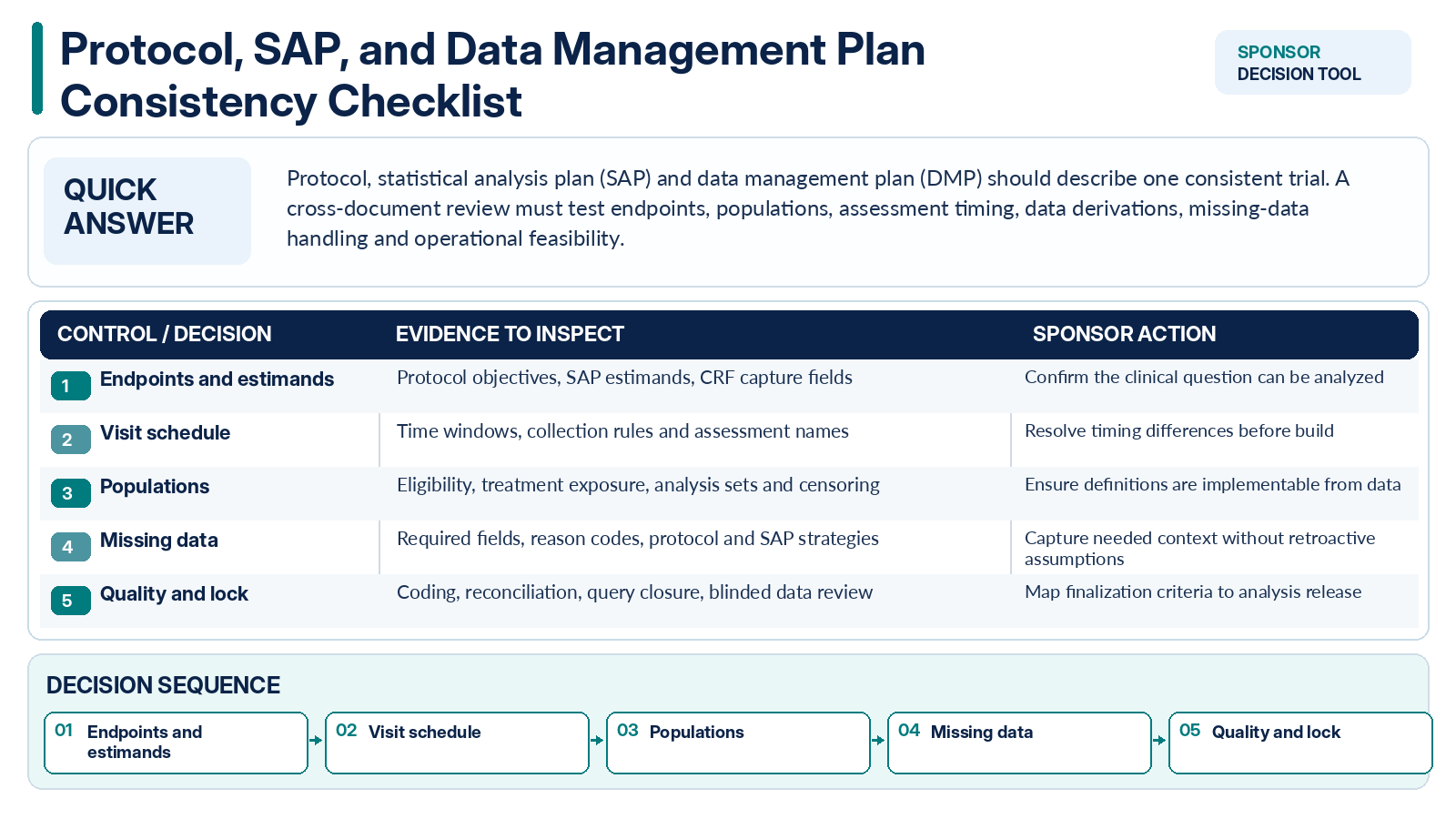
Protocol, statistical analysis plan (SAP) and data management plan (DMP) should describe one consistent trial. A cross-document review must test endpoints, populations, assessment timing, data derivations, missing-data handling and operational feasibility.
Checklist: controls and supporting evidence
Begin with the most consequential control and the evidence needed to resolve it. The following matrix connects each decision to records and an accountable action, rather than treating the list as a generic compliance checkbox.
| Control / question | Evidence to examine | Sponsor action |
|---|---|---|
| Endpoints and estimands | Protocol objectives, SAP estimands, CRF capture fields | Confirm the clinical question can be analyzed |
| Visit schedule | Time windows, collection rules and assessment names | Resolve timing differences before build |
| Populations | Eligibility, treatment exposure, analysis sets and censoring | Ensure definitions are implementable from data |
| Missing data | Required fields, reason codes, protocol and SAP strategies | Capture needed context without retroactive assumptions |
| Quality and lock | Coding, reconciliation, query closure, blinded data review | Map finalization criteria to analysis release |
For teams that need support implementing this across functions, BioBoston CRO Data Management Plan Review can help adapt the controls to the study, vendors, and decision calendar.
Working through the controls
1. Endpoints and estimands
Evidence: Protocol objectives, SAP estimands, CRF capture fields. Decision: Confirm the clinical question can be analyzed. Record the responsible function and the approved source version, and keep any remaining exceptions visible to the sponsor before this item is closed.
2. Visit schedule
Evidence: Time windows, collection rules and assessment names. Decision: Resolve timing differences before build. Record the responsible function and the approved source version, and keep any remaining exceptions visible to the sponsor before this item is closed.
3. Populations
Evidence: Eligibility, treatment exposure, analysis sets and censoring. Decision: Ensure definitions are implementable from data. Record the responsible function and the approved source version, and keep any remaining exceptions visible to the sponsor before this item is closed.
4. Missing data
Evidence: Required fields, reason codes, protocol and SAP strategies. Decision: Capture needed context without retroactive assumptions. Record the responsible function and the approved source version, and keep any remaining exceptions visible to the sponsor before this item is closed.
5. Quality and lock
Evidence: Coding, reconciliation, query closure, blinded data review. Decision: Map finalization criteria to analysis release. Record the responsible function and the approved source version, and keep any remaining exceptions visible to the sponsor before this item is closed.
Red flags that should change the plan
- Protocol amendment not propagated into SAP or DMP.
- EDC lacks inputs for a derived endpoint.
- Different teams interpret an endpoint differently.
Decision gate and governance
Maintain an issue matrix showing exact document section, discrepancy, decision owner, revised version and sign-off. The control owner should record the decision, evidence version, date, residual uncertainty and next re-review trigger. Where delegated providers perform the work, the sponsor should retain the relevant oversight and acceptance evidence.
Regulatory note: Determine which electronic records and signatures are regulated before applying 21 CFR Part 11 controls; FDA guidance supports risk- and intended-use-based implementation.
Need practical support?
Use BioBoston CRO Data Management Plan Review to review the evidence, define decision rights, and build a study-specific action plan for the next milestone.