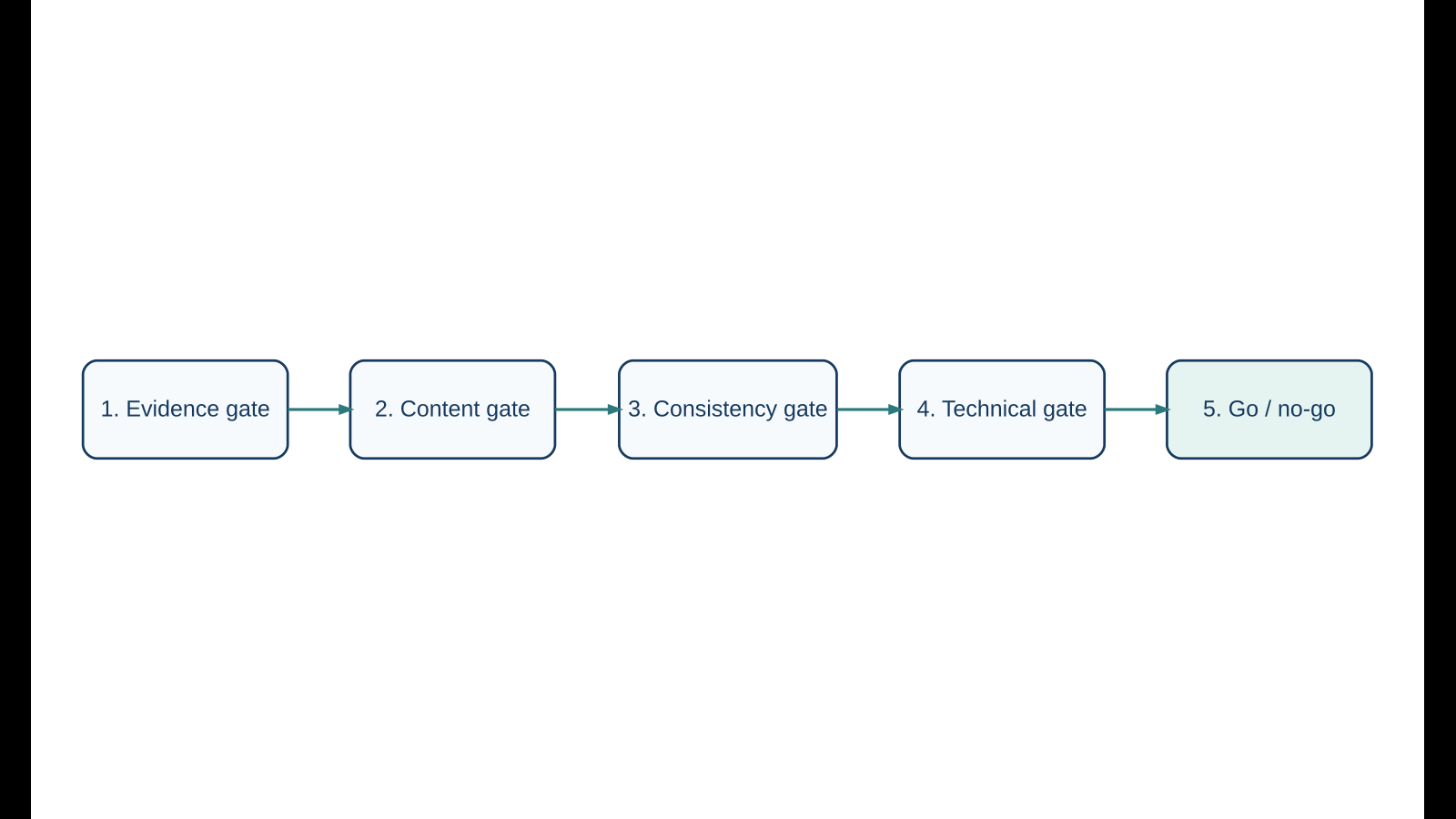
regulatory submission readiness checklist planning should help the sponsor make a controlled decision, not merely create another document. A go/no-go readiness gate for regulatory submissions. It helps sponsors distinguish a truly file-ready application from a package that is merely close to complete.
Practical principle: Regulatory submission readiness should be judged by unresolved risk, not percent complete. A package can be 98% written and still be a no-go if the remaining 2% changes the regulatory position, core evidence, labeling, or technical validity.
Quick answer: what belongs in the go/no-go gate?
- Regulatory strategy remains valid.
- Critical evidence and analyses are final enough for filing.
- Required documents and forms are complete.
- Cross-document inconsistencies are resolved.
- Approvals are documented.
- Publishing and technical validation are complete.
- Open issues have explicit acceptance or mitigation.
1. Use Green / Yellow / Red criteria
| Status | Meaning | Action |
|---|---|---|
| Green | Ready; no unresolved issue materially threatens filing | Proceed |
| Yellow | Open issue is bounded, owned, and does not invalidate filing if resolved as planned | Proceed conditionally with deadline |
| Red | Open issue could change safety, efficacy, quality, regulatory basis, required content, or technical acceptance | Do not file until resolved or formally re-strategized |
2. Evidence gate
- Critical study reports and analyses available.
- CMC/nonclinical/clinical source versions controlled.
- Data cutoffs aligned across dependent documents.
- Known limitations and inconsistencies have a documented regulatory interpretation.
3. Content and consistency gate
- Application content inventory reconciled.
- Key numbers, dates, populations, doses, and claims agree across documents.
- Meeting commitments and prior authority feedback are addressed.
- Labeling or indication language matches the evidence and pathway.
4. Technical gate
- File naming, formats, placement, and metadata conform to current technical requirements.
- Hyperlinks/bookmarks and references work.
- Submission validation has been run and errors resolved.
- Transmission roles and backup plan are confirmed.
5. Decision record
| Question | Decision |
|---|---|
| What is still open? | List only issues that could affect filing or review |
| Who owns it? | One accountable owner |
| By when? | Resolution deadline before or after filing |
| Can FDA review without it? | Document rationale |
| What happens if assumption is wrong? | Define contingency |
6. Red flags
- “We can explain it if FDA asks” is being used for a known material inconsistency.
- Final numbers differ across summary documents.
- Late changes bypass targeted re-review.
- Publishing validation is treated as a same-day task.
- No one owns FDA information requests after transmission.
Need an independent readiness gate?
BioBoston CRO Submission Planning can help run a structured readiness assessment and convert open items into a controlled go/no-go decision.
For sponsors that need hands-on support applying this framework, BioBoston CRO Submission Planning can support the underlying regulatory and cross-functional work.