A responsibility matrix review checklist is a focused way to confirm that a changed protocol, vendor arrangement, contract or team still has the correct operational owners and approval pathways. The key question is not whether the RACI document has a new version number. It is whether the study can continue safely with the revised responsibilities, evidence routes and sponsor oversight.
This checklist serves Clinical Operations, Project Management and Quality leaders working with outsourced trial functions. It is designed for change-control meetings, when a protocol amendment changes procedures, a specialty vendor joins or leaves, a CRO changes scope, a decision maker is replaced, or a critical handoff fails. Record an owner, evidence, and red flag for each item rather than checking a box without documenting the answer.
When to trigger the review
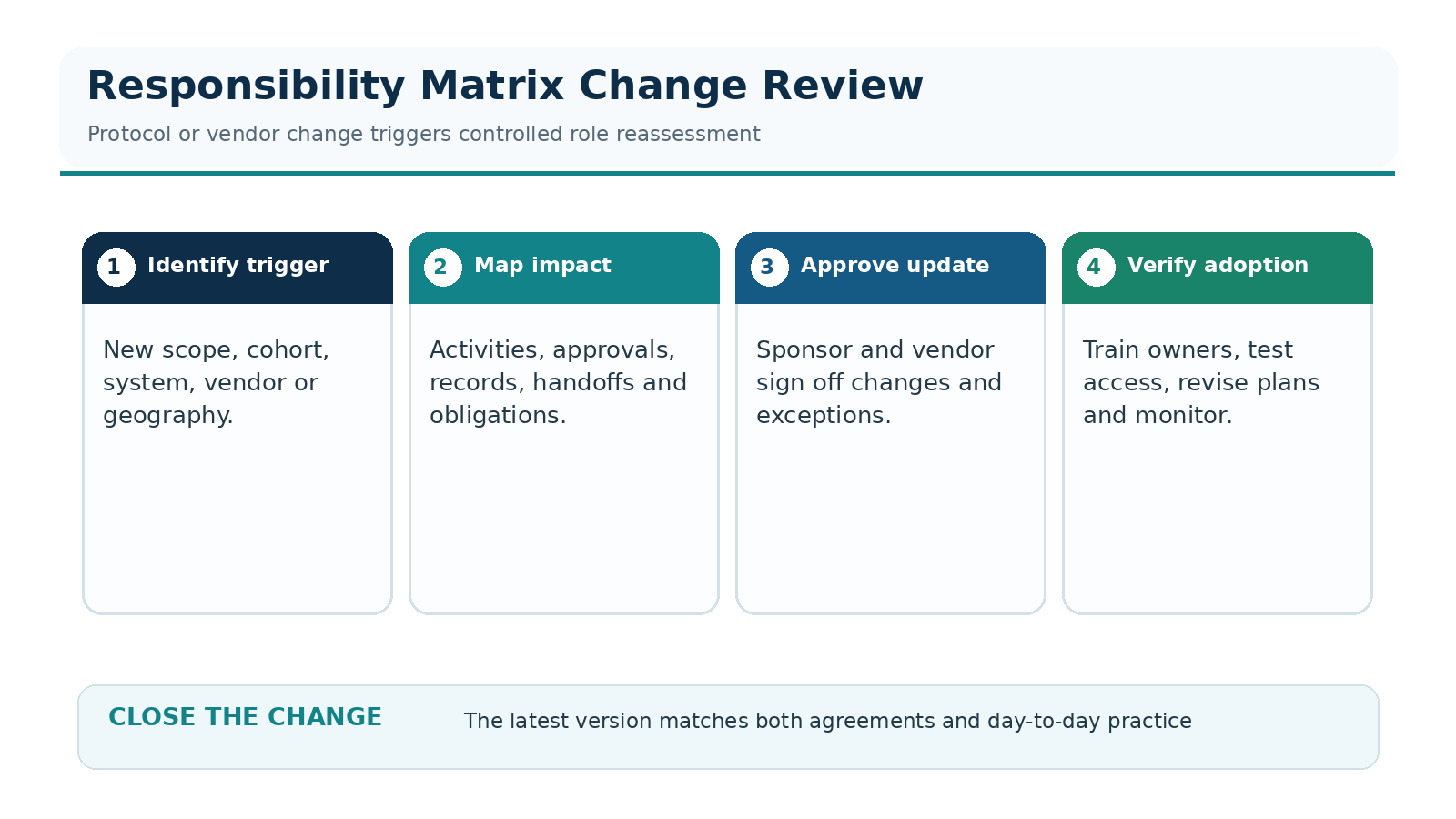
Review the current matrix whenever a controlled change could affect who performs, approves, monitors or records a trial activity. Common triggers include a revised protocol schedule, changes to sample collection or central laboratory interfaces, new safety requirements, an EDC or randomization-system change, a site-activation model change, subcontracting of important work, and a new sponsor or vendor team structure.
Do not assume a regulatory transfer has changed simply because a RACI role has changed. In U.S. IND studies, any transfer of sponsor obligations to a CRO is addressed by the written requirements in 21 CFR 312.52. ICH E6(R3) is GCP guidance addressing documented service-provider responsibilities, quality management and sponsor oversight. Operational owners should reconcile the matrix to the actual agreements and applicable laws.
The 12-point responsibility matrix review checklist
Use the following table as the meeting control. "Evidence" is an artifact that the sponsor can retrieve later; "red flag" is a reason to keep the change open until it is resolved.
| # and check | Required evidence / owner | Red flag / next decision |
|---|---|---|
| 1. Change scope is defined | Approved amendment or change request; sponsor change owner | Impact statement does not identify affected trial functions |
| 2. Protocol tasks are translated | Workflow-to-activity map; clinical operations lead | New assessments have no operational performer |
| 3. Accountable decisions are explicit | Revised decision/RACI table; sponsor program lead | Two teams both assume the other approves |
| 4. Contracts match role changes | Current SOW and applicable transfer record; procurement/legal | New responsibilities outside signed scope |
| 5. Sponsor oversight remains assigned | Oversight plan and meeting evidence; QA/clinical ops | Work delegated without oversight evidence |
| 6. Data handoffs are reconciled | Transfer specification, validation and data flow; data owner | New data source omitted from transfer map |
| 7. Systems and permissions align | Access request, training and test records; system owner | Removed vendor retains production privileges |
| 8. Safety and escalation are mapped | Safety agreement/contacts and case workflow; medical/safety lead | Serious-event or urgent signal lacks backup |
| 9. Site and laboratory impact is controlled | Site communications and lab manual changes; site/vendor owner | Sites receive contradictory procedures |
| 10. TMF and records ownership is defined | Document filing map, named custodian and completeness check | Vendor exit leaves inaccessible source records |
| 11. Timeline and cost effects are accepted | Integrated change-log and approval; PM/finance | Revised milestones lack approved predecessor logic |
| 12. Matrix is released and trained | Version history, approval, effective date, acknowledgement | Teams use different versions at next milestone |
The sponsor should tailor the checks to the trial and applicable contractual obligations. Not every check represents a separate regulatory requirement.
Run the review as a controlled change meeting
Before the meeting: obtain the current matrix, prior signed responsibilities, relevant contracts and a concise change description. Flag the high-impact workflows, such as participant safety, critical data and trial release decisions. Ask the sponsor, CRO and material provider leads to identify proposed new owners before convening.
During the meeting: read each affected row aloud with the performer, accountable decision maker, evidence owner, recipient and backup. Require a direct answer to "Who signs or accepts this deliverable under the new model?" Capture disagreements as numbered issues, not verbal assumptions. If a delegated task involves regulatory obligations, route it to legal/regulatory review of the written transfer and contract terms.
After the meeting: publish a controlled revision, communicate changed interfaces to affected providers and sites, update access and training records, and retest time-critical handoffs. Link matrix changes to the approved change record rather than leaving competing versions in email.
Record a sponsor-side disposition for every failed check
A usable responsibility matrix review checklist supports decisions, not just observations. Add a status field with "pass," "pass with action," "blocked," or "not applicable"; list the open issue, risk, accountable resolution owner, due date, evidence link, and who authorizes closure. For participant safety and data-integrity critical paths, an unresolved owner should be treated as a stop-and-resolve condition for the affected workflow.
Separate the operational decision to proceed from legal and scientific approvals. A project manager may own the change log, but the sponsor’s competent approver must make an approval that falls within their actual authority. Keep records of exceptions and the rationale for acceptance where an alternate process is used.
Example: protocol amendment adds a central assay
Hypothetical illustration only. A Phase I protocol amendment adds collection and analysis by a new central laboratory. The original responsibility matrix assigns "labs" to a single CRO workstream. That label is no longer adequate. The revised matrix should identify the source of the sampling instructions, laboratory qualification and shipment owner, site training lead, system and data-transfer owner, reconciliation approver, safety escalation, deviation handling and archive custodian.
The approval gate should verify a consistent schedule of activities, lab manual, electronic forms, shipping arrangements and analysis plan. An open data-transfer owner is not solved by marking the vendor name as Responsible in a broad row. The evidence needs to show who tested and accepted the actual interface.
Problems to escalate rather than close administratively
Do not simply reissue the matrix when a material contract conflict exists, a sponsor approval cannot be performed, a service provider has not accepted the revised work, an essential system has no accountable owner, or a critical safety/data handoff remains ambiguous. Escalate these gaps through governance with a decision date. Where participant safety is affected, the sponsor’s quality and medical oversight processes take priority over schedule pressure.
Check the Clinical Project Management framework for milestone integration and Vendor Governance for vendor interface controls. The matrix should connect to these operating processes rather than becoming a static spreadsheet.
Final approval questions
Can each affected party explain the new role without relying on an oral handoff? Does every changed deliverable have a controlled acceptance record? Is sponsor oversight of outsourced activities documented? Are any regulatory transfers separately captured in the correct written instrument? Can a successor retrace who made the decision after the study is closed? If any answer is no, retain the issue as open with an owner and agreed closeout evidence.
Need an independent responsibility-matrix review?
BioBoston CRO Responsibility Matrix support can help assess protocol- and vendor-driven changes, reconcile owner and evidence gaps, and release an updated operating model with a clear sponsor approval path.