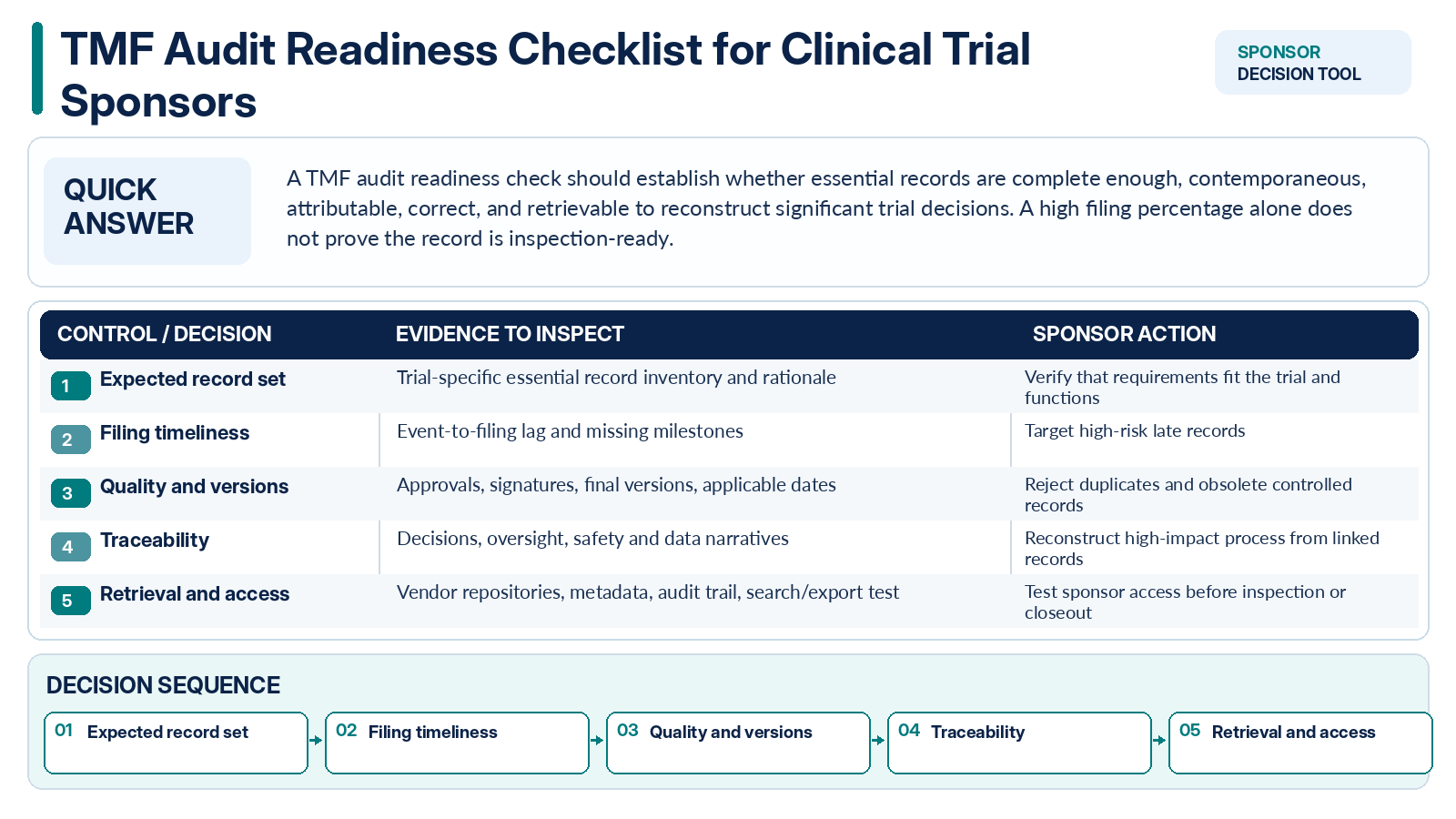
A TMF audit readiness check should establish whether essential records are complete enough, contemporaneous, attributable, correct, and retrievable to reconstruct significant trial decisions. A high filing percentage alone does not prove the record is inspection-ready.
Checklist: controls and supporting evidence
Begin with the most consequential control and the evidence needed to resolve it. The following matrix connects each decision to records and an accountable action, rather than treating the list as a generic compliance checkbox.
| Control / question | Evidence to examine | Sponsor action |
|---|---|---|
| Expected record set | Trial-specific essential record inventory and rationale | Verify that requirements fit the trial and functions |
| Filing timeliness | Event-to-filing lag and missing milestones | Target high-risk late records |
| Quality and versions | Approvals, signatures, final versions, applicable dates | Reject duplicates and obsolete controlled records |
| Traceability | Decisions, oversight, safety and data narratives | Reconstruct high-impact process from linked records |
| Retrieval and access | Vendor repositories, metadata, audit trail, search/export test | Test sponsor access before inspection or closeout |
For teams that need support implementing this across functions, BioBoston CRO TMF Audits can help adapt the controls to the study, vendors, and decision calendar.
Working through the controls
1. Expected record set
Evidence: Trial-specific essential record inventory and rationale. Decision: Verify that requirements fit the trial and functions. Record the responsible function and the approved source version, and keep any remaining exceptions visible to the sponsor before this item is closed.
2. Filing timeliness
Evidence: Event-to-filing lag and missing milestones. Decision: Target high-risk late records. Record the responsible function and the approved source version, and keep any remaining exceptions visible to the sponsor before this item is closed.
3. Quality and versions
Evidence: Approvals, signatures, final versions, applicable dates. Decision: Reject duplicates and obsolete controlled records. Record the responsible function and the approved source version, and keep any remaining exceptions visible to the sponsor before this item is closed.
4. Traceability
Evidence: Decisions, oversight, safety and data narratives. Decision: Reconstruct high-impact process from linked records. Record the responsible function and the approved source version, and keep any remaining exceptions visible to the sponsor before this item is closed.
5. Retrieval and access
Evidence: Vendor repositories, metadata, audit trail, search/export test. Decision: Test sponsor access before inspection or closeout. Record the responsible function and the approved source version, and keep any remaining exceptions visible to the sponsor before this item is closed.
Red flags that should change the plan
- Counting placeholders as complete records.
- No proof of approvals or version history.
- Discovering inaccessible vendor files during an inspection.
Decision gate and governance
Run a risk-based document challenge: select one significant event and trace it from decision through approval, implementation and retained evidence. The control owner should record the decision, evidence version, date, residual uncertainty and next re-review trigger. Where delegated providers perform the work, the sponsor should retain the relevant oversight and acceptance evidence.
Regulatory note: Applicable regulations, trial commitments and agreements must be distinguished from nonbinding FDA and ICH guidance. Apply this framework to the actual product, jurisdiction and study.
Need practical support?
Use BioBoston CRO TMF Audits to review the evidence, define decision rights, and build a study-specific action plan for the next milestone.