FDA briefing book review checklist use should begin before the package reaches final executive approval. A briefing book can be technically complete and still be weak if its questions are broad, sponsor positions are inconsistent, evidence is hard to trace, prior FDA advice is not reconciled, or the package is difficult to navigate under meeting-time pressure.
The final review should therefore test more than grammar and formatting. It should confirm that the package is strategically coherent, scientifically supportable, internally consistent, traceable to controlled sources, and organized so FDA can understand the sponsor’s questions and prepare useful responses.
Quick answer: what should the final briefing book review test?
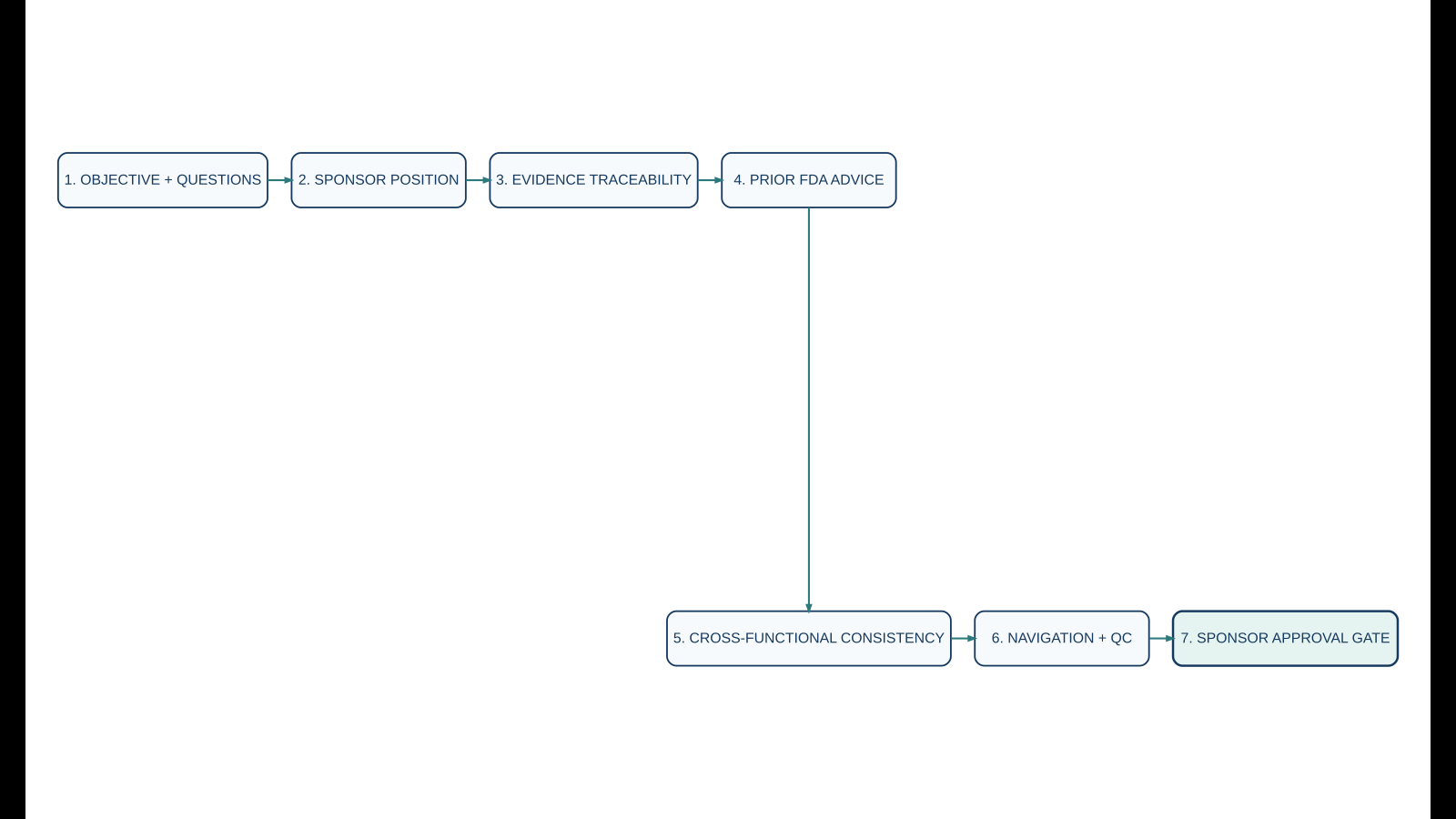
A strong sponsor-approval review should answer seven questions: Are the meeting objectives and final questions clear? Does each question have an approved sponsor position? Is the evidence current and traceable? Are prior FDA commitments reconciled? Are Clinical, Nonclinical, CMC, Statistics, and Regulatory sections consistent? Is the document navigable and technically clean? Are all remaining risks explicitly owned before submission?
If any of those answers is “no,” the package is not ready for sponsor approval simply because the deadline is close.
Who this checklist is for
This FDA briefing book review checklist is designed for CEOs, CMOs, Heads of Regulatory Affairs, clinical-development leaders, program managers, medical/regulatory writers, and independent reviewers preparing a pre-IND, Type B, Type C, or other formal FDA meeting package. It is most useful as a final cross-functional quality gate after the integrated draft exists but before executive approval and submission publishing.
1. Meeting objective, agenda, and question alignment
| Review item | Evidence to verify | Owner | Red flag |
|---|---|---|---|
| Meeting objective is explicit and decision-oriented | Approved meeting objective / request | Regulatory lead | Objective is broad enough to support unrelated questions |
| Final questions match the granted interaction | Meeting request, grant letter, final question list | Regulatory + functional leads | Questions changed materially without clear rationale |
| Questions are grouped by FDA discipline | Final package TOC / question register | Package lead | Questions require reviewers to infer ownership or discipline |
| Agenda reflects unresolved discussion needs | Proposed agenda and estimated discussion time | Regulatory lead | Agenda time is not aligned to question complexity |
For a deeper question-quality review, use the companion guide on drafting focused FDA meeting questions.
2. Sponsor position and evidence traceability
An FDA briefing book review checklist should confirm that each important question has a sponsor position the cross-functional team can defend. The reviewer should be able to trace that position to the data, analysis, prior correspondence, or scientific rationale used to support it.
| Review item | Evidence to verify | Owner | Red flag |
|---|---|---|---|
| Sponsor position is stated consistently | Question context, executive summary, discipline sections | Functional lead | Different sections imply different proposed approaches |
| Supporting data are current | Controlled source documents and data cutoff | Source owner | Tables or conclusions use different cutoffs |
| Claims are traceable | Source register / reference map | Writer + source owner | Reviewer cannot identify the source behind a key statement |
| Uncertainty is transparent | Open-issue log / risk register | Program lead | Known limitations are hidden in wording instead of managed explicitly |
3. Prior FDA advice and commitment reconciliation
A common approval-stage gap is treating prior FDA interactions as background rather than active constraints. Review every relevant prior meeting minute, written response, information request, or correspondence item that affects the current proposal.
- Confirm prior FDA advice is quoted or summarized accurately.
- Identify commitments the sponsor made and whether they are complete, ongoing, modified, or no longer applicable.
- Explain substantive strategy changes rather than silently presenting a different plan.
- Confirm current questions do not re-ask a resolved issue unless new evidence or changed circumstances justify it.
4. Cross-functional consistency review
An FDA briefing book review checklist should test whether the final package reads as one program, not several functional documents assembled together. Cross-functional inconsistencies can be more damaging than minor editorial defects because they undermine the sponsor position itself.
| Cross-check | What must agree | Typical conflict |
|---|---|---|
| Clinical ↔ Nonclinical | Starting dose, escalation logic, exposure margins, safety monitoring | Clinical dose rationale uses assumptions not supported by the current nonclinical summary |
| Clinical ↔ CMC | Product configuration, formulation, strength, route, storage, administration | Clinical description does not match the product/process summary |
| Protocol ↔ briefing book | Population, endpoints, dose, schedule, stopping rules | Package discusses a design version that is no longer current |
| Questions ↔ supporting sections | Proposal, evidence, requested feedback | Question asks FDA to assess an approach not actually described in the support section |
If the package architecture itself is unstable, review the companion resource on what to include and how to organize a pre-IND meeting briefing package.
5. Data, tables, figures, and source-control review
Final review should test whether every data display is both correct and decision-relevant. FDA’s guidance emphasizes summarized material relevant to the questions rather than unnecessary full reports or detailed data dumps.
- Verify table and figure titles, units, populations, timepoints, and data cutoffs.
- Confirm conclusions are supported by the displayed data.
- Check that statistical terminology and denominators are consistent across narrative and tables.
- Remove duplicate or low-value exhibits that do not help answer a question.
- Confirm appendices and cross-references point to the correct final content.
6. Navigation and document-control review
A technically correct package can still be difficult to review if navigation is weak. FDA recommends sequential pagination, a table of contents, appropriate electronic linking, indices, appendices, and cross-references that help reviewers move across the document.
| QC item | Pass condition |
|---|---|
| Pagination | Sequential and stable across the final PDF |
| Table of contents | Matches final headings and page numbers; electronic links work |
| Question numbering | Consistent with the final request/package question structure |
| Cross-references | All section, table, figure, and appendix references resolve correctly |
| Abbreviations / terminology | Consistent and defined where needed |
| File / version control | Final approved version is unambiguous and submission-ready |
7. Final sponsor approval gate
The sponsor-approval meeting should focus on residual risk and decision ownership, not line editing. Before approval, every remaining open item should have an owner, a due date, and an explicit decision on whether it blocks submission.
| Gate | Go | Hold / escalate |
|---|---|---|
| Questions | Final, prioritized, aligned to meeting objective | Scope or sponsor position is still changing |
| Evidence | Current, traceable, internally consistent | Key support is provisional or disputed |
| Prior FDA advice | Reconciled and accurately represented | Unresolved contradiction with prior feedback |
| Cross-functional review | Substantive comments closed | Functional disagreement remains open |
| QC / publishing | Navigation, links, versioning, and files verified | Document-control or submission risk remains |
BioBoston CRO provides FDA Briefing Book Writing support for independent package review, gap identification, question refinement, cross-functional integration, and final quality control when sponsors want an external review layer before approval.
FDA briefing book review checklist: final sign-off
- Meeting objective and agenda are aligned to the decisions needed from FDA.
- Final questions are precise, prioritized, grouped by discipline, and internally approved.
- Each question has a consistent sponsor position and traceable supporting evidence.
- Prior FDA advice and sponsor commitments are reconciled.
- Clinical, Nonclinical, CMC, Statistical, and Regulatory content use the same assumptions and source versions.
- Tables, figures, conclusions, units, populations, and data cutoffs are consistent.
- Question numbering, pagination, TOC links, cross-references, and appendices are correct.
- All substantive review comments are closed or explicitly dispositioned.
- Residual risks have owners and do not create hidden submission blockers.
- The final approved file is the same file that will be submitted.
Need an independent FDA briefing book review?
Explore BioBoston CRO FDA Briefing Book Writing support for a structured review of question quality, evidence traceability, cross-functional consistency, prior FDA commitments, document control, and final submission readiness.