Pre-IND meeting briefing package preparation should start with the decisions the sponsor needs from FDA, not with a blank document. For a pre-IND meeting, the package should give FDA enough focused context, questions, and supporting evidence to understand the development issue and provide useful feedback without forcing reviewers to reconstruct the program from source documents.
The most effective package architecture links each question to an explicit sponsor position, the evidence supporting that position, and the program decision that will follow FDA feedback. That structure keeps the package concise while making the discussion easier to review and act on.
Quick answer: what should a pre-IND meeting briefing package include?
A pre-IND package should carry forward the core information from the meeting request and add the material FDA needs to evaluate the sponsor’s final questions. In practical terms, the package should establish the program context, meeting purpose, agenda, final questions, sponsor positions, and the data needed to support each discussion topic.
FDA’s current formal-meetings guidance recommends that the package be organized according to the proposed agenda, sequentially paginated, easy to navigate, and supported by a table of contents, appropriate electronic linkage, indices, appendices, and cross-references. FDA also recommends no more than 10 total questions, including subquestions, for formal meetings.
Who this guide is for
This guide is designed for a CEO, CMO, Head of Regulatory Affairs, clinical-development leader, or program lead preparing for a pre-IND interaction with FDA. It is most useful when Clinical, Nonclinical, CMC, Statistics, Regulatory, and other functions are contributing to the package and the sponsor needs one controlled structure for integrating the material.
1. Start with the meeting objective and program decisions
Before outlining sections, write down what the sponsor needs to decide after FDA responds. A meeting objective such as “obtain FDA feedback on the proposed first-in-human development approach” is directionally useful, but it is still too broad to organize the package.
Translate it into concrete decision areas. For example: whether the proposed nonclinical package supports clinical entry; whether the starting dose and escalation approach are acceptable; whether the clinical population and key safety controls are appropriate; and whether the CMC information planned for the IND is sufficient for the proposed stage.
| Decision area | Sponsor decision after FDA feedback | Package implication |
|---|---|---|
| Nonclinical | Finalize the studies or analyses required before IND submission | Summarize the evidence supporting the proposed nonclinical strategy and identify any unresolved gap |
| Clinical | Finalize first-in-human population, dose, escalation, stopping, and monitoring approach | Connect protocol concepts directly to focused questions and supporting rationale |
| CMC | Confirm the stage-appropriate manufacturing and control strategy for clinical entry | Provide concise product/process context and data relevant to the questions being asked |
| Regulatory | Confirm the planned path and sequencing of remaining IND-enabling work | Reconcile the proposal with prior FDA advice and applicable guidance |
2. Build the package around final FDA questions
The questions should be the organizing spine of the package. Each question needs enough context for FDA to understand the issue, the sponsor’s proposed approach, and why the answer matters. Avoid asking FDA to design the development program from scratch. A focused question is stronger when the sponsor has already analyzed the problem and can present a reasoned position for FDA to evaluate.
Use a question → position → evidence → decision map
| Field | What to capture | Readiness test |
|---|---|---|
| Question | The specific feedback requested from FDA | Can FDA understand exactly what is being asked? |
| Sponsor position | The proposed approach the sponsor believes is appropriate | Has the team agreed on one position? |
| Evidence | Data, analyses, guidance rationale, prior correspondence, or scientific reasoning supporting the position | Is the evidence traceable to a controlled source and current data cutoff? |
| Decision | What the sponsor will decide or change after FDA feedback | Will the response materially affect the program? |
This map prevents a common failure mode: drafting lengthy background sections before the team has agreed on the actual question and proposed answer. It also makes cross-functional review more efficient because reviewers can distinguish scientific disagreement from wording edits.
3. Organize the pre-IND package so FDA can navigate it quickly
FDA recommends organizing meeting-package content according to the proposed agenda. For a pre-IND meeting briefing package, a practical sponsor-side structure is:
- Front matter and navigation: cover information, table of contents, attendee list, abbreviations where useful, and clear electronic navigation.
- Program background: a concise development history, relevant prior FDA communications, current program status, and substantive changes to the development plan when applicable.
- Meeting purpose and agenda: the Type B pre-IND objective, proposed agenda, and expected discussion time for major topics.
- Final questions: grouped by FDA discipline, each with concise context and a defined sponsor position.
- Supporting evidence: summary data and analysis organized by discipline and question, with enough quantification to support FDA review.
- Appendices and cross-references: supporting material only when it genuinely helps answer the questions; use clear cross-references so reviewers do not have to search.
FDA’s guidance states that full protocols, full study reports, or detailed data generally are not the default meeting-package format. The package should instead provide summarized information relevant to the questions, with quantified results and conclusions where appropriate. That does not mean supporting detail is unimportant; it means detail should be selected and organized around the decision FDA is being asked to address.
4. Decide what belongs in each discipline section
The exact mix of content depends on the product and the questions. There is no universal pre-IND template that fits every development program. The package should use the minimum background necessary to make the questions answerable, while preserving enough scientific and regulatory context for meaningful review.
| Discipline | Typical package inputs | Common mistake |
|---|---|---|
| Clinical | Proposed indication/population, first-in-human concept, starting dose rationale, escalation, safety monitoring, stopping rules, key endpoints | Providing a protocol-like narrative without identifying the specific design decisions requiring FDA feedback |
| Nonclinical | Completed/planned studies, species/model rationale, exposure margins, key findings, remaining IND-enabling work | Listing studies without explaining how they support the proposed clinical entry strategy |
| CMC | Product description, manufacturing/process overview, characterization, controls, stability, stage-appropriate development status | Overloading the package with technical detail that is not tied to a question or clinical-entry risk |
| Clinical pharmacology / statistics | When relevant, dose/exposure rationale, modeling, analysis concepts, sample-size or decision logic | Adding analyses that do not change the sponsor position or FDA decision |
| Regulatory / program | Development plan, prior advice, planned IND sequence, applicable guidance considerations | Failing to reconcile the current proposal with prior FDA feedback or a material change in strategy |
5. Control source documents, data cutoffs, and ownership
A pre-IND meeting briefing package can look polished and still be unstable underneath. Before drafting accelerates, create a source register that identifies the controlled document or dataset behind each factual statement, table, figure, and sponsor position.
At minimum, track the source owner, version/date, data cutoff, intended package section, and whether the source is final enough to draft against. This is especially important when the protocol synopsis, nonclinical reports, CMC data, and dose rationale are still developing in parallel.
| Package element | Source owner | Version / cutoff | Open issue | Approval owner |
|---|---|---|---|---|
| Clinical design rationale | Clinical Development | Current approved synopsis / decision memo | Population or escalation decision pending | CMO / Clinical lead |
| Starting-dose rationale | Nonclinical / Clinical Pharmacology | Current analysis and supporting study outputs | Final exposure margin pending | Functional lead + CMO |
| CMC summary | CMC | Current development report / stability cutoff | One assay or stability update pending | CMC lead |
| FDA history | Regulatory | Current correspondence log | None | Regulatory lead |
6. Plan the authoring schedule backward from the FDA deadline
A pre-IND meeting is a Type B meeting under the current PDUFA formal-meetings framework. FDA’s August 2026 guidance states that the Type B meeting package is due no later than 30 calendar days before the scheduled meeting or WRO response time.
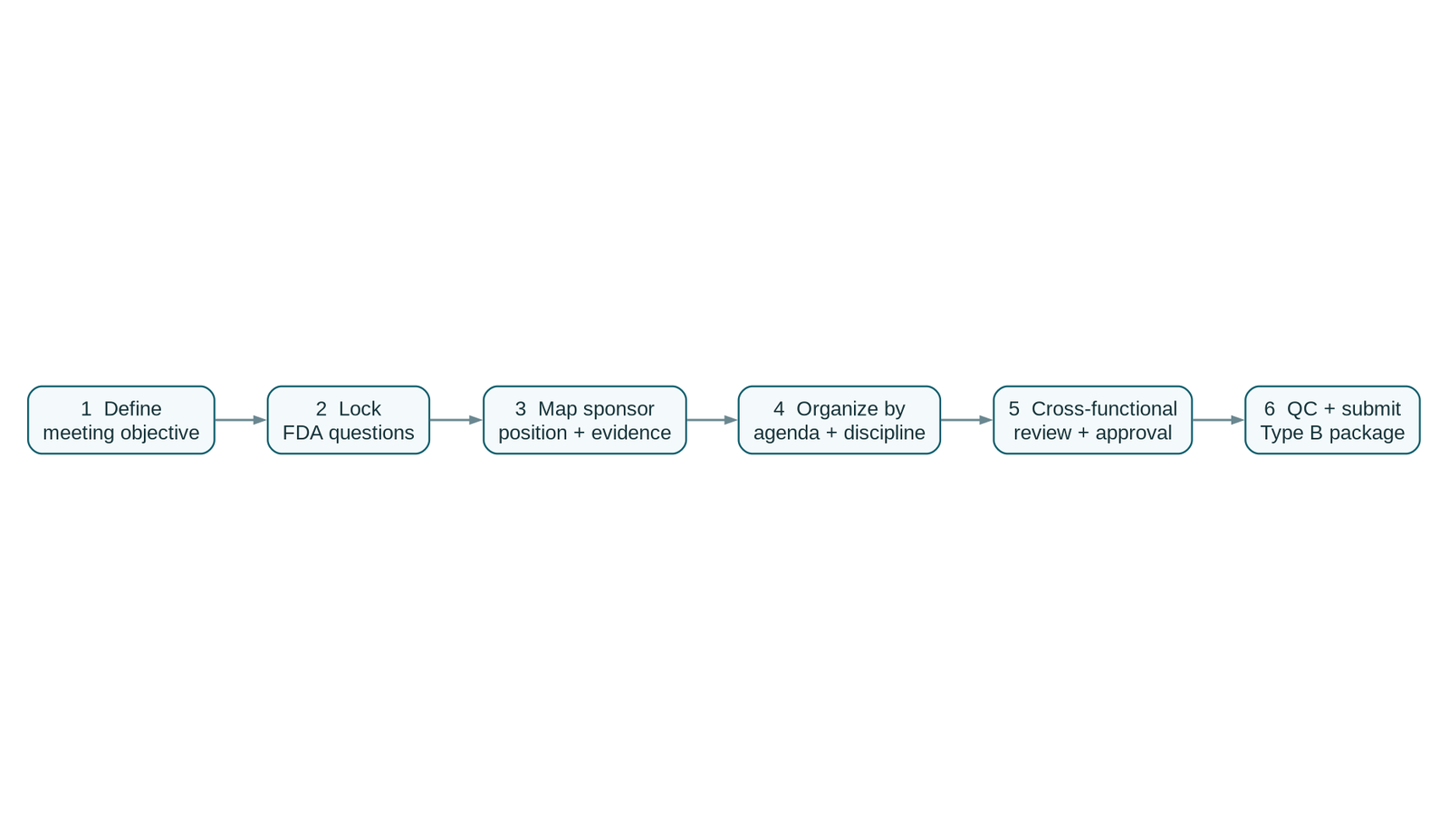
That FDA deadline is not the sponsor’s internal writing deadline. A lean team still needs time for question alignment, source stabilization, discipline drafting, integrated review, leadership decisions, quality control, and submission publishing. The internal schedule should therefore include explicit freeze points for questions and sponsor positions rather than allowing them to change until the filing date.
A practical internal sequence
- Strategy lock: confirm meeting objective, decision areas, and question inventory.
- Source lock: confirm the data, reports, analyses, and correspondence supporting each question.
- Integrated draft: draft the package around questions rather than independent functional essays.
- Cross-functional review: resolve scientific and regulatory comments before copyediting.
- Executive approval: approve sponsor positions and any material tradeoffs.
- QC and publishing: verify numbering, cross-references, data consistency, links, tables, terminology, and final submission readiness.
7. Use one review model and clear decision rights
A package becomes difficult to control when every reviewer edits every section. Define who authors, who supplies source content, who resolves technical comments, who approves sponsor positions, and who owns final question wording.
If the sponsor needs a dedicated authoring and integration layer, BioBoston CRO provides FDA Briefing Book Writing support for complete packages, selected sections, existing-draft revision, cross-functional integration, and independent quality control.
Common pre-IND meeting briefing package failure modes
- Questions are still changing while writers are polishing background sections.
- The sponsor has not agreed on a proposed position before asking FDA for feedback.
- Clinical, Nonclinical, and CMC sections use different assumptions, versions, or data cutoffs.
- Prior FDA feedback is mentioned but not reconciled with the current proposal.
- Supporting data are included because they are available, not because they help answer a question.
- Full reports or excessive appendices make the package harder to navigate.
- Review comments focus on wording while underlying scientific decisions remain unresolved.
- The team treats the 30-day FDA package deadline as the writing deadline instead of the submission deadline.
Pre-IND briefing package readiness checklist
Before the package enters final integrated review, confirm that:
- The meeting objective is tied to real development decisions.
- The final question set is prioritized and within the appropriate scope for the meeting.
- Each question has an approved or clearly identified sponsor position.
- Each sponsor position has traceable supporting evidence.
- Questions and support are grouped logically by FDA discipline and agenda topic.
- Program background is concise and reconciled with prior FDA communications.
- Data cutoffs and source-document versions are controlled.
- Functional authors, technical reviewers, approval owners, and the final QC owner are named.
- The internal review schedule leaves adequate time before the FDA package deadline.
- The final package is navigable, consistently numbered, cross-referenced, and submission-ready.
What to do if the package exposes strategic gaps
If the open issues are broader than writing, resolve the development and regulatory sequence before adding more text. BioBoston CRO’s Regulatory Pathway and Submission Planning services can support those decisions. If the clinical design itself is still moving, Protocol Writing support can help connect the study concept, FDA questions, and downstream protocol package.
Need help preparing the pre-IND meeting package?
Explore BioBoston CRO FDA Briefing Book Writing support for a source-supported package organized around defined objectives, focused questions, sponsor positions, evidence, review ownership, and submission readiness.