Tables, listings, and figures shells are most valuable when they are drafted early enough to change an unclear study decision. Waiting until the database is nearly locked may expose inconsistencies too late for efficient correction. Building every output at protocol concept stage, however, creates unnecessary rework. A staged approach balances decision value against specification stability.
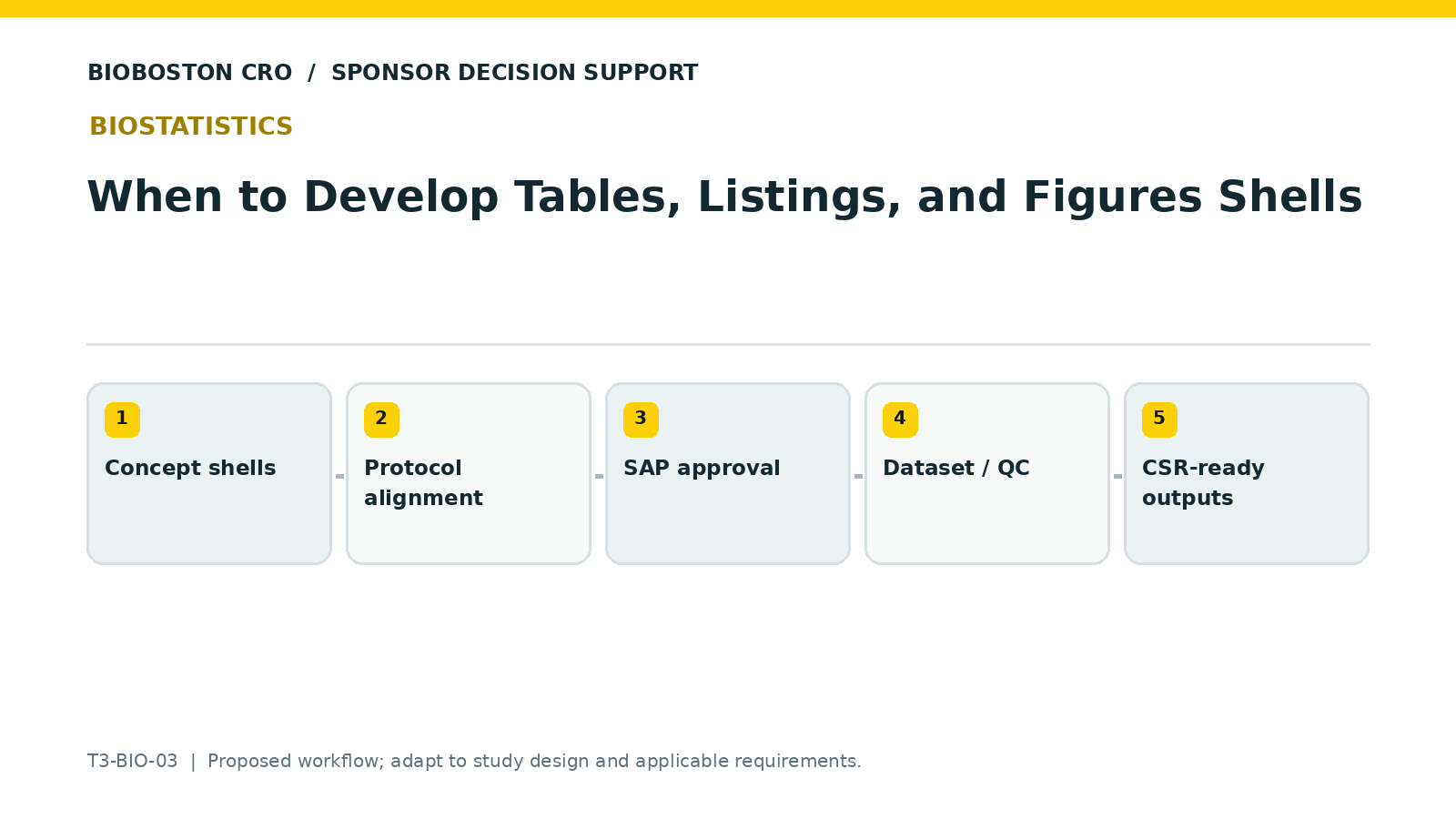
This guide separates the time to define decision-critical outputs from the time to finalize detailed shell specifications. It is for sponsors coordinating biostatistics, medical writing, data management and clinical review across a study with tight analysis and Clinical Study Report deadlines.
What the sponsor needs to decide
Treat TLFs as traceability and review tools, not decorative CSR layouts. Each planned display should answer a study question, have an identifiable source and population, and carry an owner and version. Prioritize the outputs that can change an endpoint, collection requirement or safety interpretation.
When to Develop Tables, Listings, and Figures Shells: evidence and decision matrix
| Review point | Evidence to collect | Sponsor decision or acceptance criterion |
|---|---|---|
| Protocol concept | Primary endpoint, estimand, key safety questions | Outline decision-critical displays and ensure the required data can be collected. |
| Protocol finalization | Final schedule of assessments, analysis objectives, estimand decisions | Produce high-level shells for primary, key secondary and major safety outputs. |
| Draft SAP review | Analysis populations, statistical methods, data definitions and mock TLFs | Link each key shell to SAP sections, derived variables and denominator rules. |
| EDC build and data integration | eCRFs, vendor data-transfer specs, derived data assumptions | Confirm that inputs to planned displays are captured and reconcilable. |
| Before database lock | Approved SAP, output definitions, coding conventions and validation approach | Freeze version-controlled production shells and resolve open scientific ambiguities. |
| After lock / CSR authoring | Validated datasets, approved TLFs and reviewer questions | Track deviations, output revisions, narrative interpretation and review approvals. |
How to apply this framework to a real sponsor decision
Start with decision-critical shells
For each primary or key secondary objective, sketch the intended table or figure and ask whether its rows, timepoints and population correspond to what the protocol can actually deliver. A shell is a useful stress test for an endpoint definition.
Use an explicit maturity label
Mark an outline as conceptual, review-ready, or production-approved. This prevents a draft shell from being treated as an authorized statistical analysis specification. Record why a shell was deferred or changed.
Align safety outputs with medical decisions
Exposure summaries, adverse-event categories and clinically important shifts should be reviewed with Medical and Safety. A familiar table layout may conceal an unhelpful denominator, time window or grouping rule.
Give medical writing a controlled preview
Medical writers can plan CSR structure and narratives from stable shell outlines without assuming final results. Agree on file naming, version handling, outputs to be locked and how corrected tables are reissued.
Leave a complete change trail
A protocol amendment can force changes in assessments, populations, analysis variables and TLFs. Maintain a cross-reference so reviewers know which output versions are affected and who approved the change.
Warning signs that need intervention
- Draft shells are mistaken for approved analyses.
- A table requests a variable not collected in EDC or external datasets.
- A late denominator change cascades into multiple CSR chapters.
- Clinical and Medical interpretation begins only after the final outputs arrive.
- The shell inventory has no owner or version history.
First-week sponsor action plan
- Identify the ten decision-critical displays before protocol freeze.
- Build an output inventory with objective, population, source and maturity columns.
- Review top-priority shells with Statistics, Data Management, Medical and Writing.
- Agree on production freeze, validation and reissue procedures before database lock.
To connect this decision framework to actual study responsibilities, see BioBoston CRO Biostatistics Services support. The service team can help structure sponsor oversight and the evidence needed to make a documented decision; site-facing or other specialized execution may be coordinated with qualified partners where appropriate.
Frequently asked sponsor questions
Do all TLF shells need to be finished before the protocol?
No. Prioritize shells that test clinical decisions. Detailed production shells should mature with the SAP and data specifications.
Can shells help reduce CSR writing delays?
Yes, if they clarify output ownership and expected structure early; they do not eliminate data or statistical review dependencies.
Who approves the shells?
Statistical methods belong with qualified Statistics reviewers, while Medical, Safety, Data and Writing should review their respective interpretation and usability needs.
Technical and regulatory context
The framework reflects relevant FDA/ICH principles, including ICH E9, ICH E9(R1), ICH E3. Guidance documents contain nonbinding recommendations and should not be described as universal legal requirements. Applicable binding obligations and study-specific authority expectations should be assessed separately; retain current source/version records in the internal quality file.
Next step for the sponsor
If your team is resolving the decisions above, explore BioBoston CRO Biostatistics Services services for a scoped assessment, responsibility map or expert-supported working plan. Keep the decision record and supporting evidence even if you ultimately use another delivery model.