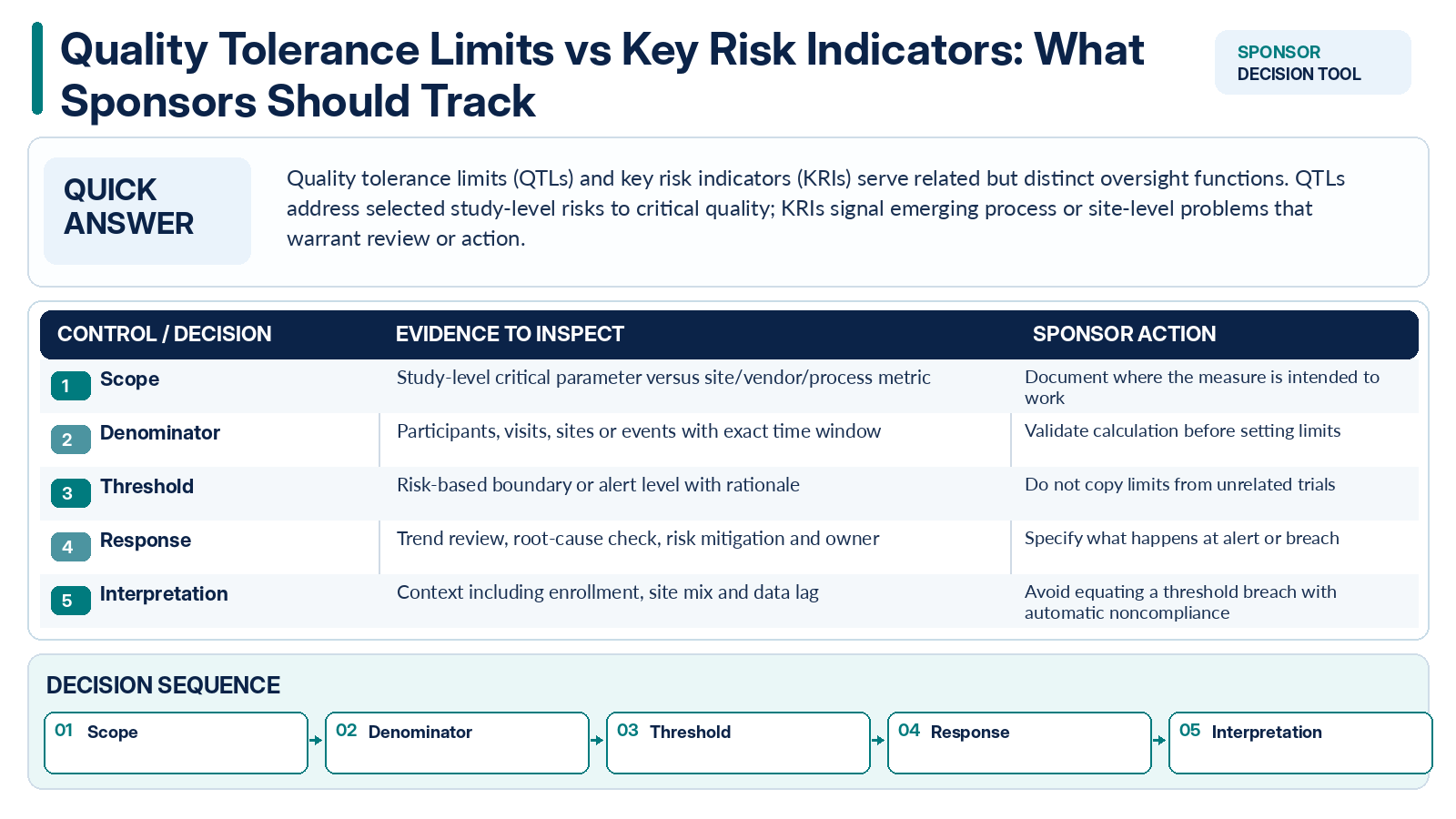
Quality tolerance limits (QTLs) and key risk indicators (KRIs) serve related but distinct oversight functions. QTLs address selected study-level risks to critical quality; KRIs signal emerging process or site-level problems that warrant review or action.
Decision factors and what they mean
Begin with the most consequential control and the evidence needed to resolve it. The following matrix connects each decision to records and an accountable action, rather than treating the list as a generic compliance checkbox.
| Control / question | Evidence to examine | Sponsor action |
|---|---|---|
| Scope | Study-level critical parameter versus site/vendor/process metric | Document where the measure is intended to work |
| Denominator | Participants, visits, sites or events with exact time window | Validate calculation before setting limits |
| Threshold | Risk-based boundary or alert level with rationale | Do not copy limits from unrelated trials |
| Response | Trend review, root-cause check, risk mitigation and owner | Specify what happens at alert or breach |
| Interpretation | Context including enrollment, site mix and data lag | Avoid equating a threshold breach with automatic noncompliance |
For teams that need support implementing this across functions, BioBoston CRO Quality Management can help adapt the controls to the study, vendors, and decision calendar.
Working through the controls
1. Scope
Evidence: Study-level critical parameter versus site/vendor/process metric. Decision: Document where the measure is intended to work. Record the responsible function and the approved source version, and keep any remaining exceptions visible to the sponsor before this item is closed.
2. Denominator
Evidence: Participants, visits, sites or events with exact time window. Decision: Validate calculation before setting limits. Record the responsible function and the approved source version, and keep any remaining exceptions visible to the sponsor before this item is closed.
3. Threshold
Evidence: Risk-based boundary or alert level with rationale. Decision: Do not copy limits from unrelated trials. Record the responsible function and the approved source version, and keep any remaining exceptions visible to the sponsor before this item is closed.
4. Response
Evidence: Trend review, root-cause check, risk mitigation and owner. Decision: Specify what happens at alert or breach. Record the responsible function and the approved source version, and keep any remaining exceptions visible to the sponsor before this item is closed.
5. Interpretation
Evidence: Context including enrollment, site mix and data lag. Decision: Avoid equating a threshold breach with automatic noncompliance. Record the responsible function and the approved source version, and keep any remaining exceptions visible to the sponsor before this item is closed.
Red flags that should change the plan
- No predefined response to a breach.
- Mistaking a KRI alert for an FDA-mandated QTL.
- Comparing rates with incompatible denominators.
Decision gate and governance
For each proposed QTL ask whether the measure reflects a genuinely critical study-wide risk; otherwise a KRI may be the more useful mechanism. The control owner should record the decision, evidence version, date, residual uncertainty and next re-review trigger. Where delegated providers perform the work, the sponsor should retain the relevant oversight and acceptance evidence.
Regulatory note: Applicable regulations, trial commitments and agreements must be distinguished from nonbinding FDA and ICH guidance. Apply this framework to the actual product, jurisdiction and study.
Need practical support?
Use BioBoston CRO Quality Management to review the evidence, define decision rights, and build a study-specific action plan for the next milestone.