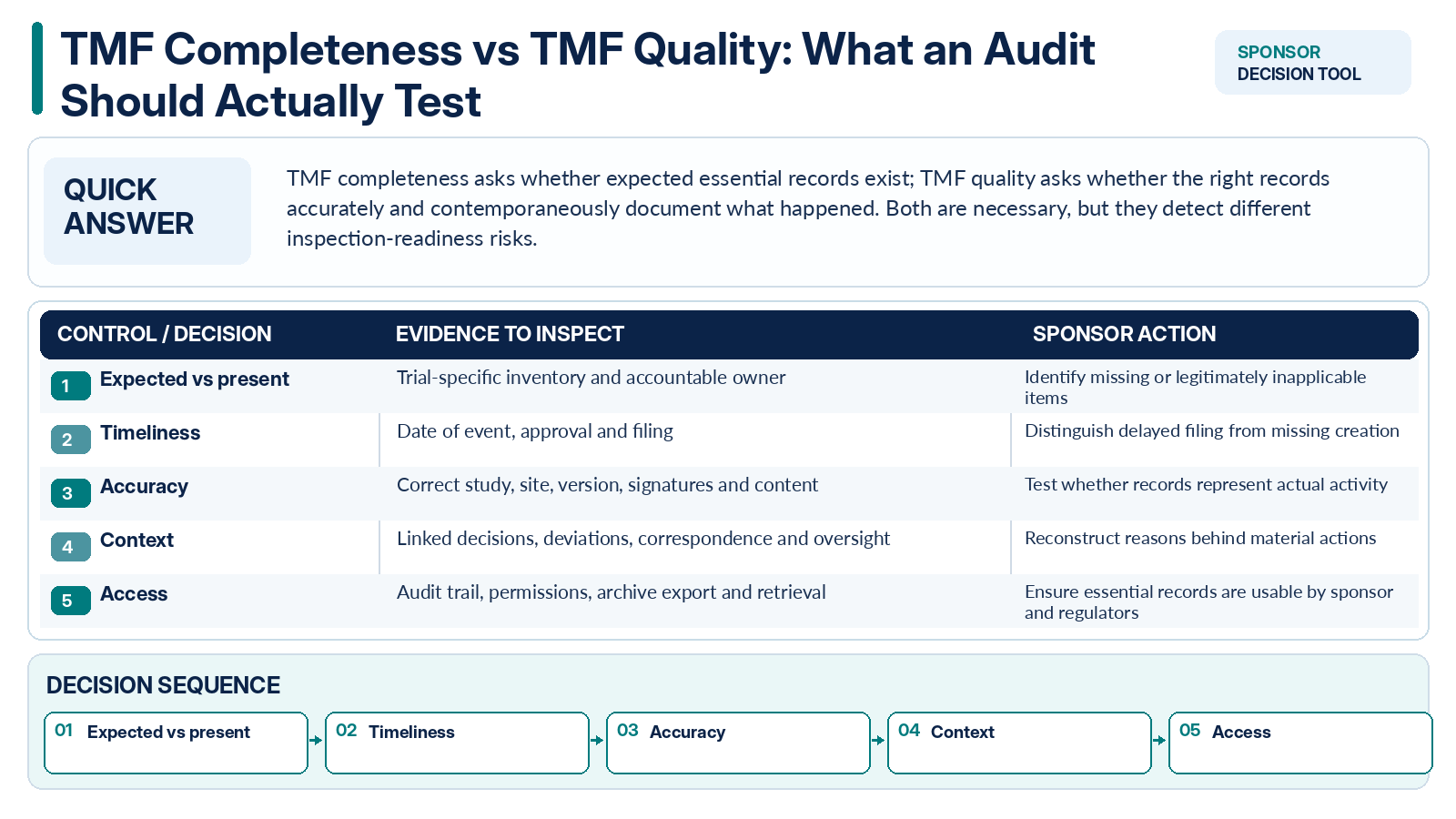
TMF completeness asks whether expected essential records exist; TMF quality asks whether the right records accurately and contemporaneously document what happened. Both are necessary, but they detect different inspection-readiness risks.
Decision factors and what they mean
Begin with the most consequential control and the evidence needed to resolve it. The following matrix connects each decision to records and an accountable action, rather than treating the list as a generic compliance checkbox.
| Control / question | Evidence to examine | Sponsor action |
|---|---|---|
| Expected vs present | Trial-specific inventory and accountable owner | Identify missing or legitimately inapplicable items |
| Timeliness | Date of event, approval and filing | Distinguish delayed filing from missing creation |
| Accuracy | Correct study, site, version, signatures and content | Test whether records represent actual activity |
| Context | Linked decisions, deviations, correspondence and oversight | Reconstruct reasons behind material actions |
| Access | Audit trail, permissions, archive export and retrieval | Ensure essential records are usable by sponsor and regulators |
For teams that need support implementing this across functions, BioBoston CRO TMF Audits can help adapt the controls to the study, vendors, and decision calendar.
Working through the controls
1. Expected vs present
Evidence: Trial-specific inventory and accountable owner. Decision: Identify missing or legitimately inapplicable items. Record the responsible function and the approved source version, and keep any remaining exceptions visible to the sponsor before this item is closed.
2. Timeliness
Evidence: Date of event, approval and filing. Decision: Distinguish delayed filing from missing creation. Record the responsible function and the approved source version, and keep any remaining exceptions visible to the sponsor before this item is closed.
3. Accuracy
Evidence: Correct study, site, version, signatures and content. Decision: Test whether records represent actual activity. Record the responsible function and the approved source version, and keep any remaining exceptions visible to the sponsor before this item is closed.
4. Context
Evidence: Linked decisions, deviations, correspondence and oversight. Decision: Reconstruct reasons behind material actions. Record the responsible function and the approved source version, and keep any remaining exceptions visible to the sponsor before this item is closed.
5. Access
Evidence: Audit trail, permissions, archive export and retrieval. Decision: Ensure essential records are usable by sponsor and regulators. Record the responsible function and the approved source version, and keep any remaining exceptions visible to the sponsor before this item is closed.
Red flags that should change the plan
- Assuming 100% completeness means audit-ready.
- Double-counting duplicates.
- Excluding vendor-controlled records from quality review.
Decision gate and governance
Report completeness and quality scores separately with criticality-weighted exceptions and remediation owners. The control owner should record the decision, evidence version, date, residual uncertainty and next re-review trigger. Where delegated providers perform the work, the sponsor should retain the relevant oversight and acceptance evidence.
Regulatory note: Applicable regulations, trial commitments and agreements must be distinguished from nonbinding FDA and ICH guidance. Apply this framework to the actual product, jurisdiction and study.
Need practical support?
Use BioBoston CRO TMF Audits to review the evidence, define decision rights, and build a study-specific action plan for the next milestone.