Investigator brochure update decisions should be based on whether new information changes what investigators need to know about the product, its risks, the clinical-development context, or safe study conduct. An annual review is a required control point under ICH E6(R3), but it is not the only trigger. Important new safety information, clinically relevant product changes, material nonclinical or clinical findings, or a change that makes the current brochure inconsistent with active protocols can require earlier action.
The practical question is not simply, “Has a year passed?” It is: Does the current IB still give investigators an accurate, balanced, and sufficiently current basis for conducting the study safely and understanding the investigational product?
Quick answer: what should trigger an Investigator Brochure revision?
Revision should be considered when new information materially affects investigator understanding, benefit-risk interpretation, Reference Safety Information (RSI), product use, protocol alignment, or the accuracy of the current brochure. Typical triggers include significant new safety findings, new or changed expected adverse reactions, meaningful nonclinical findings, new human data, formulation or manufacturing changes with clinical relevance, changes in dose or administration, important regulatory feedback, and major protocol or development-strategy changes.
By contrast, a scheduled annual review can conclude that no substantive revision is needed if the current brochure remains accurate and complete. That conclusion should still be documented through the sponsor’s controlled review process.
Who this decision guide is for
This guide is designed for Clinical Development, Medical Writing, Safety/Pharmacovigilance, Regulatory Affairs, CMC, Nonclinical, and program leaders who own an active Investigator’s Brochure or are planning the next controlled update. It is especially useful when new information is arriving continuously and the team needs a consistent method for deciding whether to revise now, include the change in the next planned update, communicate it urgently outside the IB cycle, or document that no IB change is needed.
1. Separate annual review from event-driven revision
An annual review is the minimum recurring governance checkpoint described in ICH E6(R3). It should assess whether the brochure remains current, whether accumulated evidence changes the benefit-risk interpretation, whether the RSI remains appropriate, and whether the document still aligns with active clinical use.
An event-driven revision is different. It begins because new information has emerged that may make the current brochure incomplete, inaccurate, or no longer adequate for investigators. The event can arise at any time in the year.
| Situation | Primary question | Likely action |
|---|---|---|
| Scheduled annual review | Does the current IB remain accurate and complete? | Revise if needed; otherwise document the review outcome |
| Important new safety information | Do investigators need this information now for safe conduct? | Use the appropriate urgent communication pathway; revise the IB as appropriate |
| New data with moderate impact | Does the information materially change an IB section or investigator guidance? | Targeted or planned controlled revision |
| Administrative/editorial correction | Does the change affect scientific meaning, safety, or study conduct? | Document and correct through normal document control |
2. Safety information is the highest-priority trigger
Safety information should never be treated as a routine editorial update. FDA’s IND framework requires participating investigators to be kept informed of new observations, especially adverse effects and safe-use information, and FDA guidance states that the IB must be updated on an ongoing basis with important new safety information.
Questions to ask immediately include:
- Does the new information change the known or potential risks of the investigational product?
- Does it affect the expectedness, nature, severity, or frequency of adverse reactions described in the RSI?
- Does it change monitoring, precautions, dose modification, interruption, stopping, or management guidance?
- Could the information affect an investigator’s decision to enroll, dose, monitor, or continue a participant?
- Does it require communication before the next formal IB revision can be completed?
3. New nonclinical or clinical evidence can trigger a targeted update
Not every new study result requires an immediate new IB version. The key question is whether the result changes the investigator-facing interpretation of the product.
| New evidence | Revision is more likely when… | Owner(s) |
|---|---|---|
| Nonclinical pharmacology/toxicology | It changes human relevance, dose/exposure interpretation, organ-risk understanding, monitoring, or precautions | Nonclinical + Medical/Safety |
| Human PK/PD | It changes dose, exposure assumptions, interaction concerns, or administration guidance | Clinical Pharmacology + Clinical |
| Clinical safety | It changes risk characterization, RSI, monitoring, or management | Safety/Medical |
| Clinical efficacy/activity | It materially changes the development rationale, population, benefit-risk context, or investigator interpretation | Clinical Development |
The update should reflect the maturity of the evidence. A signal under evaluation should not be written as a confirmed causal relationship, and preliminary efficacy should not be presented as established benefit.
4. Product, formulation, manufacturing, or administration changes require an impact assessment
CMC changes do not automatically mean the entire IB needs substantial rewriting, but they should be screened for investigator relevance. A formulation, strength, route, device component, storage condition, handling instruction, or manufacturing change may affect clinical use even when the change originates outside the clinical team.
Escalate the update when a product change affects:
- what investigators or site staff receive, store, prepare, or administer;
- dose, concentration, route, schedule, or administration instructions;
- known or potential risks, excipient exposure, compatibility, or handling precautions;
- the identity or description of the investigational product in active protocols; or
- the scientific rationale that connects product attributes to clinical performance or safety.
5. Protocol and development-strategy changes can make the current IB obsolete
The protocol and IB serve different purposes, but they should not conflict. A change in dose, population, route, schedule, stopping rules, safety monitoring, or study context can expose an inconsistency even when no single new data point would have triggered an IB revision by itself.
If the protocol is being revised, compare the proposed changes against the IB before approval. BioBoston CRO’s Protocol Writing support can help align protocol assumptions, investigator guidance, and source-controlled development information when both documents are moving together.
6. Regulatory feedback or external decisions can be revision triggers
FDA or other health-authority feedback can change the sponsor’s safety interpretation, clinical strategy, product use, monitoring approach, or required investigator information. The same is true when another regulator, an independent monitoring body, or a sponsor governance process identifies a material risk or development change.
Do not copy regulatory correspondence into the IB mechanically. Instead, determine what investigator-facing information, if any, must change and whether related documents also need alignment.
7. Use a structured Investigator Brochure update score
The following BioBoston CRO framework is a decision-support tool, not a regulatory rule. It helps teams triage changes consistently before Medical, Safety, Regulatory, and functional owners make the final decision.
| Decision factor | 0 | 1 | 2 |
|---|---|---|---|
| Investigator relevance | No investigator-facing impact | Useful context | Changes safe use or study conduct |
| Safety / benefit-risk impact | No meaningful change | Emerging or limited impact | Material risk, RSI, or benefit-risk change |
| Cross-document impact | No inconsistency | Minor alignment needed | Current IB conflicts with protocol or controlled source |
| Regulatory significance | Administrative only | May affect regulatory interpretation | Directly reflects important authority feedback or obligation |
| Timing sensitivity | Can wait for planned review | Should enter next controlled revision | Investigators need action/information promptly |
Suggested interpretation: 0-3 = document and assess at the next planned review; 4-7 = prepare a targeted or scheduled revision; 8-10 = escalate for prompt revision and associated document/communication assessment. Urgent safety information overrides the score. A low numerical score should never delay a required or medically necessary safety communication.
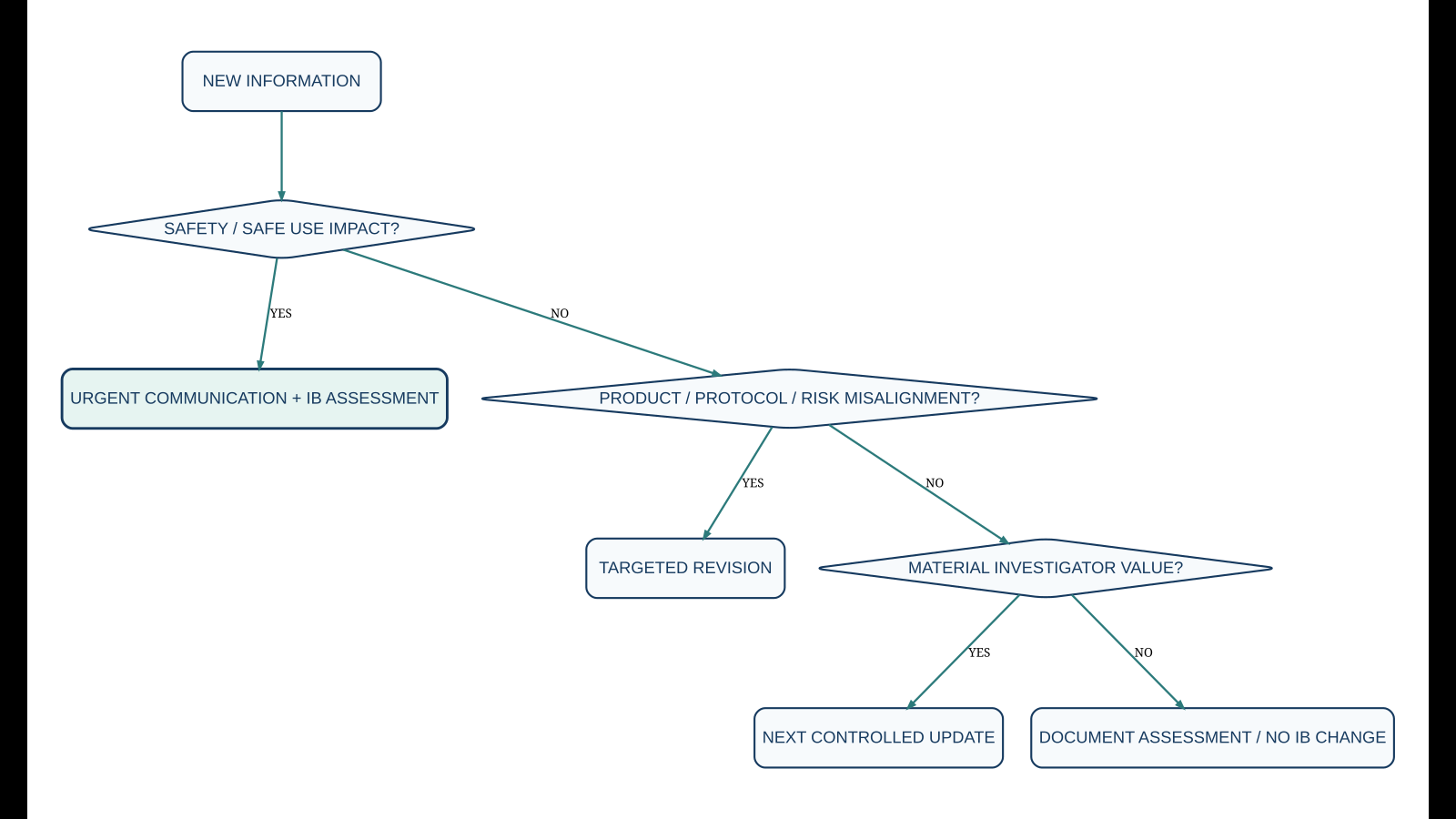
8. Investigator Brochure update decision tree
- Is the information new and verified enough to assess? If no, continue surveillance and document the open issue.
- Does it materially change risk, RSI, monitoring, precautions, dosing, or safe use? If yes, escalate immediately to Medical/Safety/Regulatory and assess urgent communication plus IB revision.
- Does it make the current IB inconsistent with the product, protocol, clinical strategy, or controlled source data? If yes, plan a targeted revision.
- Does it materially improve investigator understanding but not change immediate safe conduct? If yes, include it in the next controlled revision based on timing and program needs.
- Is the change editorial, administrative, or non-material? Document the assessment and handle through normal document control.
9. Do not update one section without checking downstream effects
A single new finding can affect several parts of the IB. A safety signal may change the human safety section, RSI, integrated summary, investigator precautions, protocol monitoring, informed-consent risk language, or other controlled documents. A formulation change may affect product description, handling, protocol instructions, and site-facing materials.
Use an impact matrix that records the new information, source, affected IB sections, related documents, decision owner, urgency, and final disposition. When the update is part of a broader submission sequence, Submission Planning support can help coordinate timing and dependencies.
Red flags that should stop routine document processing
- Safety and Medical functions disagree on the interpretation of a new risk.
- The proposed RSI change lacks an approved evidence basis.
- The active protocol and current IB describe different dose, route, formulation, population, or monitoring expectations.
- The source data cut-off is unclear or different functions are using different versions.
- A potentially urgent investigator communication is being deferred only because the IB revision is not ready.
- A major product or regulatory change has not been assessed across related documents.
- The team cannot identify who has authority to approve the revision decision.
If a breakdown in the sponsor’s change-control or clinical-quality process requires formal remediation, BioBoston CRO’s GCP CAPA Support may be relevant.
Investigator Brochure update: recommended sponsor controls
- Perform and document at least an annual IB review.
- Maintain an event-driven impact-assessment process between annual reviews.
- Define who owns Medical/Safety, Regulatory, CMC, Clinical, and Nonclinical update decisions.
- Use one controlled data cut-off and source register for each revision.
- Track affected IB sections and related protocols/documents before drafting begins.
- Separate urgent investigator communication from the slower document-revision cycle when necessary.
- Document the rationale when the annual review concludes that no substantive revision is needed.
- Include revised IB information in applicable regulatory maintenance activities, including the IND annual report when required.
BioBoston CRO provides Investigator Brochure Support for annual and event-driven impact assessment, controlled updates, substantial revision, source integration, cross-functional review, and independent quality control.
Need help deciding whether your IB needs revision?
Explore BioBoston CRO Investigator Brochure Support to assess new safety, clinical, nonclinical, product, protocol, and regulatory information and translate the approved decisions into a controlled, source-supported revision.