Clinical trial site feasibility assessment should test evidence of usable patient access, protocol fit, operational capacity and investigator readiness rather than rely on a site’s unqualified enrollment promise. A prominent investigator or large institution can be a poor fit if eligibility is restrictive, competing studies use the same population, or contracting and staffing timelines are unrealistic.
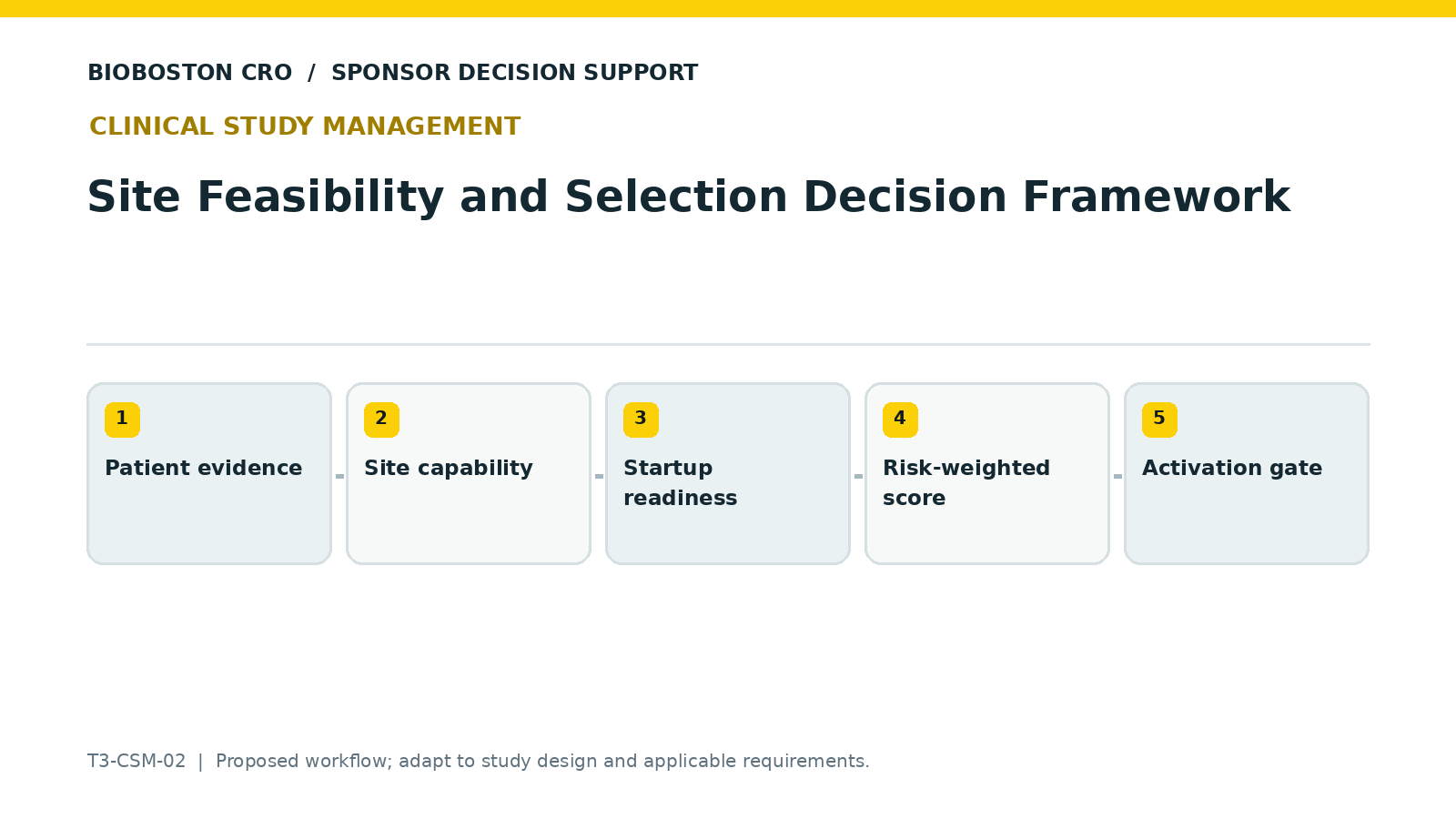
This guide gives sponsors a structured decision framework for selecting sites before activation and revisiting selections when actual recruitment diverges from the plan. It is intended for Clinical Operations, Medical, Project Management and site-startup partners working with early-phase or specialized populations.
What the sponsor needs to decide
Assess feasibility in stages: desktop qualification, documented site evidence, investigator/site discussion, and an acceptance decision. Use a consistent scoring rubric but treat critical participant-safety or capability failures as stop conditions rather than problems to be averaged away.
Site Feasibility and Selection Decision Framework: evidence and decision matrix
| Review point | Evidence to collect | Sponsor decision or acceptance criterion |
|---|---|---|
| Patient funnel and eligibility | De-identified eligible counts by criterion, available data source and look-back window | Use site-specific screen-to-randomize assumptions and confidence ranges. |
| Competing demand | Overlapping trials, competing protocols, standard-of-care pathways and referral patterns | Discount recruitment claims that assume the same patients for several programs. |
| Investigator and team capacity | PI qualifications, coordinator staffing, turnover, training and backup coverage | Check whether capacity is available during the actual startup and accrual window. |
| Protocol and equipment fit | Procedures, visit burden, pharmacy, laboratory, imaging and safety-response capability | Mandatory capability gaps are explicit no-go or remediation gates. |
| Startup and contracts | IRB pathway, budget/contract history, essential-document readiness and vendor interfaces | Estimate credible activation timing rather than an aspirational best case. |
| Quality and oversight | Past issue patterns where available, data timeliness, delegation controls and monitoring access | Ask whether the site can provide reliable protocol and source documentation. |
| Geography and participant burden | Referral travel, visit frequency, remote-visit policies and language/access barriers | Account for patient burden and retention, not only site convenience. |
How to apply this framework to a real sponsor decision
Start from the protocol, not from a preferred site list
Convert inclusion/exclusion criteria and study assessments into feasibility questions. Distinguish hard requirements (equipment, specialty care or emergency coverage) from factors that can improve with training or vendor support.
Quantify the recruitment funnel
Ask sites for plausible numbers at each stage: patients identifiable, potentially eligible, reachable, consenting, screened and randomized. Request a source and time window for each estimate; avoid treating a database query as a promised enrollment rate.
Score evidence quality as well as potential
Mark data as observed, estimated or promotional. A site with moderate patient counts backed by reliable records may be a better decision than a high estimate with no provenance. Include downside scenarios for slow recruitment or competitor trials.
Map operational dependencies
Site selection affects budget, startup lead times, monitoring capacity, biosample flows and clinical supply. Require the proposed study team to confirm whether required procedures can be performed at every critical visit.
Define activation and reassessment gates
Treat selection as a provisional decision until contracting, training, approvals, systems and site capacity are confirmed. Use early actual-versus-forecast indicators to reallocate recruitment effort rather than wait for a late enrollment crisis.
Warning signs that need intervention
- A patient database count is presented as a confirmed enrollment forecast.
- Referral partners and site staff are double-counted across site candidates.
- The sponsor overweights past reputation and underweights current staff capacity.
- Site activation forecast ignores contracting, pharmacy or external lab dependencies.
- Sites with attractive forecasts lack credible participant retention arrangements.
First-week sponsor action plan
- Define weighted selection criteria and safety-critical disqualifiers.
- Collect documented patient funnel and competitor-study evidence.
- Run a joint Operations/Medical feasibility review for the highest-ranked sites.
- Set activation gates and early performance thresholds for reallocation.
To connect this decision framework to actual study responsibilities, see BioBoston CRO Clinical Study Management support. The service team can help structure sponsor oversight and the evidence needed to make a documented decision; site-facing or other specialized execution may be coordinated with qualified partners where appropriate.
Frequently asked sponsor questions
How should we weight enrollment potential against quality?
Set non-negotiable quality and capability gates first, then score eligible sites for recruitment and operational factors. Avoid averaging away a disqualifying safety risk.
Can investigator estimates be accepted without data?
They can inform an early screen, but material activation decisions should be documented with uncertainty and supporting evidence.
What if feasibility changes after selection?
Reassess the forecast, site capacity and patient funnel; then document whether to remediate, add sites or reallocate enrollment responsibilities.
Technical and regulatory context
The framework reflects relevant FDA/ICH principles, including ICH E8(R1), ICH E6(R3), 21 CFR 312.53. Guidance documents contain nonbinding recommendations and should not be described as universal legal requirements. Applicable binding obligations and study-specific authority expectations should be assessed separately; retain current source/version records in the internal quality file.
Next step for the sponsor
If your team is resolving the decisions above, explore BioBoston CRO Clinical Study Management services for a scoped assessment, responsibility map or expert-supported working plan. Keep the decision record and supporting evidence even if you ultimately use another delivery model.