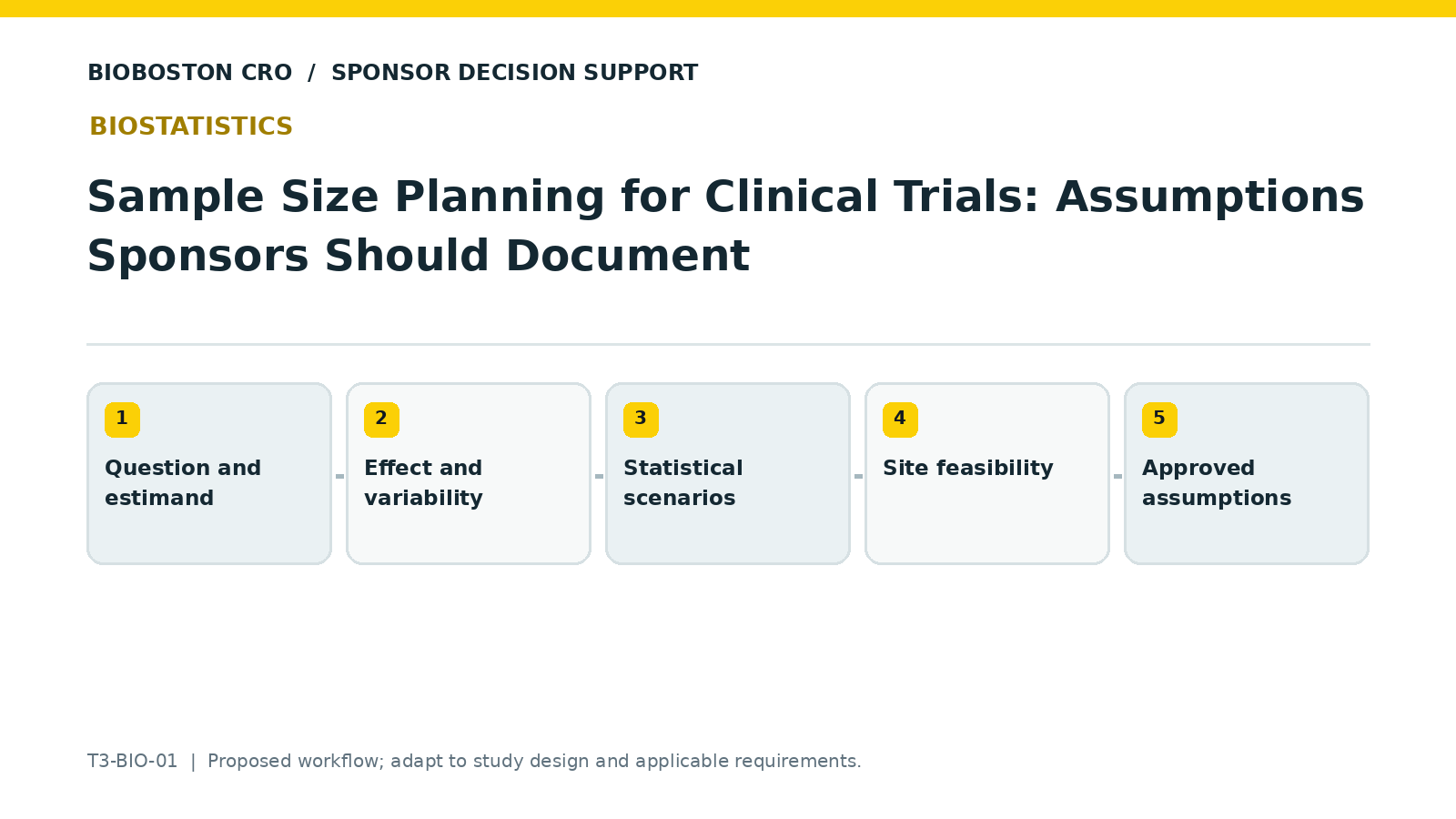
Clinical trial sample size planning should begin with a clearly defined treatment question, an endpoint and estimand, and assumptions the sponsor can defend. A power calculation is only the arithmetic at the end of that chain. If the assumed effect, variability, event rate, analysis population or dropout estimate is weak, a technically correct calculation can still produce a poor development decision.
This framework helps sponsor clinical-development, medical, statistics and operations leads distinguish evidence-backed design assumptions from placeholders. It is particularly useful before protocol freeze, vendor bid comparisons, first patient planning and internal funding decisions. The deliverable is a controlled assumptions register with owners, uncertainty ranges and explicit re-estimation triggers.
What the sponsor needs to decide
For each key assumption, separate the central estimate from a plausible adverse scenario. Have the statistician own the calculation, the clinical team own clinical relevance, and Clinical Operations own feasibility. Do not use a favorable effect assumption merely to make the trial fit the budget.
Sample Size Planning for Clinical Trials: evidence and decision matrix
| Review point | Evidence to collect | Sponsor decision or acceptance criterion |
|---|---|---|
| Treatment question and estimand | Population, treatment contrast, endpoint, intercurrent-event handling and summary measure | Confirm the intended treatment effect before choosing a statistical formula. |
| Clinically meaningful effect | Medical rationale, prior-study results and competitive/standard-of-care context | Record both the minimum useful difference and the design effect; distinguish the two. |
| Variability or event rate | Published estimates, pilot data, historical controls with comparability caveats | Use an evidence range, not one unqualified number from a dissimilar population. |
| Type I error, power and design | Multiplicity plan, endpoint hierarchy, group allocation and analysis model | Ask statistics to document choices and operating characteristics. |
| Dropout and missing data | Screen-fail, discontinuation, missed-visit, non-evaluable and survival follow-up assumptions | Do not treat all attrition as a single uniform inflation factor. |
| Accrual feasibility | Eligible population, participating sites, screening conversion and startup variability | Reconcile calculated N with site-month forecasts and supply constraints. |
| Sensitivity and re-estimation | Alternative effect/variance rates, interim information, adaptation boundaries | Prespecify what events trigger review and whether formal design changes are needed. |
How to apply this framework to a real sponsor decision
Define the question before the number
Write a one-sentence estimand and the clinical decision it supports. A study designed for exploratory signal detection is not automatically powered for confirmatory inference. Cross-functional agreement on the actual question prevents post hoc justification of sample size.
Build a transparent scenario grid
At minimum compare a planning case, a lower-effect or higher-variance case, and a slower-accrual case. Show how each changes enrollment, duration and the probability of answering the question. Keep numerical calculations owned and validated by a qualified statistician.
Separate recruitment losses from analysis losses
Screen failure changes the recruitment funnel. Withdrawal, missed endpoints and intercurrent events affect analysis differently depending on the estimand and missing-data strategy. Write a separate assumption for each rather than indiscriminately adding a fixed dropout percentage.
Link statistics to operations and finance
Translate randomized/treated/analysis sample requirements into patients screened, site activation schedules, investigational product quantities and data-readiness dates. Keep the scientific design primary; if infeasible, return to the decision-maker for an explicit tradeoff.
Lock an audit-ready decision record
Record assumption source, version, owner, confidence, calculation version, reviewer and date. Changes after protocol approval require impact assessment across statistics, protocol, contracts, enrollment and regulatory strategy.
Warning signs that need intervention
- Using effect sizes from uncontrolled populations as if they were directly transportable.
- Assuming every patient who discontinues treatment is missing the endpoint.
- Treating statistical power as a guarantee of a clinically persuasive outcome.
- Inflating the denominator without checking the treatment question, estimand or missing-data approach.
- Approving enrollment cost while the site-month forecast assumes a different randomized sample.
First-week sponsor action plan
- Clinical and Statistics sign a one-page design assumptions register.
- Run at least one downside scenario that would change a sponsor decision.
- Reconcile sample size, recruitment funnel, site-month forecast and budget.
- Define who may authorize changes and which artifacts need revision.
To connect this decision framework to actual study responsibilities, see BioBoston CRO Biostatistics Services support. The service team can help structure sponsor oversight and the evidence needed to make a documented decision; site-facing or other specialized execution may be coordinated with qualified partners where appropriate.
Frequently asked sponsor questions
Is there a universal 80% power requirement?
No. Power and type I error are design decisions that depend on trial purpose, context and applicable expectations. The statistician should justify chosen operating characteristics.
Can we take one trial’s variance into another?
Only after checking measurement, population, visit timing and treatment context. Record comparability limitations and sensitivity scenarios.
Should dropout always inflate sample size?
Not mechanically. The handling of intercurrent events, missing data and the estimand determines how loss of information is evaluated.
Technical and regulatory context
The framework reflects relevant FDA/ICH principles, including ICH E8(R1), ICH E9, ICH E9(R1). Guidance documents contain nonbinding recommendations and should not be described as universal legal requirements. Applicable binding obligations and study-specific authority expectations should be assessed separately; retain current source/version records in the internal quality file.
Next step for the sponsor
If your team is resolving the decisions above, explore BioBoston CRO Biostatistics Services services for a scoped assessment, responsibility map or expert-supported working plan. Keep the decision record and supporting evidence even if you ultimately use another delivery model.