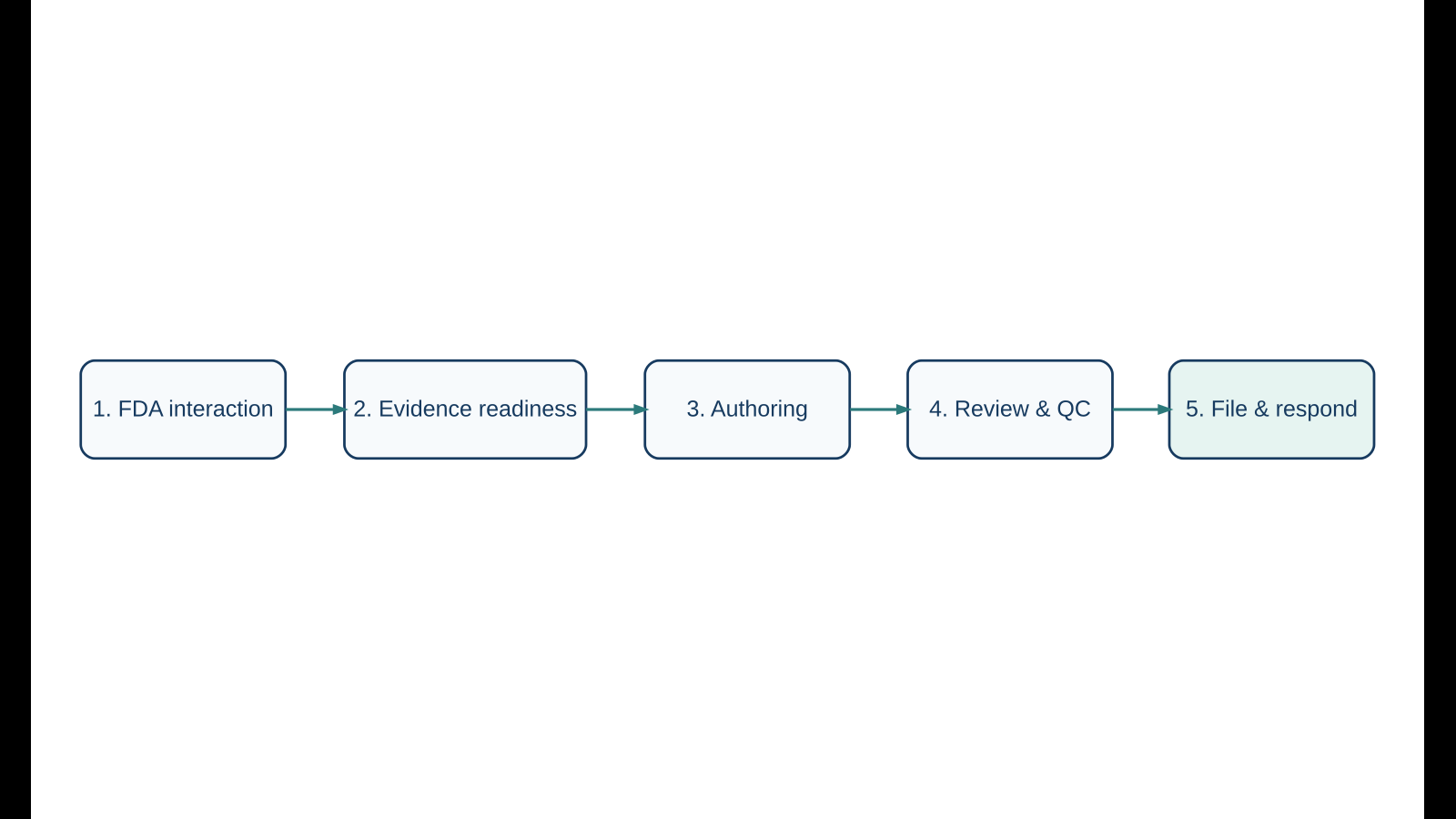
ind submission timeline planning should help the sponsor make a controlled decision, not merely create another document. A practical pre-IND-to-IND timeline for sponsors. It distinguishes FDA timing from sponsor planning assumptions and shows which decisions should be locked before authoring accelerates.
Quick answer: what is the critical path?
For many early programs, the critical path runs through pre-IND question quality, completion of IND-enabling evidence, CMC and nonclinical source readiness, protocol/IB decisions, integrated authoring, cross-functional review, publishing validation, and filing. The exact duration is program-specific.
For sponsors that need hands-on support applying this framework, BioBoston CRO Submission Planning can support the underlying regulatory and cross-functional work.
Sponsor planning timeline — example, not an FDA requirement
| Planning window | Sponsor focus |
|---|---|
| T-20 to T-16 weeks | Confirm filing objective, FDA interaction strategy, open evidence gaps, and content owners |
| T-16 to T-12 | Resolve high-impact CMC/nonclinical/clinical decisions; start source register and document shells |
| T-12 to T-8 | Draft core documents as source evidence stabilizes; track meeting feedback and commitments |
| T-8 to T-4 | Integrated review, gap closure, targeted re-analysis, document QC |
| T-4 to T-1 | Approval, publishing preparation, technical validation, final forms and metadata |
| T0 | Transmit IND and confirm receipt |
| After receipt | Own FDA questions; monitor the statutory 30-day period and any clinical-hold communication |
1. Put FDA interaction timing on a separate lane
Pre-IND meetings for PDUFA products are Type B meetings under FDA’s current formal-meetings framework. Use the current August 2026 guidance and division-specific instructions when planning the request, meeting package, and meeting date; do not rely on an old internal calendar copied from a prior program.
2. Freeze decisions before prose
- Starting dose and exposure rationale.
- First-in-human or early clinical study design.
- Key CMC controls and phase-appropriate specifications.
- Nonclinical package and unresolved findings.
- Safety monitoring and stopping rules.
- Outstanding FDA questions that could change the filing content.
3. Track the true critical path
The longest document is not always the critical path. A short unresolved CMC issue, final toxicology report, bioanalytical validation, or protocol dose rule can block multiple sections. Use dependencies, not page count, to forecast the filing date.
4. Protect the publishing window
- Set a substantive-content freeze before final publishing.
- Separate editorial corrections from scientific changes.
- Define how late source changes reopen affected sections.
- Validate files and submission structure before transmission day.
5. Recovery triggers
- A pivotal source report slips beyond the date assumed in the content plan.
- FDA feedback changes the study design or evidence expectation.
- Late analysis changes affect multiple documents.
- Publishing receives unstable files.
- The team has no owner for anticipated FDA questions after filing.
Need help building the critical path?
BioBoston CRO Submission Planning can help map milestones, dependencies, content readiness, and filing controls from pre-IND through IND submission.