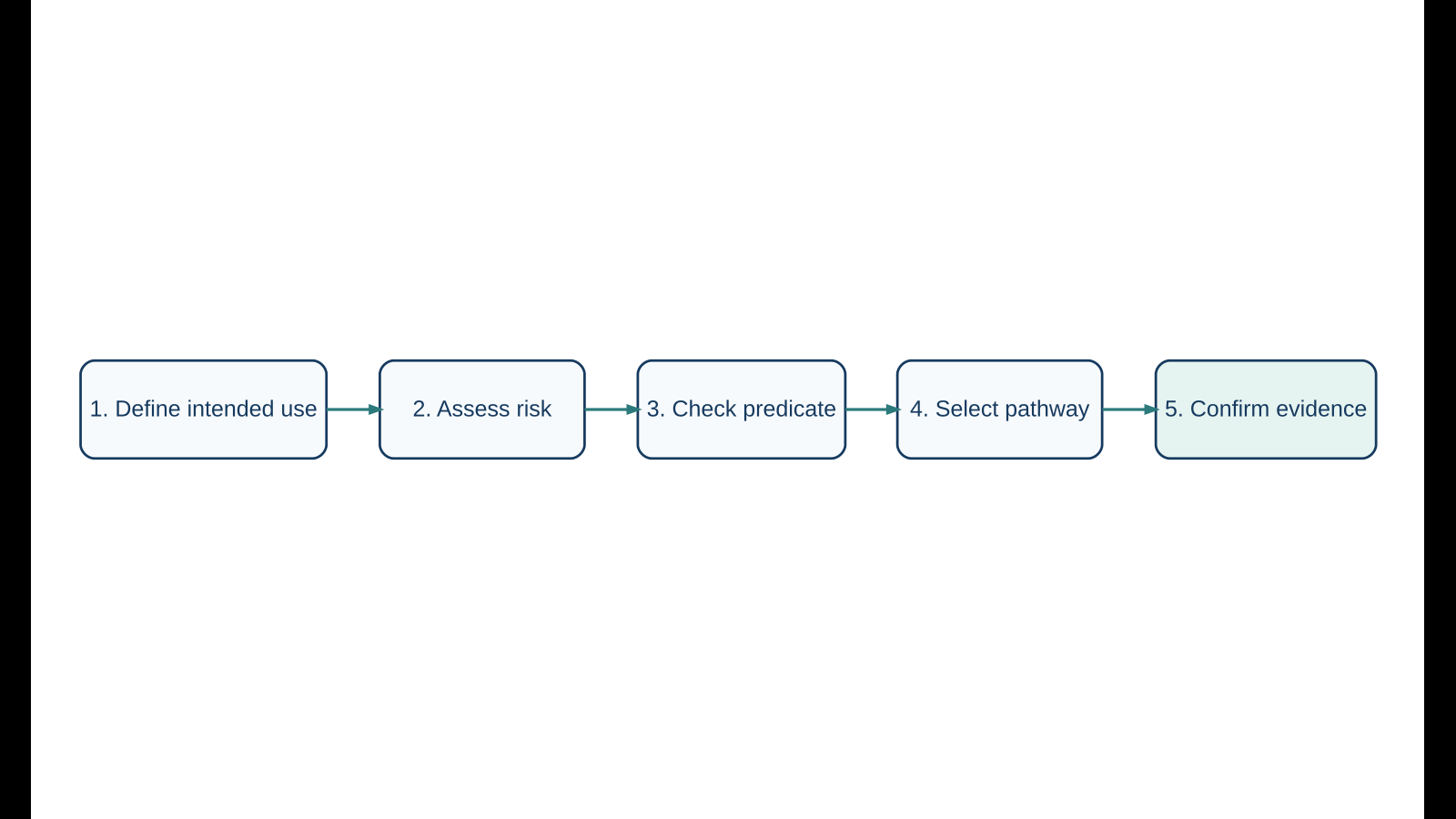
A 510(k) vs De Novo vs PMA comparison begins with intended use, device risk, classification, and appropriate predicate availability. Use the decision matrix to identify which regulatory assumptions need evidence or FDA feedback before selecting a route.
Quick answer: when does each pathway fit?
| Pathway | Core fit | Primary FDA question |
|---|---|---|
| 510(k) | A legally marketed predicate supports substantial equivalence | Is the new device substantially equivalent to the predicate? |
| De Novo | Novel low-to-moderate-risk device without an appropriate predicate | Can general and special controls provide reasonable assurance of safety and effectiveness? |
| PMA | Class III / high-risk device subject to PMA | Does valid scientific evidence provide reasonable assurance of safety and effectiveness? |
1. Define intended use before searching for a pathway
Write the intended use, indications, users, patient population, clinical setting, output, and consequence of error. Device names and technology labels are poor pathway anchors if the actual clinical use is unclear.
For sponsors that need hands-on support applying this framework, BioBoston CRO Regulatory Pathway can support the underlying regulatory and cross-functional work.
2. Search for an appropriate predicate — not merely a similar product
- Same or sufficiently aligned intended use.
- Technological characteristics that support substantial equivalence or can be addressed with performance evidence.
- No difference that raises an unresolved different question of safety or effectiveness.
- Legally marketed status and relevant product code/classification.
3. Use risk and controls to test De Novo fit
When no suitable predicate exists, ask whether the device can be classified into Class I or II because general controls alone, or general plus special controls, can provide reasonable assurance of safety and effectiveness. Novelty alone does not make a device De Novo-appropriate.
4. Recognize PMA-level evidence early
For Class III devices subject to PMA, the evidence program must independently support safety and effectiveness. Clinical, manufacturing, software, design, and labeling requirements should be integrated into the pathway plan early because late pathway changes are expensive.
5. Use Q-Submission feedback strategically
- Predicate and substantial-equivalence strategy.
- Proposed De Novo classification and special controls.
- Clinical or performance-study design.
- Software, cybersecurity, usability, or novel-technology testing as applicable.
- PMA evidence and pivotal-study questions.
Pathway decision tree
- Is the device subject to PMA / Class III? If yes, plan PMA unless another classification route applies.
- If not, is there an appropriate legally marketed predicate supporting substantial equivalence? If yes, assess 510(k).
- If no predicate exists, can risks be controlled as Class I or II? If yes, assess De Novo.
- If uncertainty remains, frame the decision and evidence questions for FDA feedback before committing to the program.
Need help choosing the route?
BioBoston CRO Regulatory Pathway support can help assess classification, predicate strategy, evidence gaps, and FDA interaction options.