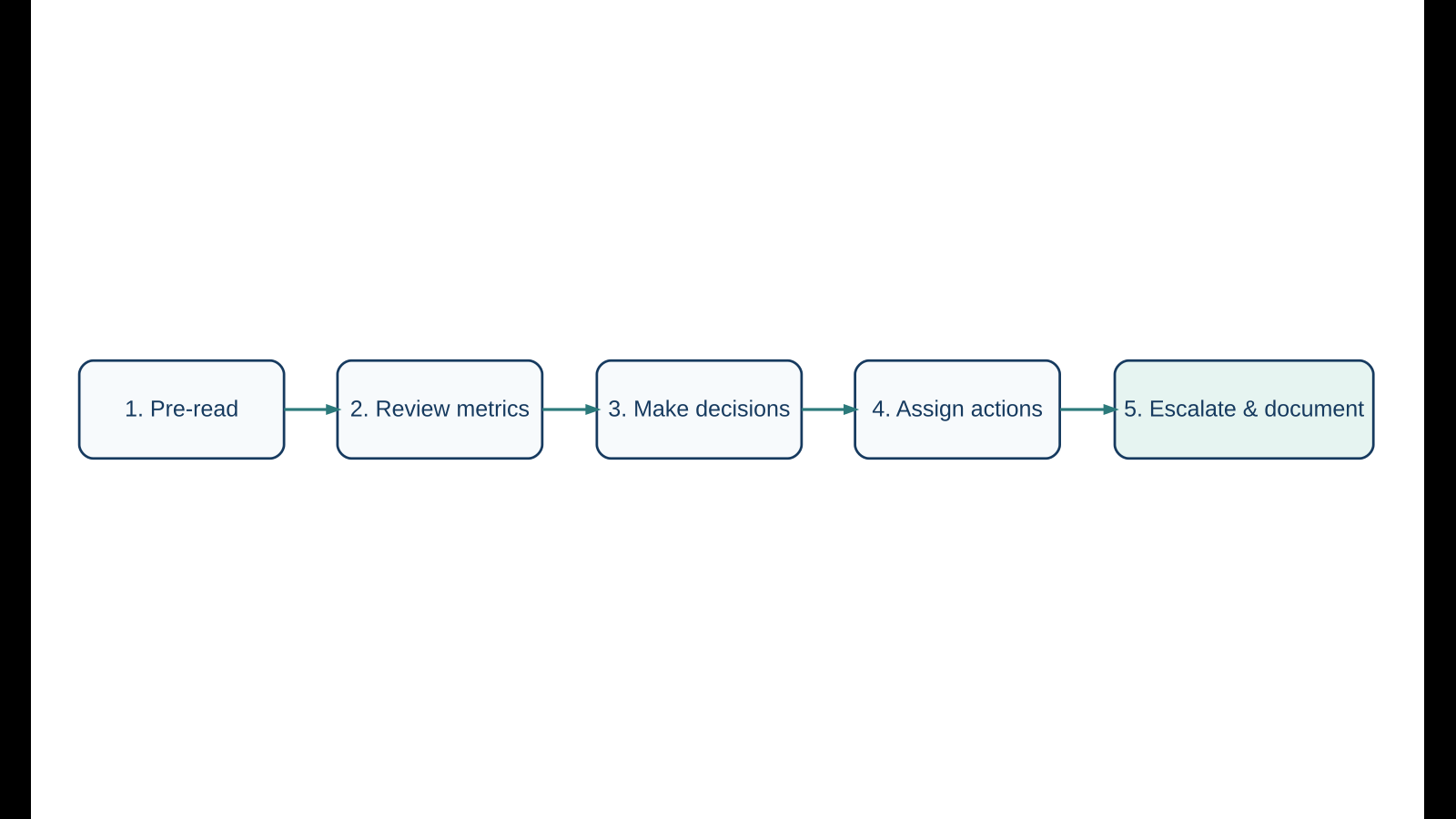
Sponsor-CRO governance meetings should leave a reliable trail of decisions, owners, due dates, and escalations. This framework provides a focused agenda, pre-read structure, action log, and criteria for moving unresolved issues to senior governance.
Practical principle: Sponsor CRO governance should produce decisions and evidence of control, not recurring status narration. The meeting design should make critical risks visible, assign actions, escalate unresolved issues, and preserve the sponsor’s decision rights.
Quick answer: what belongs in the meeting framework?
- Standard pre-read with critical KPIs/KRIs.
- Decision log and prior-action review.
- Quality, safety, data, site, timeline, and vendor risk review.
- Change requests and dependency decisions.
- Escalations requiring sponsor authority.
- Named owners, due dates, and disposition.
1. Use a fixed agenda with variable depth
| Agenda block | Purpose |
|---|---|
| Prior decisions/actions | Confirm closure and effectiveness |
| Critical metrics | Review thresholds and trends |
| Quality / safety issues | Assess participant/data risk and CAPA |
| Timeline / operational risks | Review critical-path changes |
| Changes / decisions | Approve, reject, defer, or escalate |
| Subcontractor/vendor topics | Maintain visibility into delegated chain |
| Next-period risks | Identify emerging issues before threshold breach |
2. Send a decision-focused pre-read
- One-page executive summary.
- Metric dashboard with threshold status.
- Top open issues and overdue actions.
- Decisions requested from sponsor.
- Changes to critical path, scope, or risk profile.
3. Maintain separate logs for decisions and actions
| Record | What to capture |
|---|---|
| Decision log | Decision, date, rationale, approver, affected documents/processes |
| Action log | Action, owner, due date, status, escalation date |
| Issue log | Problem, severity, impact, root-cause status, mitigation/CAPA |
| Change log | Scope/process/vendor change and sponsor approval status |
4. Define escalation levels
| Level | Example | Governance response |
|---|---|---|
| 1 — Routine | Local issue within threshold | Manage in functional team |
| 2 — Material | Trend or milestone risk | Governance review and recovery action |
| 3 — Critical | Participant safety, data integrity, major compliance or critical-path threat | Immediate sponsor executive/quality escalation |
5. Keep meetings proportional
Stable workstreams should not consume the same governance time as new, high-risk, or deteriorating activities. Use the pre-read to identify which topics require discussion and which can remain exception-only.
For sponsors that need hands-on support applying this framework, BioBoston CRO Sponsor Oversight can support the underlying regulatory and cross-functional work.
6. Governance red flags
- Same issue appears in three meetings with no decision.
- Actions have owners but no due dates.
- Metrics are presented without thresholds.
- Sponsor decisions are not documented outside meeting notes.
- CRO raises scope or subcontractor changes after implementation.
- Executive escalation criteria are informal.
Governance effectiveness check
- Decisions are traceable.
- Actions close on time or escalate.
- Critical trends are reviewed before failure.
- Scope and vendor changes are controlled.
- Meeting evidence is retained.
- Sponsor authority is visible in the record.
BioBoston CRO Sponsor Oversight support can help establish or remediate governance, metrics, and escalation evidence.