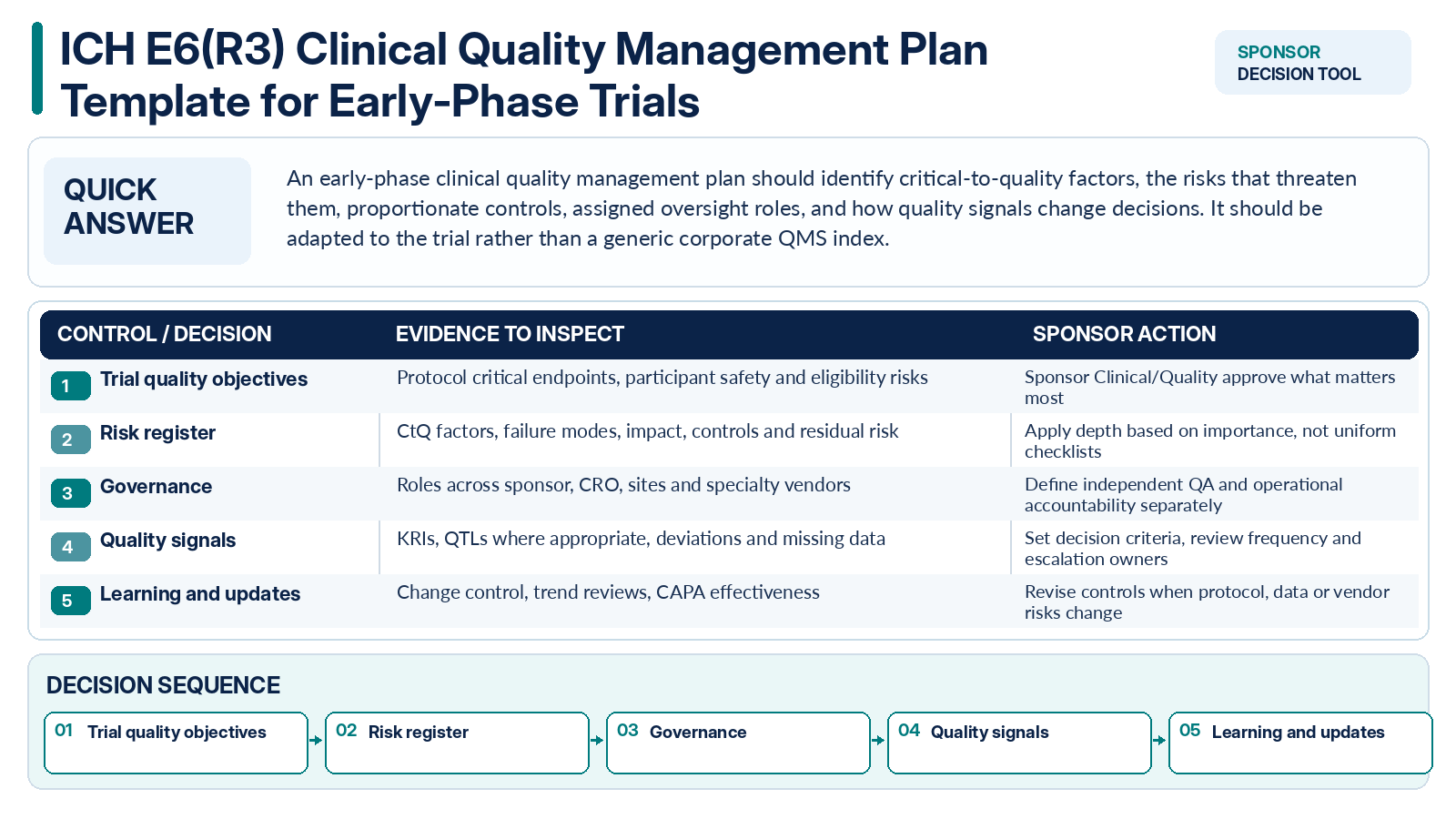
An early-phase clinical quality management plan should identify critical-to-quality factors, the risks that threaten them, proportionate controls, assigned oversight roles, and how quality signals change decisions. It should be adapted to the trial rather than a generic corporate QMS index.
Reusable decision and evidence template
Begin with the most consequential control and the evidence needed to resolve it. The following matrix connects each decision to records and an accountable action, rather than treating the list as a generic compliance checkbox.
| Control / question | Evidence to examine | Sponsor action |
|---|---|---|
| Trial quality objectives | Protocol critical endpoints, participant safety and eligibility risks | Sponsor Clinical/Quality approve what matters most |
| Risk register | CtQ factors, failure modes, impact, controls and residual risk | Apply depth based on importance, not uniform checklists |
| Governance | Roles across sponsor, CRO, sites and specialty vendors | Define independent QA and operational accountability separately |
| Quality signals | KRIs, QTLs where appropriate, deviations and missing data | Set decision criteria, review frequency and escalation owners |
| Learning and updates | Change control, trend reviews, CAPA effectiveness | Revise controls when protocol, data or vendor risks change |
For teams that need support implementing this across functions, BioBoston CRO Quality Management can help adapt the controls to the study, vendors, and decision calendar.
Working through the controls
1. Trial quality objectives
Evidence: Protocol critical endpoints, participant safety and eligibility risks. Decision: Sponsor Clinical/Quality approve what matters most. Record the responsible function and the approved source version, and keep any remaining exceptions visible to the sponsor before this item is closed.
2. Risk register
Evidence: CtQ factors, failure modes, impact, controls and residual risk. Decision: Apply depth based on importance, not uniform checklists. Record the responsible function and the approved source version, and keep any remaining exceptions visible to the sponsor before this item is closed.
3. Governance
Evidence: Roles across sponsor, CRO, sites and specialty vendors. Decision: Define independent QA and operational accountability separately. Record the responsible function and the approved source version, and keep any remaining exceptions visible to the sponsor before this item is closed.
4. Quality signals
Evidence: KRIs, QTLs where appropriate, deviations and missing data. Decision: Set decision criteria, review frequency and escalation owners. Record the responsible function and the approved source version, and keep any remaining exceptions visible to the sponsor before this item is closed.
5. Learning and updates
Evidence: Change control, trend reviews, CAPA effectiveness. Decision: Revise controls when protocol, data or vendor risks change. Record the responsible function and the approved source version, and keep any remaining exceptions visible to the sponsor before this item is closed.
Red flags that should change the plan
- Plan covers only audits instead of designing quality into the trial.
- Metrics without thresholds.
- Delegated duties with no sponsor review cadence.
Decision gate and governance
Approve the plan before first participant activity and revisit it after significant protocol, site or vendor changes. The control owner should record the decision, evidence version, date, residual uncertainty and next re-review trigger. Where delegated providers perform the work, the sponsor should retain the relevant oversight and acceptance evidence.
Regulatory note: Applicable regulations, trial commitments and agreements must be distinguished from nonbinding FDA and ICH guidance. Apply this framework to the actual product, jurisdiction and study.
Need practical support?
Use BioBoston CRO Quality Management to review the evidence, define decision rights, and build a study-specific action plan for the next milestone.