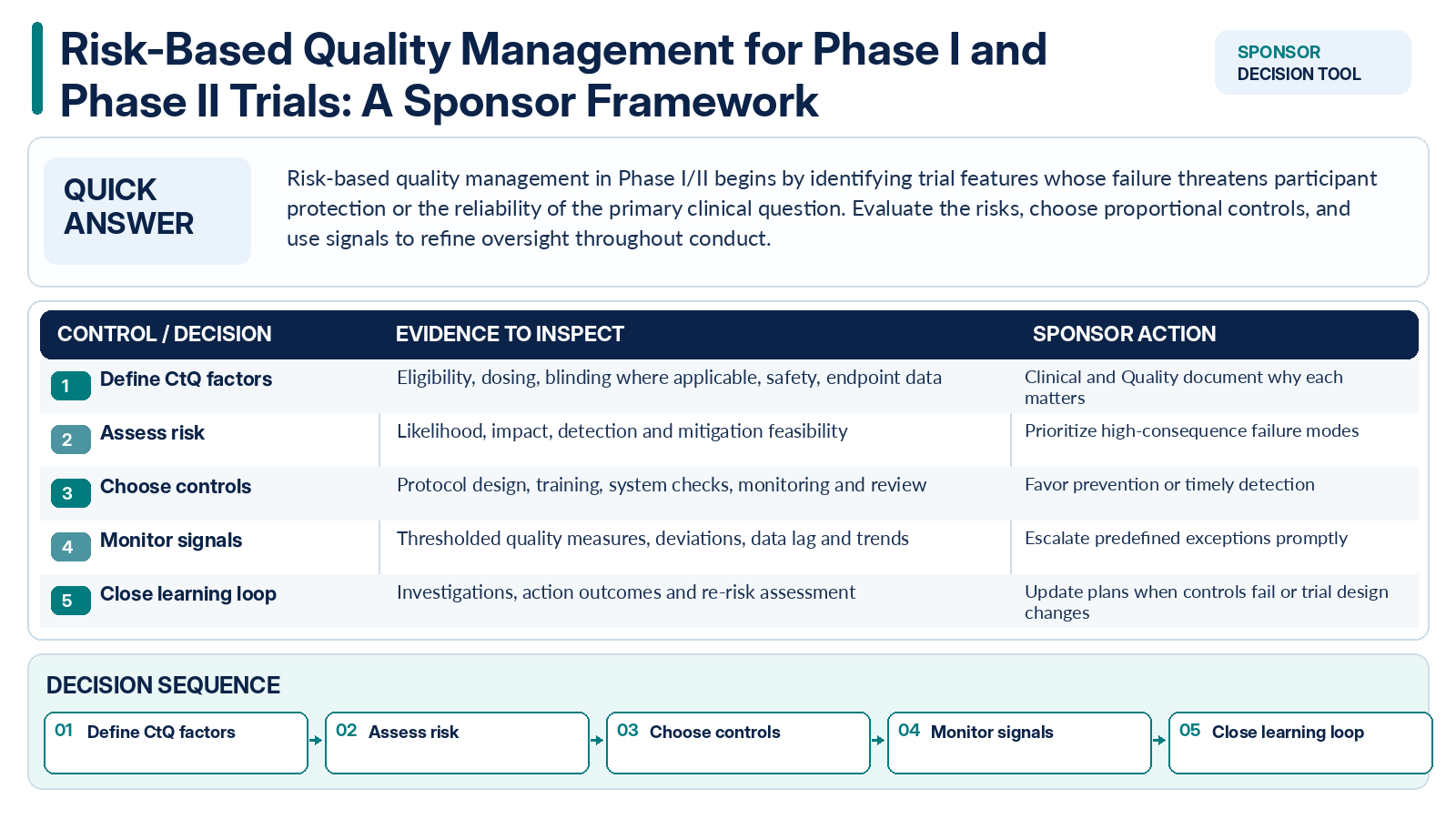
Risk-based quality management in Phase I/II begins by identifying trial features whose failure threatens participant protection or the reliability of the primary clinical question. Evaluate the risks, choose proportional controls, and use signals to refine oversight throughout conduct.
How to apply this workflow in practice
Begin with the most consequential control and the evidence needed to resolve it. The following matrix connects each decision to records and an accountable action, rather than treating the list as a generic compliance checkbox.
| Control / question | Evidence to examine | Sponsor action |
|---|---|---|
| Define CtQ factors | Eligibility, dosing, blinding where applicable, safety, endpoint data | Clinical and Quality document why each matters |
| Assess risk | Likelihood, impact, detection and mitigation feasibility | Prioritize high-consequence failure modes |
| Choose controls | Protocol design, training, system checks, monitoring and review | Favor prevention or timely detection |
| Monitor signals | Thresholded quality measures, deviations, data lag and trends | Escalate predefined exceptions promptly |
| Close learning loop | Investigations, action outcomes and re-risk assessment | Update plans when controls fail or trial design changes |
For teams that need support implementing this across functions, BioBoston CRO Quality Management can help adapt the controls to the study, vendors, and decision calendar.
Working through the controls
1. Define CtQ factors
Evidence: Eligibility, dosing, blinding where applicable, safety, endpoint data. Decision: Clinical and Quality document why each matters. Record the responsible function and the approved source version, and keep any remaining exceptions visible to the sponsor before this item is closed.
2. Assess risk
Evidence: Likelihood, impact, detection and mitigation feasibility. Decision: Prioritize high-consequence failure modes. Record the responsible function and the approved source version, and keep any remaining exceptions visible to the sponsor before this item is closed.
3. Choose controls
Evidence: Protocol design, training, system checks, monitoring and review. Decision: Favor prevention or timely detection. Record the responsible function and the approved source version, and keep any remaining exceptions visible to the sponsor before this item is closed.
4. Monitor signals
Evidence: Thresholded quality measures, deviations, data lag and trends. Decision: Escalate predefined exceptions promptly. Record the responsible function and the approved source version, and keep any remaining exceptions visible to the sponsor before this item is closed.
5. Close learning loop
Evidence: Investigations, action outcomes and re-risk assessment. Decision: Update plans when controls fail or trial design changes. Record the responsible function and the approved source version, and keep any remaining exceptions visible to the sponsor before this item is closed.
Red flags that should change the plan
- Copying a late-phase risk register into a small study.
- Replacing judgment with arbitrary scoring.
- Allowing issues to remain green on a dashboard after risk materializes.
Decision gate and governance
Hold a cross-functional risk review before activation and after each material change; document decisions that altered controls. The control owner should record the decision, evidence version, date, residual uncertainty and next re-review trigger. Where delegated providers perform the work, the sponsor should retain the relevant oversight and acceptance evidence.
Regulatory note: Applicable regulations, trial commitments and agreements must be distinguished from nonbinding FDA and ICH guidance. Apply this framework to the actual product, jurisdiction and study.
Need practical support?
Use BioBoston CRO Quality Management to review the evidence, define decision rights, and build a study-specific action plan for the next milestone.