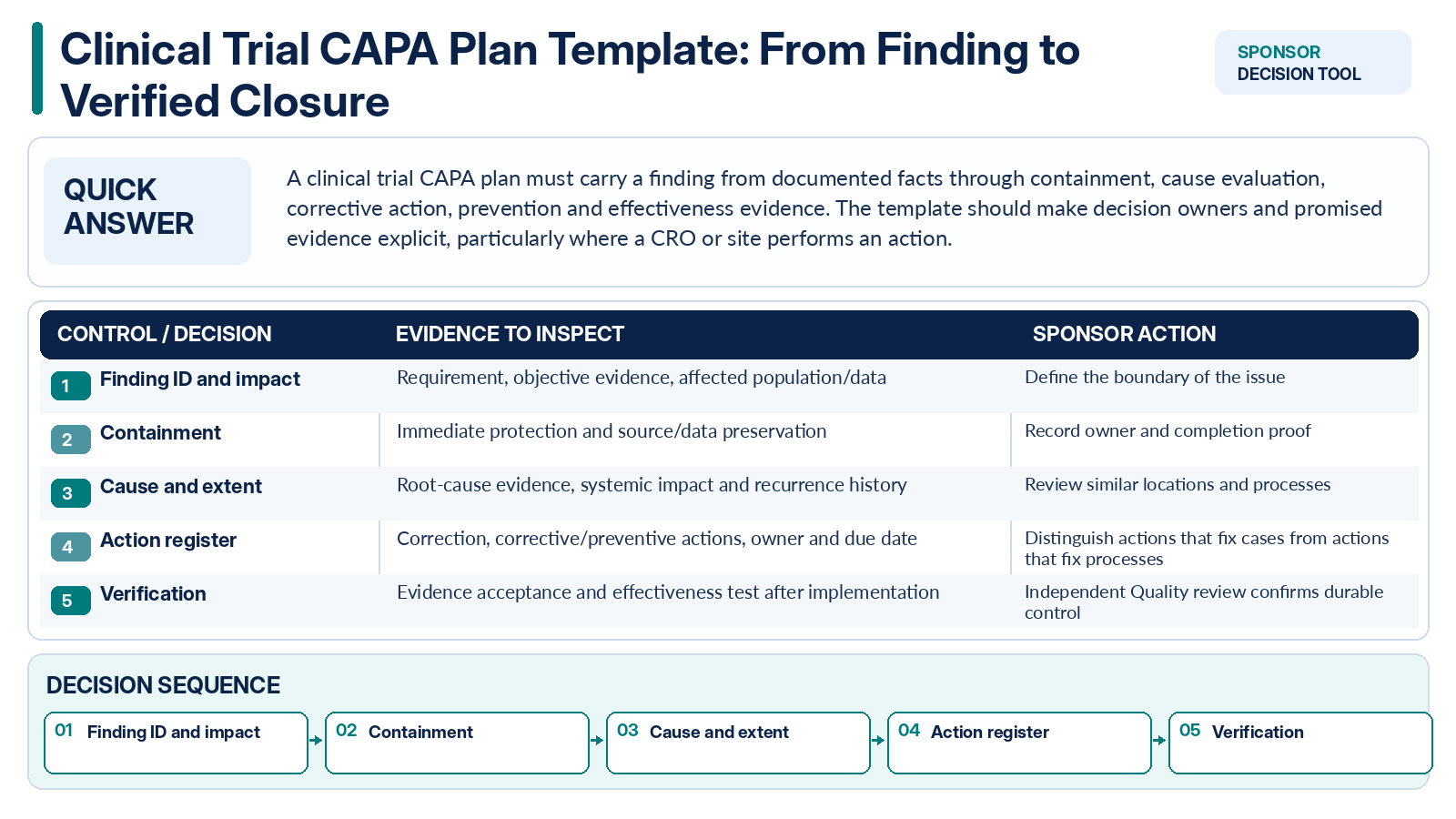
A clinical trial CAPA plan must carry a finding from documented facts through containment, cause evaluation, corrective action, prevention and effectiveness evidence. The template should make decision owners and promised evidence explicit, particularly where a CRO or site performs an action.
Reusable decision and evidence template
Begin with the most consequential control and the evidence needed to resolve it. The following matrix connects each decision to records and an accountable action, rather than treating the list as a generic compliance checkbox.
| Control / question | Evidence to examine | Sponsor action |
|---|---|---|
| Finding ID and impact | Requirement, objective evidence, affected population/data | Define the boundary of the issue |
| Containment | Immediate protection and source/data preservation | Record owner and completion proof |
| Cause and extent | Root-cause evidence, systemic impact and recurrence history | Review similar locations and processes |
| Action register | Correction, corrective/preventive actions, owner and due date | Distinguish actions that fix cases from actions that fix processes |
| Verification | Evidence acceptance and effectiveness test after implementation | Independent Quality review confirms durable control |
For teams that need support implementing this across functions, BioBoston CRO GCP CAPA Support can help adapt the controls to the study, vendors, and decision calendar.
Working through the controls
1. Finding ID and impact
Evidence: Requirement, objective evidence, affected population/data. Decision: Define the boundary of the issue. Record the responsible function and the approved source version, and keep any remaining exceptions visible to the sponsor before this item is closed.
2. Containment
Evidence: Immediate protection and source/data preservation. Decision: Record owner and completion proof. Record the responsible function and the approved source version, and keep any remaining exceptions visible to the sponsor before this item is closed.
3. Cause and extent
Evidence: Root-cause evidence, systemic impact and recurrence history. Decision: Review similar locations and processes. Record the responsible function and the approved source version, and keep any remaining exceptions visible to the sponsor before this item is closed.
4. Action register
Evidence: Correction, corrective/preventive actions, owner and due date. Decision: Distinguish actions that fix cases from actions that fix processes. Record the responsible function and the approved source version, and keep any remaining exceptions visible to the sponsor before this item is closed.
5. Verification
Evidence: Evidence acceptance and effectiveness test after implementation. Decision: Independent Quality review confirms durable control. Record the responsible function and the approved source version, and keep any remaining exceptions visible to the sponsor before this item is closed.
Red flags that should change the plan
- Vague actions such as improve communication.
- No target evidence for closure.
- Assigning the vendor sole approval of its own CAPA.
Decision gate and governance
Do not approve the plan until every action has a linked cause, accountable sponsor-side reviewer and a measurable effectiveness criterion. The control owner should record the decision, evidence version, date, residual uncertainty and next re-review trigger. Where delegated providers perform the work, the sponsor should retain the relevant oversight and acceptance evidence.
Regulatory note: Applicable regulations, trial commitments and agreements must be distinguished from nonbinding FDA and ICH guidance. Apply this framework to the actual product, jurisdiction and study.
Need practical support?
Use BioBoston CRO GCP CAPA Support to review the evidence, define decision rights, and build a study-specific action plan for the next milestone.