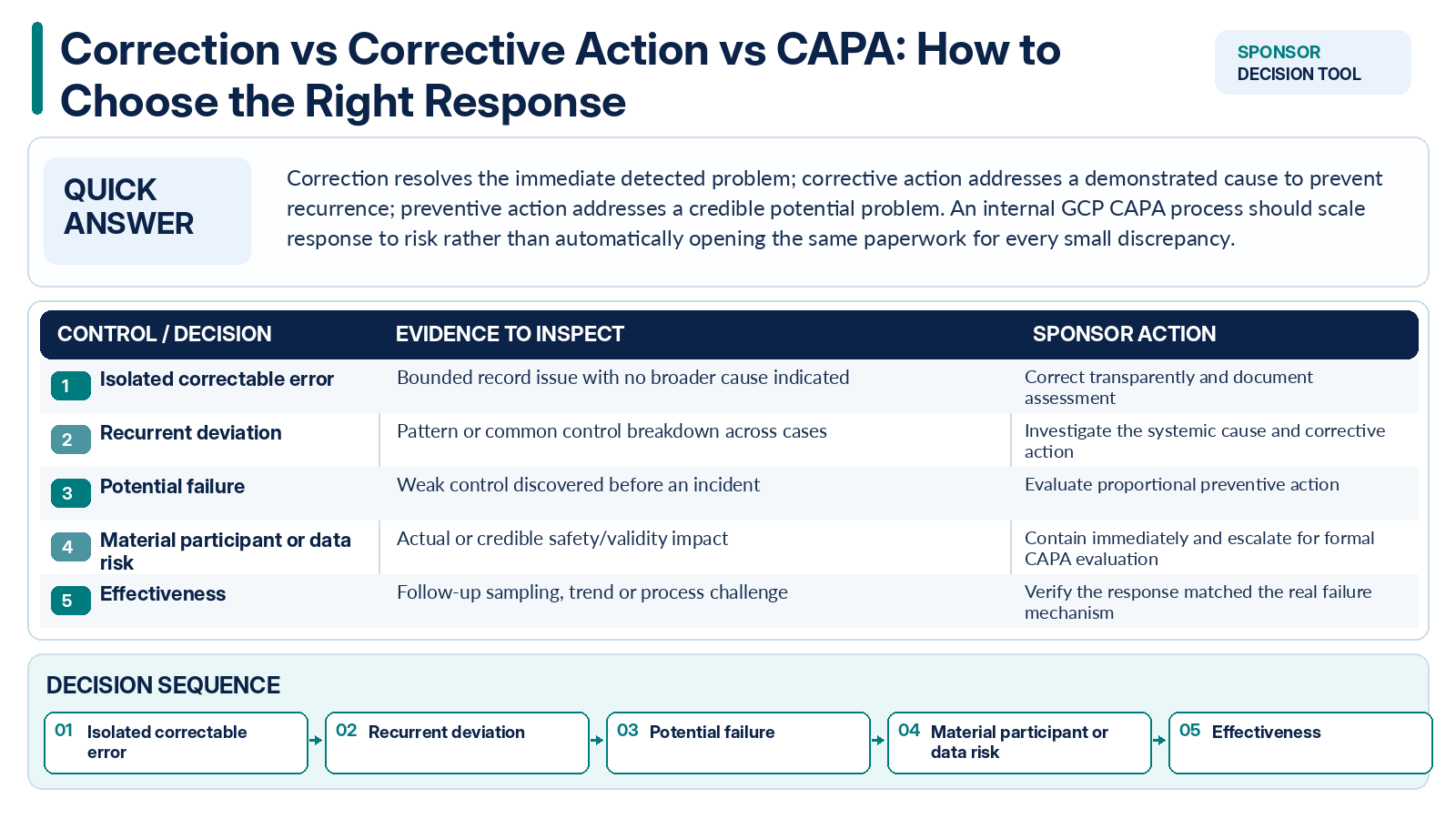
Correction resolves the immediate detected problem; corrective action addresses a demonstrated cause to prevent recurrence; preventive action addresses a credible potential problem. An internal GCP CAPA process should scale response to risk rather than automatically opening the same paperwork for every small discrepancy.
Decision factors and what they mean
Begin with the most consequential control and the evidence needed to resolve it. The following matrix connects each decision to records and an accountable action, rather than treating the list as a generic compliance checkbox.
| Control / question | Evidence to examine | Sponsor action |
|---|---|---|
| Isolated correctable error | Bounded record issue with no broader cause indicated | Correct transparently and document assessment |
| Recurrent deviation | Pattern or common control breakdown across cases | Investigate the systemic cause and corrective action |
| Potential failure | Weak control discovered before an incident | Evaluate proportional preventive action |
| Material participant or data risk | Actual or credible safety/validity impact | Contain immediately and escalate for formal CAPA evaluation |
| Effectiveness | Follow-up sampling, trend or process challenge | Verify the response matched the real failure mechanism |
For teams that need support implementing this across functions, BioBoston CRO GCP CAPA Support can help adapt the controls to the study, vendors, and decision calendar.
Working through the controls
1. Isolated correctable error
Evidence: Bounded record issue with no broader cause indicated. Decision: Correct transparently and document assessment. Record the responsible function and the approved source version, and keep any remaining exceptions visible to the sponsor before this item is closed.
2. Recurrent deviation
Evidence: Pattern or common control breakdown across cases. Decision: Investigate the systemic cause and corrective action. Record the responsible function and the approved source version, and keep any remaining exceptions visible to the sponsor before this item is closed.
3. Potential failure
Evidence: Weak control discovered before an incident. Decision: Evaluate proportional preventive action. Record the responsible function and the approved source version, and keep any remaining exceptions visible to the sponsor before this item is closed.
4. Material participant or data risk
Evidence: Actual or credible safety/validity impact. Decision: Contain immediately and escalate for formal CAPA evaluation. Record the responsible function and the approved source version, and keep any remaining exceptions visible to the sponsor before this item is closed.
5. Effectiveness
Evidence: Follow-up sampling, trend or process challenge. Decision: Verify the response matched the real failure mechanism. Record the responsible function and the approved source version, and keep any remaining exceptions visible to the sponsor before this item is closed.
Red flags that should change the plan
- Changing a record without audit trail.
- Escalating harmless typos into heavy CAPA bureaucracy.
- Calling retraining a preventive action with no cause evidence.
Decision gate and governance
Choose the lightest response that adequately controls risk, but document the rationale whenever formal CAPA is not opened. The control owner should record the decision, evidence version, date, residual uncertainty and next re-review trigger. Where delegated providers perform the work, the sponsor should retain the relevant oversight and acceptance evidence.
Regulatory note: Applicable regulations, trial commitments and agreements must be distinguished from nonbinding FDA and ICH guidance. Apply this framework to the actual product, jurisdiction and study.
Need practical support?
Use BioBoston CRO GCP CAPA Support to review the evidence, define decision rights, and build a study-specific action plan for the next milestone.