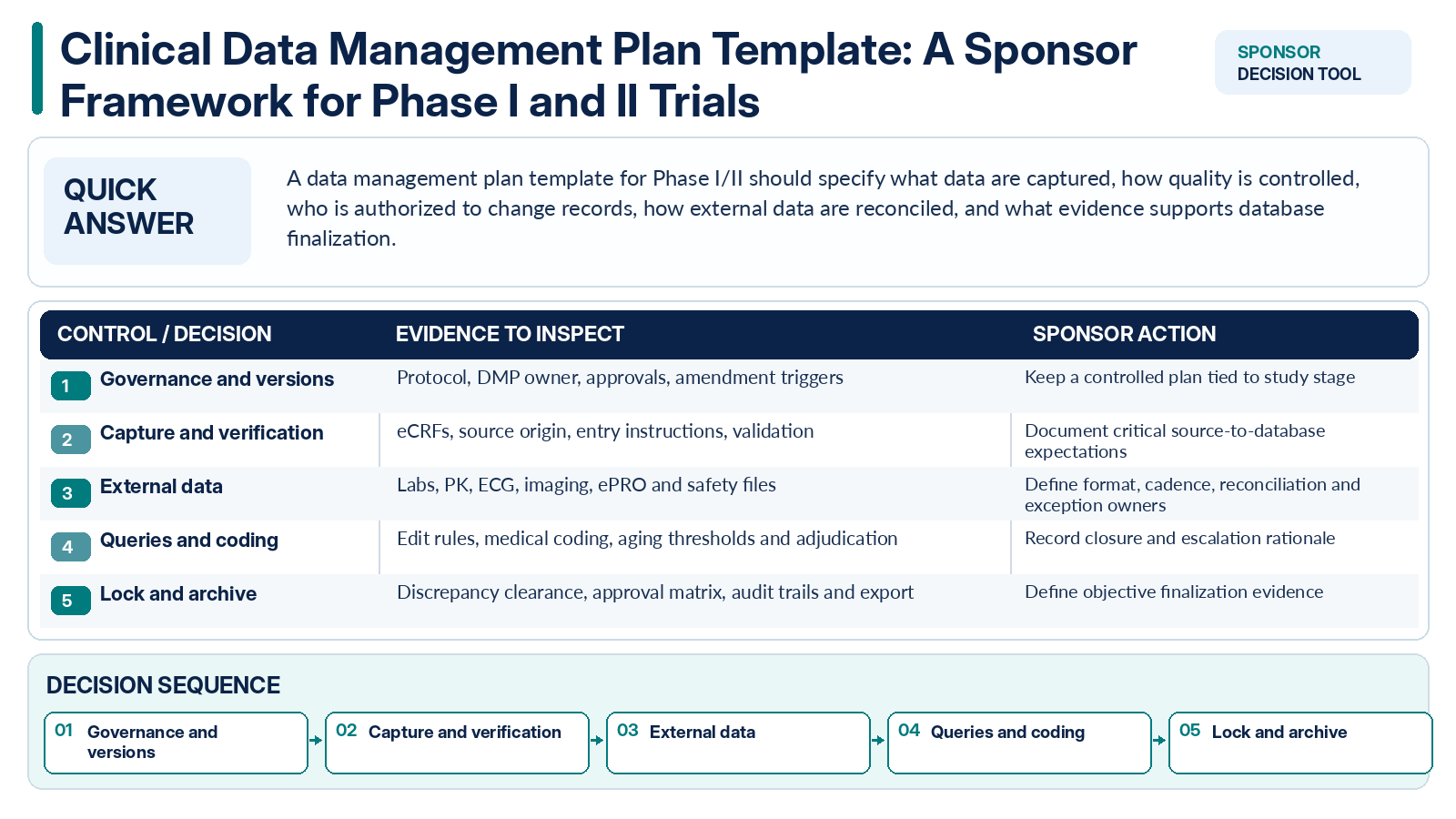
A data management plan template for Phase I/II should specify what data are captured, how quality is controlled, who is authorized to change records, how external data are reconciled, and what evidence supports database finalization.
Reusable decision and evidence template
Begin with the most consequential control and the evidence needed to resolve it. The following matrix connects each decision to records and an accountable action, rather than treating the list as a generic compliance checkbox.
| Control / question | Evidence to examine | Sponsor action |
|---|---|---|
| Governance and versions | Protocol, DMP owner, approvals, amendment triggers | Keep a controlled plan tied to study stage |
| Capture and verification | eCRFs, source origin, entry instructions, validation | Document critical source-to-database expectations |
| External data | Labs, PK, ECG, imaging, ePRO and safety files | Define format, cadence, reconciliation and exception owners |
| Queries and coding | Edit rules, medical coding, aging thresholds and adjudication | Record closure and escalation rationale |
| Lock and archive | Discrepancy clearance, approval matrix, audit trails and export | Define objective finalization evidence |
For teams that need support implementing this across functions, BioBoston CRO Data Management Plan Review can help adapt the controls to the study, vendors, and decision calendar.
Working through the controls
1. Governance and versions
Evidence: Protocol, DMP owner, approvals, amendment triggers. Decision: Keep a controlled plan tied to study stage. Record the responsible function and the approved source version, and keep any remaining exceptions visible to the sponsor before this item is closed.
2. Capture and verification
Evidence: eCRFs, source origin, entry instructions, validation. Decision: Document critical source-to-database expectations. Record the responsible function and the approved source version, and keep any remaining exceptions visible to the sponsor before this item is closed.
3. External data
Evidence: Labs, PK, ECG, imaging, ePRO and safety files. Decision: Define format, cadence, reconciliation and exception owners. Record the responsible function and the approved source version, and keep any remaining exceptions visible to the sponsor before this item is closed.
4. Queries and coding
Evidence: Edit rules, medical coding, aging thresholds and adjudication. Decision: Record closure and escalation rationale. Record the responsible function and the approved source version, and keep any remaining exceptions visible to the sponsor before this item is closed.
5. Lock and archive
Evidence: Discrepancy clearance, approval matrix, audit trails and export. Decision: Define objective finalization evidence. Record the responsible function and the approved source version, and keep any remaining exceptions visible to the sponsor before this item is closed.
Red flags that should change the plan
- Template lists processes but not acceptance criteria.
- No plan for system changes.
- Finalized database cannot be reconstructed.
Decision gate and governance
Customize every template field to the protocol; discard boilerplate controls that add no meaningful assurance. The control owner should record the decision, evidence version, date, residual uncertainty and next re-review trigger. Where delegated providers perform the work, the sponsor should retain the relevant oversight and acceptance evidence.
Regulatory note: Determine which electronic records and signatures are regulated before applying 21 CFR Part 11 controls; FDA guidance supports risk- and intended-use-based implementation.
Need practical support?
Use BioBoston CRO Data Management Plan Review to review the evidence, define decision rights, and build a study-specific action plan for the next milestone.